Starting homeschooling in the first month comes down to four things, in order: find out what your state and district actually require, withdraw formally and request records if your child is already enrolled somewhere, file anything due, and start a plain record on day one. Curriculum and a full schedule can wait.
This is for a family in the United States starting from scratch, whether your child is coming out of public or private school or has never been enrolled anywhere. It can't tell you your own state's rules or write your paperwork for you, only the order to do the parts in.
Example: two weeks for one family
Say you decide on a Tuesday that your nine-year-old will finish out the week at school and start homeschooling the following Monday. That Tuesday, you find your state's page and write down what it actually asks for. Wednesday, you write and hand-deliver a withdrawal letter to the school office, and ask the secretary to sign and date your copy. Thursday, you send a separate letter asking for your child's records, since a withdrawal letter and a records request are not the same document. By Friday, you know whether your state also wants a notice of intent, and if it does, you file it before the weekend.
The following Monday, you start. The first entry in your new record says nothing more than the date, the subject, and how it went. By the second Friday, you've filed what was due, requested the records, and have ten days of a real record started, which is further ahead than most families are after two weeks.
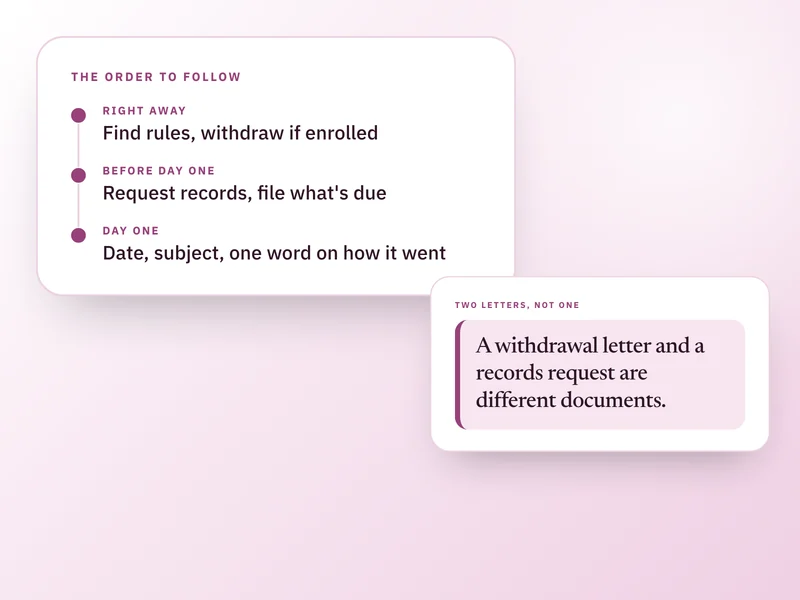
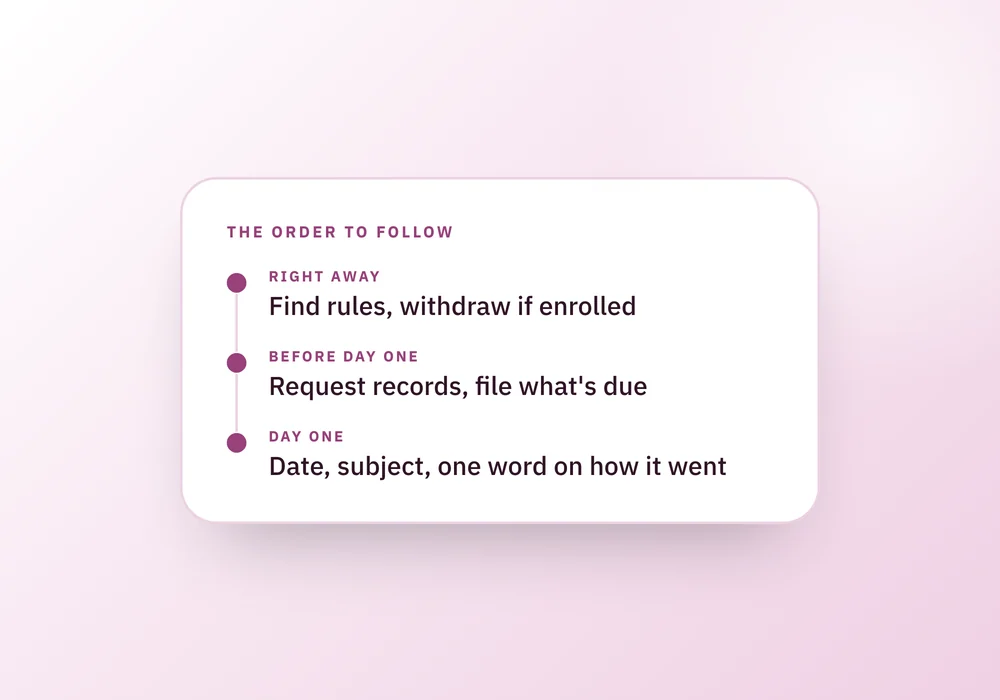
The order to follow
Find your state's rules
Once, from the official source. Your state department of education is the place to start.
Withdraw, if enrolled
A short letter to your child's current school, hand-delivered, with a signed and dated copy kept for you.
Request the records
A separate letter asking for the cumulative file: transcripts, test results, and any records you'll want later.
File what's due
Where a notice of intent is required, file it early and keep a copy of what you sent.
Start a record
The date, the subject and roughly what part, and one word about how it went, from day one.
Two letters, not one
A withdrawal letter and a records request do different jobs. Most families withdrawing from a school need to send both.
Withdrawal letter
- Says what
- Your child is leaving, as of a date you set
- Goes to
- The school office, hand-delivered if you can
Records request
- Says what
- Send the cumulative file: transcripts, test results, health and any IEP records
- Goes to
- The same office, as a separate letter
| Letter | Says what | Goes to |
|---|---|---|
| Withdrawal letter | Your child is leaving, as of a date you set | The school office, hand-delivered if you can |
| Records request | Send the cumulative file: transcripts, test results, health and any IEP records | The same office, as a separate letter |
What can wait
Curriculum does not have to be settled in the first week, a schedule does not have to be perfect, and a portfolio builds through the year rather than on day one. Deciding between a five-day week and a four-day week can wait too, until you've seen how a normal week actually goes. Testing or an evaluation, where your state asks for one, usually falls partway through the year or at the end, not in week one, so check the timing on your state's page and move on.
If you are starting after your child has been in school, give yourselves a stretch of lighter days before diving into a full schedule. Some homeschooling writers call this deschooling, and the rule of thumb repeated across their sites, not a research finding, is about one month of adjustment for every year your child spent in a traditional classroom. Treat it as a rough guide, not a countdown.
A first week that does not need a plan
3 things to do
Ticks are for this visit only. Nothing here is saved anywhere.
What to buy, and what to leave for later
Buy less than feels necessary in the first month. A notebook or an app for records, and whatever your state's page says a notice needs, cover the paperwork side completely. A full curriculum is the one large purchase worth deferring: you can't yet know from a single week what your child needs more or less of, and most publishers sell individual subjects if you later decide you only need to replace one. If you are starting with more than one child at once, keep each child's record separate from day one rather than untangling one shared notebook later.
Questions people ask
Do I have to withdraw my child in writing before I start homeschooling?
If your child is currently enrolled in a public or private school, yes, in most cases. A short letter stating the withdrawal date, hand-delivered with a signed and dated copy kept for you, is the standard approach recommended by state homeschool associations. A separate letter requesting your child's records is a different document, sent alongside it.
How do I get my child's school records after withdrawing?
Send a written request for the cumulative file, transcripts, report cards, test results, and any IEP or health records, to the school's front office. If nothing arrives within about six weeks, send a follow-up request in writing and keep a copy of both letters.
How long should deschooling last?
There is no official answer. A rule of thumb repeated across homeschooling blogs, not a research finding, suggests roughly one month of lighter days for every year your child spent in a traditional classroom. Treat it as a starting guess, not a deadline, and adjust based on how your child is actually doing.
Do I need to choose a curriculum before I start homeschooling?
No. You can begin with a page, a subject, and a plan to add the rest as you go. Most curriculum decisions get better, not worse, once you've seen a week or two of what your child actually needs.
What paperwork is actually required in the first month?
It depends entirely on your state. Some want a notice of intent before you begin, some want nothing filed at all, and if your child was previously enrolled in school, a withdrawal letter is usually expected regardless. Your state department of education's own page is the only way to know which of these applies to you.
What Homeschooling Companion does with a new child
Adding a child in Homeschooling Companion starts with how they are schooled. Mark a child as attending public or private school and the curriculum questions never come up at all, since there is nothing to record there yet. Mark a child as homeschooled and it asks one question: are you already following a curriculum? Answer Yes, we have one, No, we are doing our own, or Not sure yet, and for Not sure yet, a suggested starting outline is offered by age, clearly labeled a starting point you can change, keep, or throw away. It does not choose or sell a curriculum. See Homeschooling Companion.
Sources and how we checked
- Homeschool Association of California: Withdrawing Your Child from School: Two separate letters (withdrawal and records request), what the cumulative file includes, and the roughly six-week follow-up guideline.Checked 26 September 2026.
- Homeschool Better Together: Deschooling and Your Homeschool: The 'one month per year in school' deschooling guideline, described there as a rule of thumb, not a research finding, as stated in the guide.Checked 26 September 2026.
Where to go next
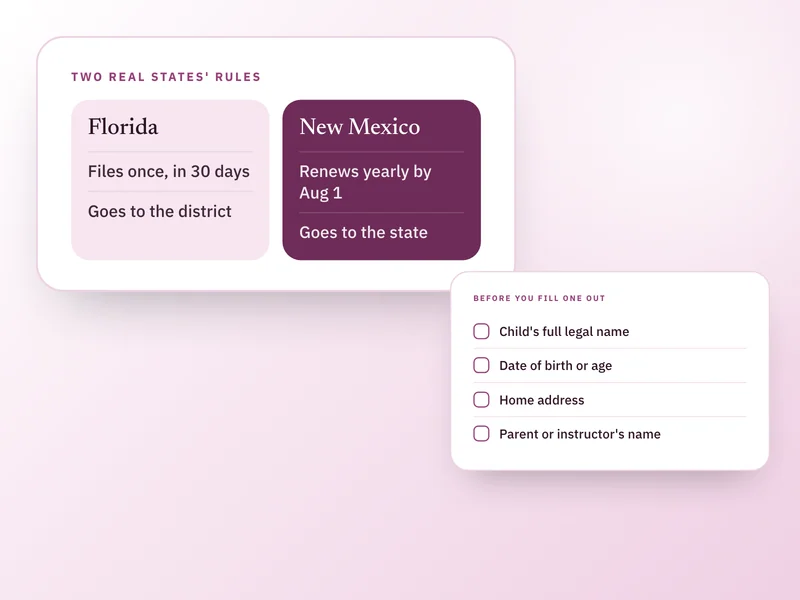 If this is where you areHomeschool notice of intent: what it is, how to find yoursThe first thing due in many states. This explains what a notice covers and five steps to find yours.
- Homeschool requirements by state: what records to keep
Find your state's level and the official source in this table before you file anything.
- A simple homeschool record keeping system you will keep
Start a record on day one with three things per entry, in a notebook or an app.
- Homeschool weekly schedule with a spare day built in
Ready to plan the week? This one leaves a spare day and a short-day list built in.