A four-day homeschool week means teaching on four fixed days and leaving the fifth open on purpose, then deciding how many of those four days each subject actually needs, because not every subject needs all four. Math might run all four days. Geography might run one. You decide the numbers once, and the plan follows them after that.
This is for a family in the United States moving from five teaching days to four, or starting out with four from day one. It won't tell you whether four days meets your state's required count of days or hours, since that's a separate question with a different answer in every state.
Three ways to lay out four days
Three real shapes this takes, as an example. None is the correct one. Pick whichever fits the day you actually have free.
Front-loaded
- Days taught
- Monday, Tuesday, Wednesday, Thursday
- What happens to the fifth day
- Friday is open for a co-op, a field trip, or errands
Split around a spare day
- Days taught
- Monday, Tuesday, Thursday, Friday
- What happens to the fifth day
- Wednesday is open, so a bad Monday still leaves three days
Back-loaded
- Days taught
- Tuesday, Wednesday, Thursday, Friday
- What happens to the fifth day
- Monday is open, useful when an outside class runs that morning
| Layout | Days taught | What happens to the fifth day |
|---|---|---|
| Front-loaded | Monday, Tuesday, Wednesday, Thursday | Friday is open for a co-op, a field trip, or errands |
| Split around a spare day | Monday, Tuesday, Thursday, Friday | Wednesday is open, so a bad Monday still leaves three days |
| Back-loaded | Tuesday, Wednesday, Thursday, Friday | Monday is open, useful when an outside class runs that morning |
How to decide the days per subject
Do this once, on paper, before the first Monday, not during it.
- List every subject you plan to teach, then write a number of days a week next to each one, from zero to four.
- Give the subjects that need steady practice, usually math and reading, the most days. A subject a child needs to keep touching to keep momentum belongs on most or all four.
- Give lighter subjects fewer days. History, geography and science often hold up fine on one or two.
- If a co-op, an outside class, or another family's schedule already fixes one day for you, build the other three around it instead of working against it.
- Write the numbers down somewhere you will actually look at again. A number decided once and then forgotten is worse than no number at all.
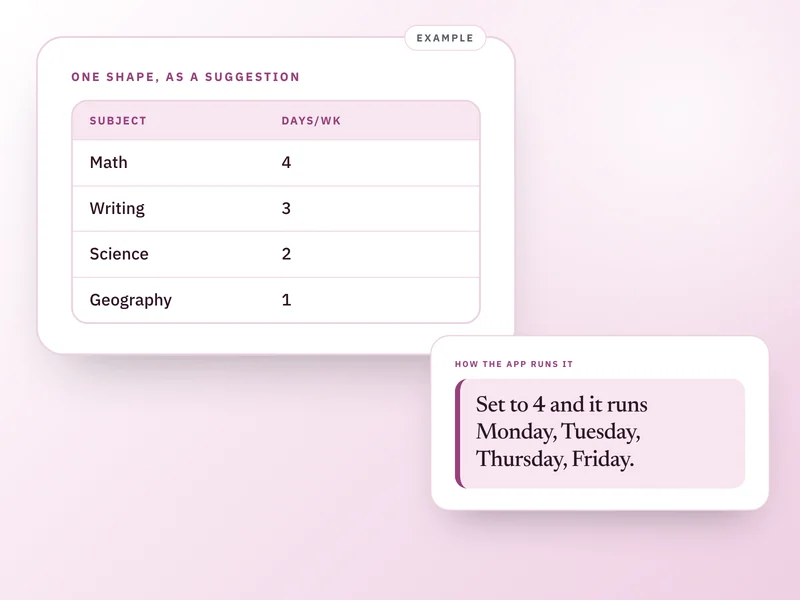
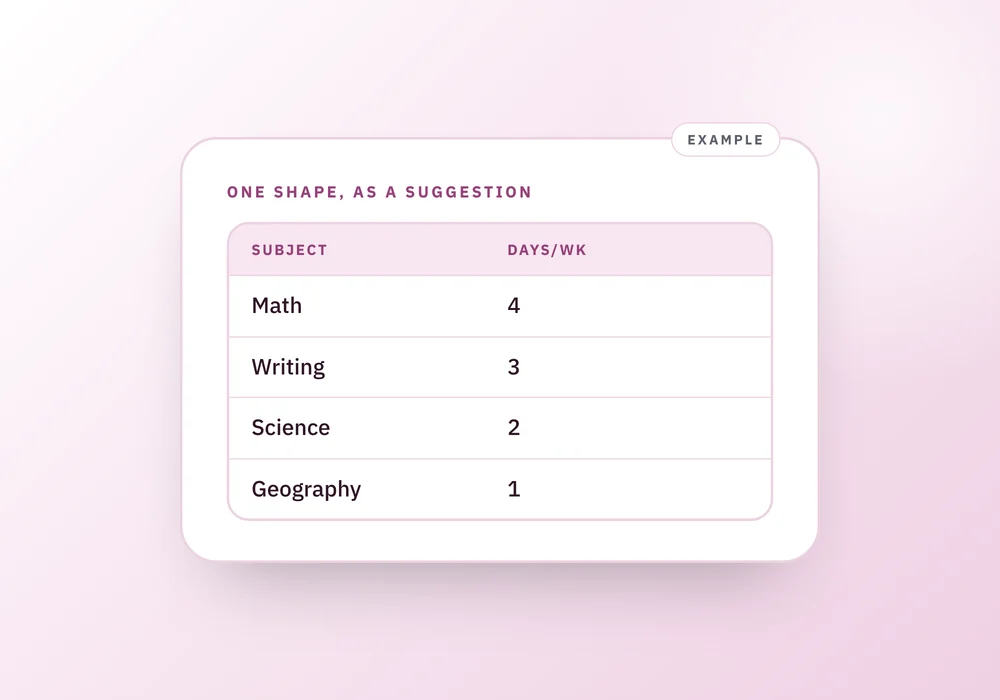
One shape, as a suggestion
One family's split, not a rule. Change every number to fit your child.
Math
- Days a week
- 4
- Why
- Needs steady practice to hold
Reading
- Days a week
- 4
- Why
- Same reason as math
Writing
- Days a week
- 3
- Why
- Holds up fine with a day off between sessions
Science
- Days a week
- 2
- Why
- A unit or an experiment doesn't need daily time
History
- Days a week
- 2
- Why
- Reads well in fewer, longer sessions
Geography
- Days a week
- 1
- Why
- A single focused session a week is often enough
| Subject | Days a week | Why |
|---|---|---|
| Math | 4 | Needs steady practice to hold |
| Reading | 4 | Same reason as math |
| Writing | 3 | Holds up fine with a day off between sessions |
| Science | 2 | A unit or an experiment doesn't need daily time |
| History | 2 | Reads well in fewer, longer sessions |
| Geography | 1 | A single focused session a week is often enough |
Does four days cover the same material?
The real worry under this question is not the schedule, it is whether four days adds up to enough over a year. There are two ways to handle it, and neither depends on stretching each day longer. Run four days across a standard school year, the same roughly 36 weeks most curricula are built for, and the fifth day simply is not taught. Some subjects lose a little ground that way, which is why lighter subjects work better with fewer days than heavy ones.
Some homeschooling families instead run four days year-round, taking shorter breaks spread across the calendar rather than one long summer, so the fifth day gets absorbed into a longer year instead of a shorter one. Neither approach is wrong. Pick whichever matches how your family actually uses the summer months.
Questions people ask
Does a four-day homeschool week cover the same material as five?
It can, if you spread the same total amount of work across the year rather than trying to fit five days of content into four. Run four days over a standard school year and the fifth day's material simply is not taught, which is fine for subjects that hold up on less time. Run four days year-round instead, with shorter breaks through the calendar, and nothing gets dropped at all.
Which day should be the one left free?
Whichever day a co-op, an outside class, or another family's schedule already fixes for you. Build the other three around that day instead of working against it. With nothing already fixed, a day in the middle of the week gives a bad Monday somewhere to recover, while a day at the end suits a family that wants a long weekend.
What if my child has a co-op or outside class on one of the four days?
Treat that day as already spoken for and plan the remaining three around it. A subject that meets at the co-op does not need a second session at home the same week, so it can often drop to zero or one day on your own schedule.
Does four days meet my state's required count?
That is a separate question from how you lay out the week. Some US states set a number of days or hours you have to clear regardless of how they are arranged, and many set no number at all. Check your own state's rule before assuming four days is or is not enough.
Do all subjects need the same number of days?
No. Subjects that need steady practice to hold, commonly math and reading, tend to do best with three or four days a week. Subjects read or covered in longer sessions, like history or geography, often hold up fine on one or two.
What Homeschooling Companion does with the numbers
In Homeschooling Companion, each subject on a child's page has its own "How often" number, a button from 0 to 7 days a week, and that number is the only thing that decides what shows up on Today. Set a subject to 1 and it runs on Wednesday. Set it to 4 and it runs Monday, Tuesday, Thursday and Friday. Set it to 0 and the subject stays on record without ever appearing on Today. It does not choose these numbers for you, and a day with nothing scheduled does not count as missed. See Homeschooling Companion.
Sources and how we checked
- The Home School Mom: How to Create a Homeschool Schedule (with 10 Sample Schedules): General practice for four-day weeks: curricula built with four- and five-day plans, and the open day becoming a field-trip or errand day.Checked 26 September 2026.
- Proverbial Homemaker: Our Year-Round 4-Day a Week Homeschooling Schedule: Example of running four days year-round with shorter breaks instead of one long summer, used for the 'does four days cover the material' section.Checked 26 September 2026.
Where to go next
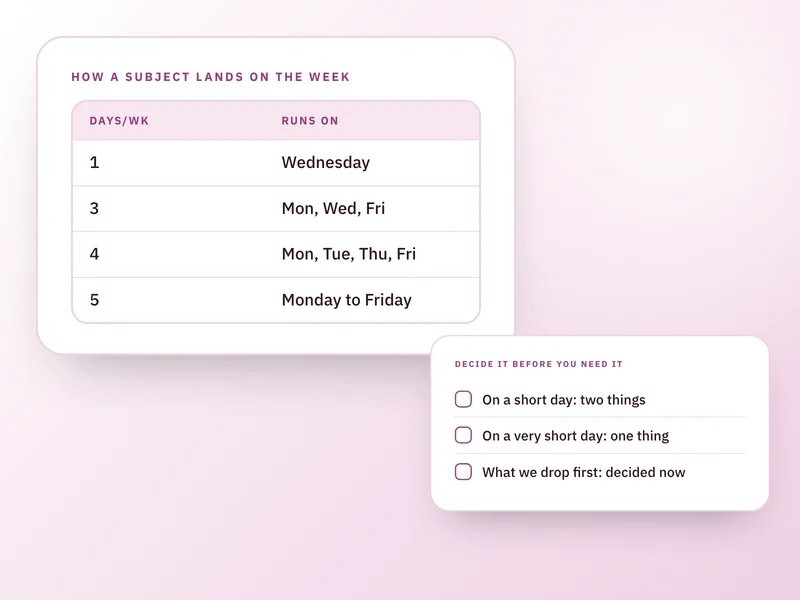 If this is where you areHomeschool weekly schedule with a spare day built inFill-in lines and a short-day list are in this weekly plan, built around one deliberately empty day.
- Do you have to count homeschool days or hours?
Does a four-day week meet your state's count? This shows how to find out whether yours counts days or hours.
- How to tell if your homeschooler actually learned it
Fewer days on a subject raises the question of retention. This gives four questions to ask a week later.
- Homeschool subject not working? What to change first
If a subject gets four days and still is not moving, start here for the cheapest fix first.