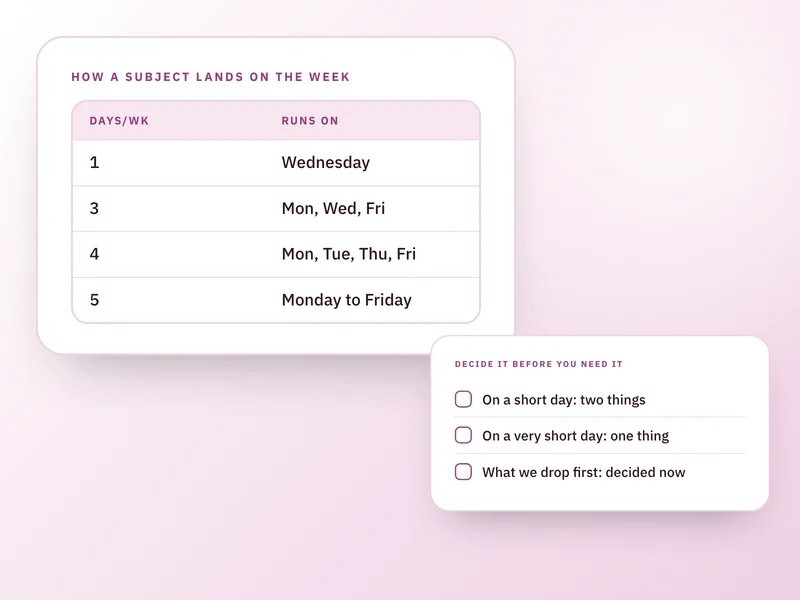
A homeschool weekly plan that survives a bad day plans four full days and leaves one spare, decided on paper before the week starts, not chosen on the fly. The hardest subject goes first, while everyone still has something left. The spare day absorbs whatever the week throws at it: an appointment, a sick morning, a lesson that ran long.
This is a planning method for homeschooling in the United States, on paper or in an app, not a rule any state sets. It can't tell you how many days or hours your own state expects, only how to build a week that survives an ordinary bad Tuesday: see do you have to count homeschool days or hours for that separate question.
An example: four subjects, one spare Wednesday
Say a family teaches four subjects, math, reading, writing and science, four days a week each. Written out, the week is Monday, Tuesday, Thursday and Friday full, and Wednesday carries nothing at all: no math lesson planned, no reading chapter due. In an ordinary week, Wednesday becomes a lighter day, an errand day, or a trip to the library. In the week the toddler gets a stomach bug on Tuesday night, Wednesday is where Tuesday's math lesson actually happens, and nothing else in the week has to move.
Nothing about the subjects changed. Four days a week is still four days a week. The only decision was which day carries nothing, made in September rather than guessed at on a Tuesday morning.
How a four-day subject actually lands on the calendar
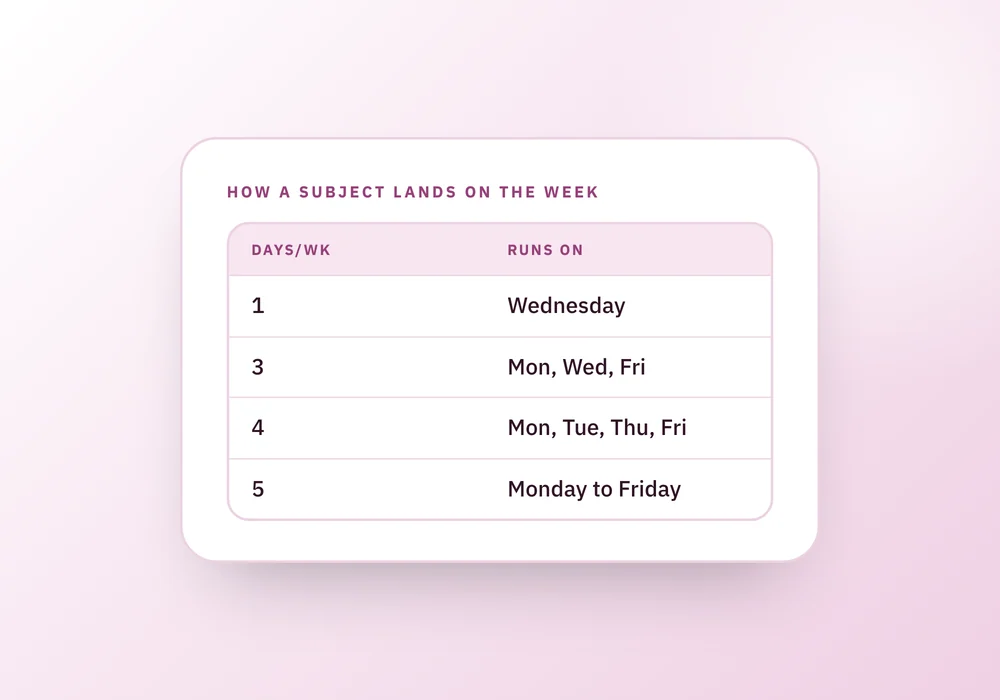
The weekday pattern Homeschooling Companion uses once you set a subject to a given number of days a week. Wednesday only stays empty at four days or fewer, with this particular split.
8 of 8 rows shown
0
- Runs on
- Never (kept on record, not on Today)
1
- Runs on
- Wednesday
2
- Runs on
- Tuesday, Thursday
3
- Runs on
- Monday, Wednesday, Friday
4
- Runs on
- Monday, Tuesday, Thursday, Friday
5
- Runs on
- Monday through Friday
6
- Runs on
- Monday through Saturday
7
- Runs on
- Every day
| Days a week | Runs on |
|---|---|
| 0 | Never (kept on record, not on Today) |
| 1 | Wednesday |
| 2 | Tuesday, Thursday |
| 3 | Monday, Wednesday, Friday |
| 4 | Monday, Tuesday, Thursday, Friday |
| 5 | Monday through Friday |
| 6 | Monday through Saturday |
| 7 | Every day |
A subject set to three days a week or fewer already has slack built into the calendar. It's the four and five-day subjects, the ones that fill most of the week, where a spare day has to be planned on purpose, because nothing in the schedule leaves one for you.
Put the hardest subject first, and keep it short
Whatever is hardest, for your child or for you, goes first in the day, while there's still patience left on both sides. This isn't about adding time to it: keep the hard subject to its usual length, just move it earlier, so a rough start doesn't sour everything that comes after it.
If a subject is hard most days rather than occasionally, that's a different problem than timing. When a homeschool subject is not working: what to change first covers what to try before assuming the material itself is the issue.
Decide the short-day list before you need it
Fill these in once, on an ordinary day, and keep them somewhere you'll actually see on the day you need them.
3 things to do
Ticks are for this visit only. Nothing here is saved anywhere.
What to record on a short day
The same way as any other day: a date, what you actually covered, even if it's one subject for fifteen minutes, and one word on how it went. A record made only of full days tells a story that isn't true. A short day written down is worth more than a blank one.
For the habit that keeps a log like this going past the first month, see a simple homeschool record keeping system you will keep.
Where this plan breaks down
The most common mistake is treating the spare day as a day off every single week, whether or not anything went wrong. Do that, and the week you actually need it, the one with the stomach bug, has already been spent on a museum trip, and something else has to give instead.
The second is assuming an app or planner has a spare-day switch somewhere. Homeschooling Companion doesn't have one: a day with nothing scheduled just shows as a day with nothing scheduled, and it's specific to each subject's own day count, not a single feature you turn on for the whole week. The plan lives on your own calendar or a page like the handbook's weekly one, not inside a setting.
More than one child, one spare day
The spare day covers the whole household, not one child at a time, but whatever it absorbs still needs recording per child once it happens. Log each child's short day the way you'd log any other day, on their own page, even when the cause was the same appointment or the same stomach bug for everyone. Keeping records for more than one child without mixing them up covers filing by child in more detail.
Questions people ask
What is a spare day in a homeschool schedule?
A day left empty on purpose when you plan the week, so it can absorb whatever goes wrong, an appointment, a sick morning, a lesson that ran long, without pushing the rest of the week around. In a week where nothing goes wrong, it becomes a lighter day or a day out instead.
Is a four-day homeschool week enough?
For most families, yes, if the fifth day isn't simply dropped but planned as slack. A subject set to four days a week still gets four sessions; the difference is which specific days carry it. What a four-day week can't tell you is whether it satisfies your own state's day or hour count, if it sets one, so check that separately.
What if the spare day isn't needed some weeks?
Then use it for whatever the week could use: a lighter day, an outing, a trip to the library, or nothing at all. A spare day that goes unused isn't wasted. It did its job by existing, the same way a spare tire earns its place without ever being driven on.
How do I record a short day so it doesn't look like a failure?
The same way as any other day: a date, what you actually covered, even if it's one subject for fifteen minutes, and one word on how it went. Leaving the day blank hides that anything happened at all; a short line is a truer record than a gap.
Can I set a subject to run on specific days in Homeschooling Companion?
You choose how many days a week, from zero to seven, for each subject on a child's page, and the app spreads it across the week using a fixed pattern rather than letting you pick individual weekdays. Zero keeps a subject on record without putting it on the Today screen at all.
What the Companion does with the plan
Homeschooling Companion doesn't build a weekly plan for you, and it has no setting called a spare day. What it does is take the day count you choose for each subject, zero to seven, and show only what's due that day on the Today screen; a day with nothing scheduled reads "Nothing scheduled today," plainly, not as a warning. Recording a subject is one tap, and marking one "Did not get to it" still records the day: it comes back next time as a quiet flag, "Last time this was not finished," rather than a gap in the log. See it on the Homeschooling Companion page.
Sources and how we checked
- Homeschool Connections, 8 Tips for Scheduling Your Homeschool Day: Backs using a weekly buffer day for catch-up work, the general planning practice behind the spare day.Checked 26 September 2026.
Where to go next
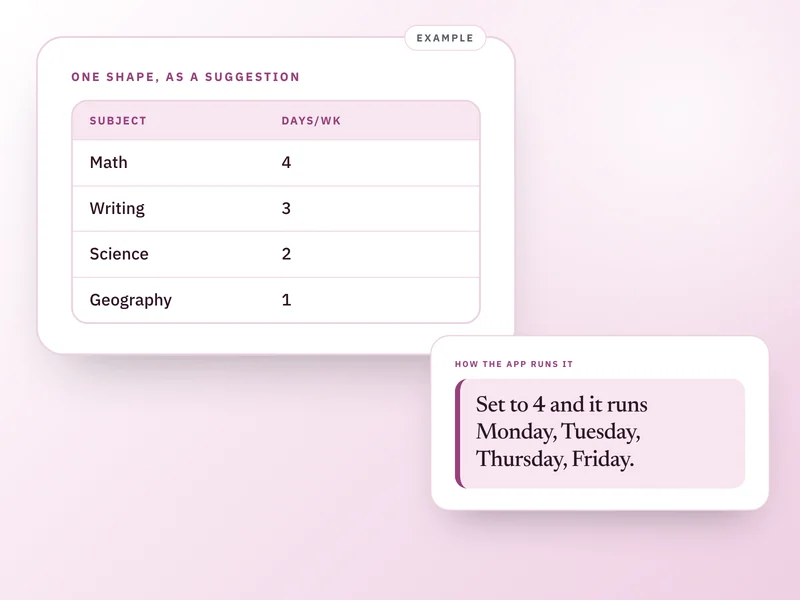 If this is where you areFour-day homeschool week: how many days each subject getsThis shows how many days each subject gets across a four-day week and what to record when the fifth stays empty.
- Homeschool subject not working? What to change first
When the plan holds and one subject still stalls, change the time, then the amount, then go back a step.
- Homeschool record keeping for multiple children
Planning around more than one child? See how to keep each child's record apart and log shared lessons.
- How to start homeschooling: what to do in the first month
New to all this? Here is the order to set things up in the first month, ending with a plain first week.