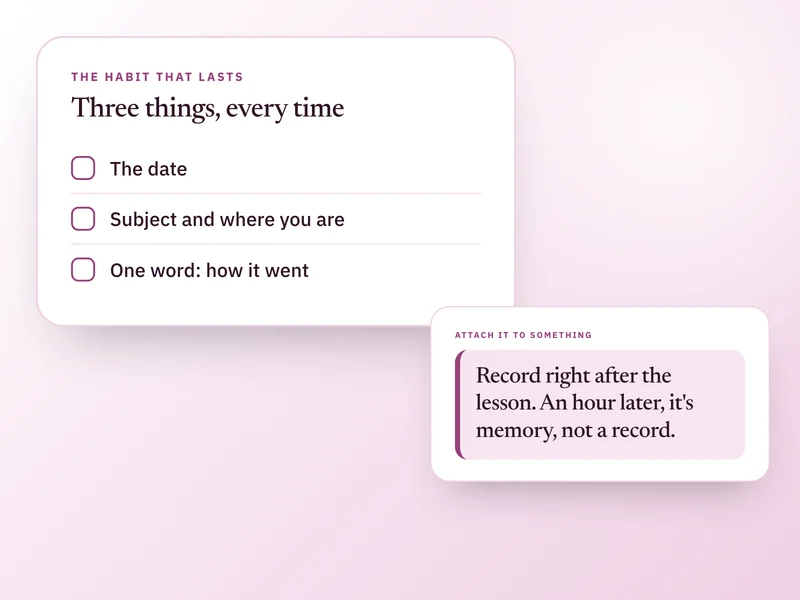
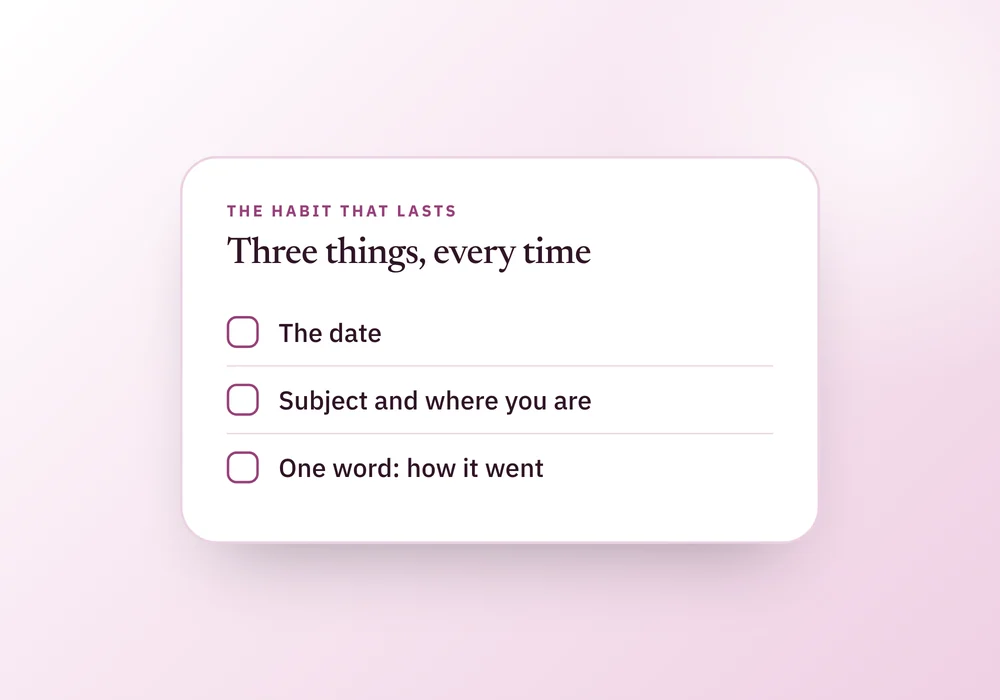
The record keeping system that lasts writes three things every time: the date, the subject and roughly where you are in it, and one word on how it went. Nothing else is required to make it useful. Write it in under a minute, right after the lesson, or you'll rebuild it from memory later and get it wrong.
This is for a parent in the United States who has already tried a system that died, or hasn't started one and wants to skip the version that doesn't last. It can't tell you what your own state requires you to keep, only what actually gets written down week after week: see homeschool record keeping requirements by state for that.
An example: a week with two short days
Monday and Thursday go as planned: math, reading and writing each get a line, same as any week. Tuesday, the toddler has an ear infection and the whole morning is gone, so the entry for Tuesday is one line, "Read together on the couch, 20 minutes, easy," and nothing else. Friday, an orthodontist appointment eats the morning, so Friday gets "Math Unit 3, 15 minutes, about right" and stops there.
Neither short day gets a note explaining why, and neither gets left blank. A week like this one still produces four days with something written down, instead of two full days and two gaps, and the record reads as an ordinary week rather than a bad one.
What makes the habit stop
Every one of these feels reasonable in September. If your current system does two or more, that's usually why it stalled.
5 things to do
Ticks are for this visit only. Nothing here is saved anywhere.
Attach it to something that already happens
A record kept as a separate task competes with everything else in the day for a slot, and it's usually the thing that loses. A record attached to something you already do every day, closing a book, packing the table away, doesn't need a reminder, because the moment that triggers it is already built into the day.
Setting this up takes about two minutes: pick the moment, right after the last subject, right before lunch, whenever the workbooks go back on the shelf, and pick where it will live, whatever's already in reach at that moment. Write today's date on the first line and start. If you'd rather start from an already-formatted table than a blank page, homeschool record keeping template: three columns to copy has the exact columns.
What doesn't fit the three things
A photo of a project, or anything three-dimensional, is worth taking the day it happens, for the same reason a note is: it's hard to recreate later. It doesn't need its own place in the daily habit. Keep it wherever your phone already keeps photos, dated automatically, and mention what it was of in that day's line so you can find it again.
With more than one child, keep the habit the same per child rather than combining entries on one page. Keeping records for more than one child without mixing them up covers filing by child in more detail.
When a bad week breaks it anyway
Some weeks nothing gets written for two or three days running: illness, travel, a week that simply falls apart. The system that survives isn't the one where that never happens. It's the one where a gap doesn't stop the next entry.
Write today's entry today, whatever gaps came before it. A week with three days logged and two blank is still a record of what happened, not a failure, and going back to fill in the blank days from memory usually makes the record less accurate, not more. If a bigger stretch has gone unrecorded, how to catch up on homeschool records you have not kept covers what's actually recoverable and what isn't.
Questions people ask
How much detail does each homeschool record entry actually need?
Three things: the date, the subject and roughly where you are in it (Unit 3, Lesson 12 is plenty), and one word on how it went, easy, about right, or difficult. Anything beyond that, a paragraph, a time log, a color code, is a reason the system gets heavier than a normal week can support and eventually stops.
What if I miss a few days in a row?
Write today's entry today and let the missed days stay blank rather than guessed at. A record with real gaps in it is more useful later than one padded with entries reconstructed from memory, because you'll actually know which parts you can trust. If the gap is bigger, a term or more, rebuilding it takes a different approach.
Should each child have a separate record?
Yes, once you have more than one child. A shared page mixing two children's entries is hard to read back a year later, and it's the first thing that makes a system feel heavier than it is. File by child from the start rather than splitting a combined page after the fact.
Is a notebook good enough, or do I need an app?
A notebook is good enough for the whole system described here: a date, a subject and where you are, one word. The real question is whether it's already open or in reach when a lesson ends, since a record made from memory an hour later is less accurate than one made in the moment.
What do I do with the occasional big thing worth remembering, like a breakthrough?
Write it the day it happens, in a sentence, separate from the daily three things: "She finally got equivalent fractions today, after weeks of it not landing." It doesn't need to fit the usual format, and it's usually the one line from an entire year you'd actually want to keep.
What the Companion does with the habit
Homeschooling Companion is built around the same three things and nothing more. Tap a subject done on the Today screen and it's dated automatically, keeps the subject and position you already typed in, Math, Unit 3, Lesson 12, and asks one optional question, how did it go, with easy, about right, or difficult as the only answers. Marking a subject "Did not get to it" still records the day; it just comes back next time as a quiet flag to go over it again, not a blank. Add the occasional bigger note on the Record tab, in your own words, and choose whether it prints or stays private. See it on the Homeschooling Companion page.
Sources and how we checked
- HSLDA, Types of Homeschool Records: Backs that it's easier to keep records as you go than to construct them later, the basis for the right-after-the-lesson recommendation.Checked 26 September 2026.
- Seeking Delectare, Simple Homeschool Record-Keeping: A parent account backing the point that a system has to be simple to survive, used for why elaborate systems get abandoned.Checked 26 September 2026.
Where to go next
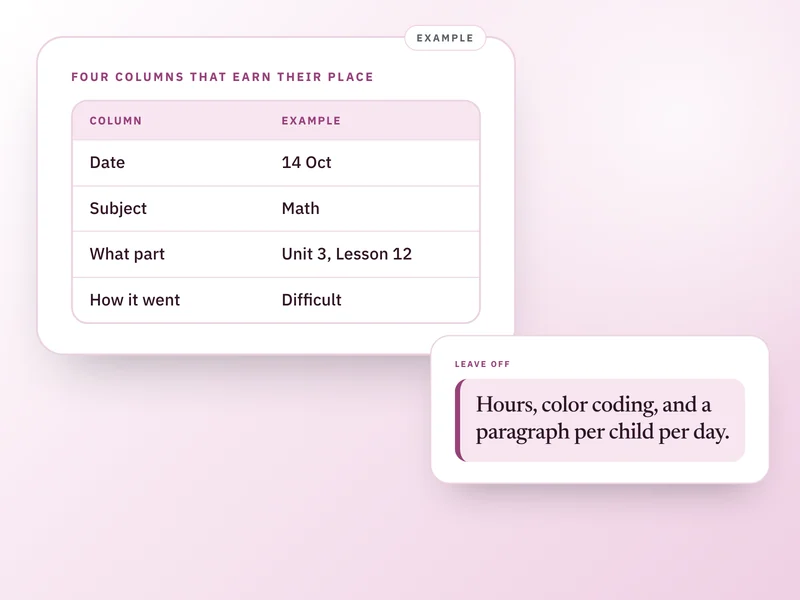 If this is where you areHomeschool record keeping template: three columns to copyReady for the paper or spreadsheet version? Copy the four columns and see what to leave off.
- Homeschool record keeping for multiple children
Two or more children make one system easy to muddle. This shows how to file by child.
- How to catch up on homeschool records you did not keep
Fell off the habit already? This covers how to rebuild what you did not write down.
- Homeschool requirements by state: what records to keep
Not sure how much your state wants you to keep? This table sets the level for all 50 states and DC.