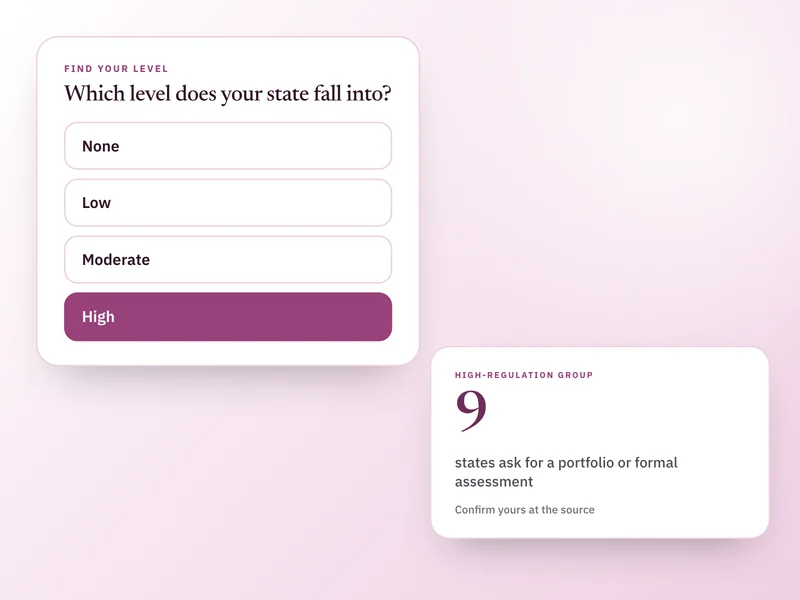
Every state treats homeschool record keeping differently. In our summary of each state's own laws, 8 states file nothing with the state at all, 15 ask for a notice and basic records, 19 add some form of annual reporting or testing, and 9 require a portfolio or a formal yearly assessment. Find your state in the table below.
This is for a homeschooling parent who wants a plain read on where their state sits, not legal advice about their exact situation. It cannot tell you whether you are meeting the law today: state rules change, and only your state's department of education or a state homeschool association can confirm the current one.
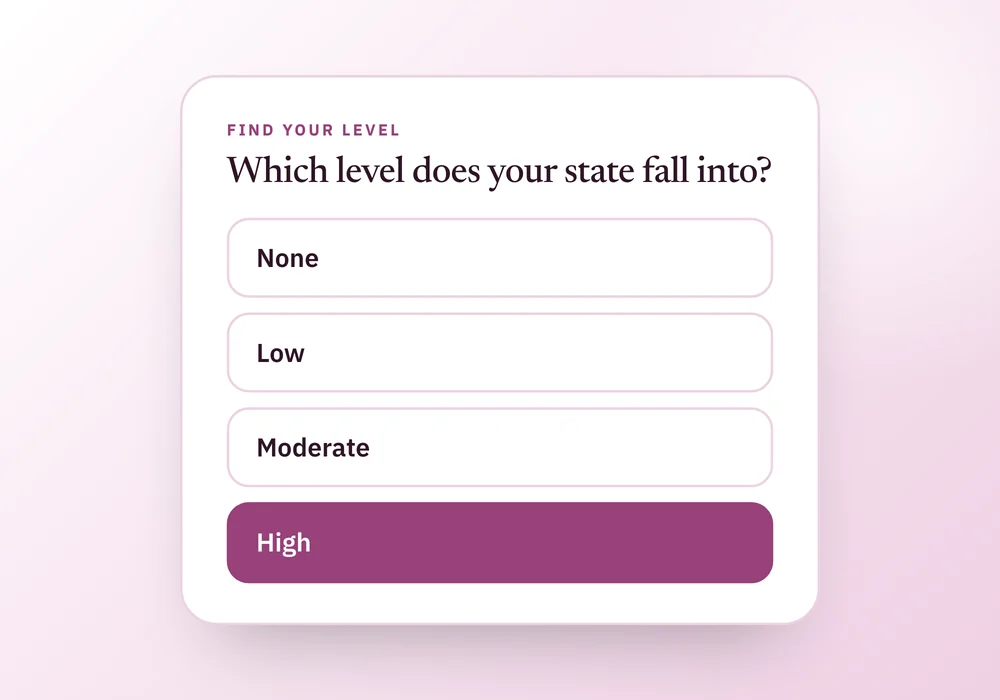
Reading one row, as an example
Take Florida's row in the table below. It reads High, with the note: notice, portfolio of work and log kept two years, annual evaluation. Read plainly, that is a family filing something at the start of the year, keeping a running log and samples of a child's actual work for two years, and going through an evaluation once a year.
Now compare Alaska's row: None, with the note nothing filed, records for your own use. Both families can teach the same six subjects the same number of days a week. Only one of them has something to produce if anyone ever asks.
Every state, and what it asks you to keep
Sorted alphabetically. The level is how much the state involves itself, not how hard homeschooling is there or how good a job you are doing. Confirm against your own state before relying on it, because these rules change.
51 of 51 rows shown
Alabama
- Level
- Low
- What you are asked to keep
- Notice through a church or private school; attendance records
Alaska
- Level
- None
- What you are asked to keep
- Nothing filed; records for your own use
Arizona
- Level
- Low
- What you are asked to keep
- Notice of intent; keep your own records
Arkansas
- Level
- Moderate
- What you are asked to keep
- Notice of intent each year; records of instruction
California
- Level
- Moderate
- What you are asked to keep
- Private school affidavit; attendance register and course list
Colorado
- Level
- Moderate
- What you are asked to keep
- Notice; attendance, immunization and test or evaluation every other year
Connecticut
- Level
- None
- What you are asked to keep
- Nothing required; portfolio only if you opt into review
Delaware
- Level
- Low
- What you are asked to keep
- Enrollment and attendance reported annually
District of Columbia
- Level
- High
- What you are asked to keep
- Notice; portfolio available for review; annual reporting
Florida
- Level
- High
- What you are asked to keep
- Notice; portfolio of work and log kept two years; annual evaluation
Georgia
- Level
- Moderate
- What you are asked to keep
- Declaration of intent; attendance; annual progress reports kept
Hawaii
- Level
- Moderate
- What you are asked to keep
- Notice; record of curriculum; annual progress report
Idaho
- Level
- None
- What you are asked to keep
- Nothing filed; records for your own use
Illinois
- Level
- None
- What you are asked to keep
- Nothing filed; records for your own use
Indiana
- Level
- Low
- What you are asked to keep
- Attendance records, produced on request
Iowa
- Level
- Low
- What you are asked to keep
- Options range from none to reporting; depends on the route chosen
Kansas
- Level
- Low
- What you are asked to keep
- Register as a non-accredited private school; keep attendance
Kentucky
- Level
- Low
- What you are asked to keep
- Notice; attendance and scholarship records
Louisiana
- Level
- Moderate
- What you are asked to keep
- Application or notice; portfolio or test results annually
Maine
- Level
- Moderate
- What you are asked to keep
- Notice; annual assessment by test or portfolio review
Maryland
- Level
- High
- What you are asked to keep
- Notice; portfolio reviewed by the district up to three times a year
Massachusetts
- Level
- High
- What you are asked to keep
- Prior approval of your plan; progress reports as agreed
Michigan
- Level
- None
- What you are asked to keep
- Nothing filed under the home education route
Minnesota
- Level
- Moderate
- What you are asked to keep
- Notice; annual testing; records of subjects and attendance
Mississippi
- Level
- Low
- What you are asked to keep
- Certificate of enrollment filed annually
Missouri
- Level
- Moderate
- What you are asked to keep
- No notice, but a log of hours, samples of work and evaluations kept
Montana
- Level
- Low
- What you are asked to keep
- Notice; attendance and immunization records kept
Nebraska
- Level
- Moderate
- What you are asked to keep
- Notice and information filed annually; attendance records
Nevada
- Level
- Low
- What you are asked to keep
- Notice of intent filed once; records for your own use
New Hampshire
- Level
- Moderate
- What you are asked to keep
- Notice; portfolio kept two years; annual evaluation
New Jersey
- Level
- None
- What you are asked to keep
- Nothing filed; records for your own use
New Mexico
- Level
- Low
- What you are asked to keep
- Notice filed annually; immunization records
New York
- Level
- High
- What you are asked to keep
- Notice; individualised plan; quarterly reports; annual assessment
North Carolina
- Level
- Moderate
- What you are asked to keep
- Notice; attendance and immunization; annual standardised test kept
North Dakota
- Level
- Moderate
- What you are asked to keep
- Notice; annual testing in certain grades; records kept
Ohio
- Level
- High
- What you are asked to keep
- Notice; annual academic assessment by test or portfolio review
Oklahoma
- Level
- None
- What you are asked to keep
- Nothing filed; records for your own use
Oregon
- Level
- Moderate
- What you are asked to keep
- Notice on starting; testing at certain grades, results kept
Pennsylvania
- Level
- High
- What you are asked to keep
- Affidavit; log, portfolio, and annual evaluator review
Rhode Island
- Level
- Moderate
- What you are asked to keep
- District approval; attendance and progress as the district requires
South Carolina
- Level
- High
- What you are asked to keep
- Association or district option; portfolio, log and progress records
South Dakota
- Level
- Low
- What you are asked to keep
- Notice; testing at certain grades
Tennessee
- Level
- Moderate
- What you are asked to keep
- Notice; attendance; testing at certain grades depending on route
Texas
- Level
- None
- What you are asked to keep
- Nothing filed; keep curriculum evidence for your own use
Utah
- Level
- Low
- What you are asked to keep
- One-time affidavit; records for your own use
Vermont
- Level
- High
- What you are asked to keep
- Enrollment filed annually; assessment and progress report
Virginia
- Level
- Moderate
- What you are asked to keep
- Notice; annual evidence of progress by test or evaluation
Washington
- Level
- Moderate
- What you are asked to keep
- Declaration of intent; annual test or assessment, results kept
West Virginia
- Level
- Moderate
- What you are asked to keep
- Notice; annual academic assessment kept
Wisconsin
- Level
- Low
- What you are asked to keep
- Annual enrollment report filed
Wyoming
- Level
- Low
- What you are asked to keep
- Curriculum submitted annually to the local board
| State | Level | What you are asked to keep |
|---|---|---|
| Alabama | Low | Notice through a church or private school; attendance records |
| Alaska | None | Nothing filed; records for your own use |
| Arizona | Low | Notice of intent; keep your own records |
| Arkansas | Moderate | Notice of intent each year; records of instruction |
| California | Moderate | Private school affidavit; attendance register and course list |
| Colorado | Moderate | Notice; attendance, immunization and test or evaluation every other year |
| Connecticut | None | Nothing required; portfolio only if you opt into review |
| Delaware | Low | Enrollment and attendance reported annually |
| District of Columbia | High | Notice; portfolio available for review; annual reporting |
| Florida | High | Notice; portfolio of work and log kept two years; annual evaluation |
| Georgia | Moderate | Declaration of intent; attendance; annual progress reports kept |
| Hawaii | Moderate | Notice; record of curriculum; annual progress report |
| Idaho | None | Nothing filed; records for your own use |
| Illinois | None | Nothing filed; records for your own use |
| Indiana | Low | Attendance records, produced on request |
| Iowa | Low | Options range from none to reporting; depends on the route chosen |
| Kansas | Low | Register as a non-accredited private school; keep attendance |
| Kentucky | Low | Notice; attendance and scholarship records |
| Louisiana | Moderate | Application or notice; portfolio or test results annually |
| Maine | Moderate | Notice; annual assessment by test or portfolio review |
| Maryland | High | Notice; portfolio reviewed by the district up to three times a year |
| Massachusetts | High | Prior approval of your plan; progress reports as agreed |
| Michigan | None | Nothing filed under the home education route |
| Minnesota | Moderate | Notice; annual testing; records of subjects and attendance |
| Mississippi | Low | Certificate of enrollment filed annually |
| Missouri | Moderate | No notice, but a log of hours, samples of work and evaluations kept |
| Montana | Low | Notice; attendance and immunization records kept |
| Nebraska | Moderate | Notice and information filed annually; attendance records |
| Nevada | Low | Notice of intent filed once; records for your own use |
| New Hampshire | Moderate | Notice; portfolio kept two years; annual evaluation |
| New Jersey | None | Nothing filed; records for your own use |
| New Mexico | Low | Notice filed annually; immunization records |
| New York | High | Notice; individualised plan; quarterly reports; annual assessment |
| North Carolina | Moderate | Notice; attendance and immunization; annual standardised test kept |
| North Dakota | Moderate | Notice; annual testing in certain grades; records kept |
| Ohio | High | Notice; annual academic assessment by test or portfolio review |
| Oklahoma | None | Nothing filed; records for your own use |
| Oregon | Moderate | Notice on starting; testing at certain grades, results kept |
| Pennsylvania | High | Affidavit; log, portfolio, and annual evaluator review |
| Rhode Island | Moderate | District approval; attendance and progress as the district requires |
| South Carolina | High | Association or district option; portfolio, log and progress records |
| South Dakota | Low | Notice; testing at certain grades |
| Tennessee | Moderate | Notice; attendance; testing at certain grades depending on route |
| Texas | None | Nothing filed; keep curriculum evidence for your own use |
| Utah | Low | One-time affidavit; records for your own use |
| Vermont | High | Enrollment filed annually; assessment and progress report |
| Virginia | Moderate | Notice; annual evidence of progress by test or evaluation |
| Washington | Moderate | Declaration of intent; annual test or assessment, results kept |
| West Virginia | Moderate | Notice; annual academic assessment kept |
| Wisconsin | Low | Annual enrollment report filed |
| Wyoming | Low | Curriculum submitted annually to the local board |
What the four levels mean
This is our own summary, sorted by how much a state's law asks you to file or produce, not a rating of how strict or lenient it is to raise a family there.
- None, 8 states: nothing is filed with the state. Records are for your own use.
- Low, 15 states: a notice is typically filed, and basic records are kept, with no ongoing review.
- Moderate, 19 states: notice plus some form of annual reporting or testing is typically required.
- High, 9 states: a portfolio or a formal annual assessment is typically part of the law, not just a good habit.
Which states ask for a portfolio
Nine states sit in the high group: the District of Columbia, Florida, Maryland, Massachusetts, New York, Ohio, Pennsylvania, South Carolina and Vermont. In our summary, a portfolio or samples of work show up in ten states in total, those six of the nine High states, plus four Moderate ones: Louisiana, Maine, Missouri and New Hampshire. In Louisiana, Maine and Ohio, a portfolio review can stand in for a test rather than sit alongside one.
If your state asks for a portfolio, someone may actually read it. Building one in April from a year of memory is much harder than adding to it as you go, which is the whole case for what actually goes in a homeschool portfolio.
Where this table can mislead you
None does not mean no rules exist, only that nothing is filed with the state. Texas sits in our None group, and Texas law still expects you to teach reading, spelling, grammar, math and good citizenship in a real and organized way, even though no one reviews your plan. Read None as low paperwork, not as no rules.
Our level is a summary, built from each state's own homeschool law or department of education guidance and sorted into four bands by how much the state asks you to file or produce. It is not a citation, and other sites sort the same states slightly differently, because there is no single official four-tier scale everyone uses. If you move states partway through a year, check both: what a notice or a portfolio needs at the state you are leaving rarely matches the one you are entering.
Questions people ask
Do I have to notify my state that I am homeschooling?
It depends on your state. In our summary, most states ask for some kind of notice, declaration or affidavit, though what counts as one and where it goes varies a lot, from a one-time filing to an annual one sent to your district. Eight states, including Texas, Illinois and Alaska, ask for nothing to be filed. Check your state's own department of education page to see what currently applies to you.
Which states require a homeschool portfolio?
In our summary, ten states expect a portfolio or samples of a child's actual work: the District of Columbia, Florida, Louisiana, Maine, Maryland, Missouri, New Hampshire, Ohio, Pennsylvania and South Carolina. In Louisiana, Maine and Ohio, a portfolio review can replace a test rather than sit alongside one. This is our own reading of each state's law, not a legal opinion, so confirm the current rule with your state.
Does my state require homeschool testing?
In our summary, 18 of the 51 jurisdictions include a required test or a formal evaluation in what they ask for, usually alongside a notice, and sometimes as an alternative to a portfolio rather than in addition to one. Where testing applies, it is often set at specific grades rather than every year. Confirm the actual grades and format with your state's department of education.
What does it mean if my state is in the None group?
Nothing is filed with the state, but that is not the same as no rules at all. Texas, for example, sits in our None group, and its own law still expects a real, organized education covering reading, spelling, grammar, math and good citizenship, even though no one reviews your plan. Keep basic records anyway. They cost little, and you may want them later for a transcript or a move to another state.
What should I do if I move to a different state partway through the year?
Check both. Look up the state you are leaving in the table above, in case anything is due before you go, then look up the one you are moving to, since its notice, testing or portfolio rules may differ and may run on a school-year calendar of its own. A state homeschool association in the new state is often the fastest way to confirm what applies now.
What the Companion does with your state
Homeschooling Companion reads this same summary to run the state picker on the Kids tab. Pick your state once, and for the 28 states in the Moderate or High groups, your printed My Homeschool Record gains an extra page that lists what your state's note asks for next to what you have actually recorded: a day count, a note count, or a check count. For the 23 None and Low states, your level and note still show on the Kids tab, but there is no extra printed page, because there is less for one to say. See how it looks on the Homeschooling Companion page.
Sources and how we checked
- HSLDA, Homeschool Laws By State: General basis for grouping states by regulation level and confirming that requirements vary by state and change over time.Checked 26 September 2026.
- Texas Education Agency, Home Schooling: Backs the Texas None-group example, including that the state does not register or approve homeschool programs.Checked 26 September 2026.
- Pennsylvania Department of Education, Home Education Program: Backs the Pennsylvania High-group example: affidavit, portfolio, annual evaluation and grade-level testing.Checked 26 September 2026.
- Florida Department of Education, Home Education: Backs the Florida High-group example: notice, portfolio of records and materials, annual evaluation.Checked 26 September 2026.
Where to go next
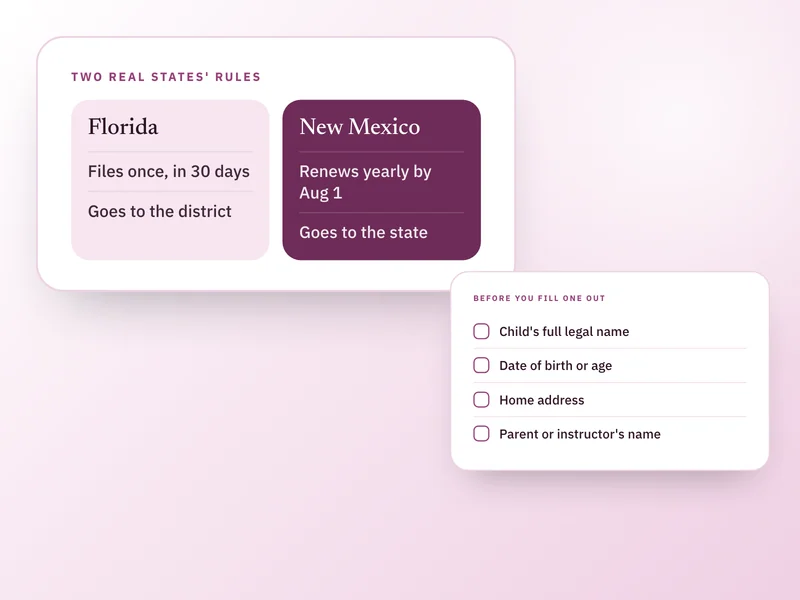 If this is where you areHomeschool notice of intent: what it is, how to find yoursOnce you know your level, this explains what a notice of intent is and how to find the form your state wants.
- Do you have to count homeschool days or hours?
Some states count days or hours and many do not. This shows how to check which yours does.
- Homeschool attendance records: what counts as a school day
If your state wants attendance, this covers what counts as a school day and the lightest way to record it.
- How to start homeschooling: what to do in the first month
Starting from scratch? Follow the order for the first month: what to file, what to record, what can wait.