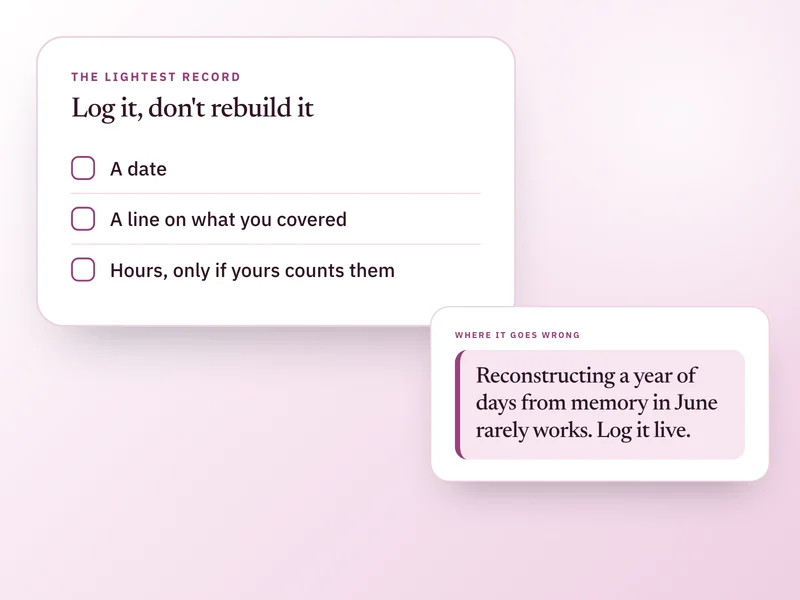
A homeschool day is usually any day with planned instruction, whether that happens at a table, on a field trip, or over a book on the couch. Where hours count, most states treat four to six hours as a full day. The lightest record that holds up is a date and a line on what you covered.
This is for a parent in the United States trying to work out what to log before finding out whether logging is even required. It can't tell you your own state's number, if it has one, only what generally counts and the record that's light enough to keep up.
An example: two days that both count
Say Tuesday is a trip to the science center: out the door at nine, four hours walking the exhibits with a scavenger-hunt sheet you wrote the night before, home for lunch. No workbook opened. Under most states' own wording, that's a full day of instruction, the same as a Thursday spent on a math lesson and forty minutes of reading that also ran about four hours.
Neither day needs a different kind of entry in the log. Both get a date and a line on what happened: "Science center, states of matter exhibit" or "Math Unit 3, reading Ch. 6."
What usually counts, and what doesn't
General practice across states, not a rule for yours specifically. Confirm anything you're relying on at your own state's source.
A morning of workbook math and reading
- Generally counts as instruction
- Yes
A field trip with a purpose you set in advance
- Generally counts as instruction
- Yes, in most states
A cooking session that worked through a recipe's fractions and measurements
- Generally counts as instruction
- Usually, if you can say what it covered
A co-op class someone else taught
- Generally counts as instruction
- Yes, log it like any other subject
A travel day with no planned learning
- Generally counts as instruction
- Not usually, unless your state counts differently
A day nothing happened at all
- Generally counts as instruction
- No
| Day | Generally counts as instruction |
|---|---|
| A morning of workbook math and reading | Yes |
| A field trip with a purpose you set in advance | Yes, in most states |
| A cooking session that worked through a recipe's fractions and measurements | Usually, if you can say what it covered |
| A co-op class someone else taught | Yes, log it like any other subject |
| A travel day with no planned learning | Not usually, unless your state counts differently |
| A day nothing happened at all | No |
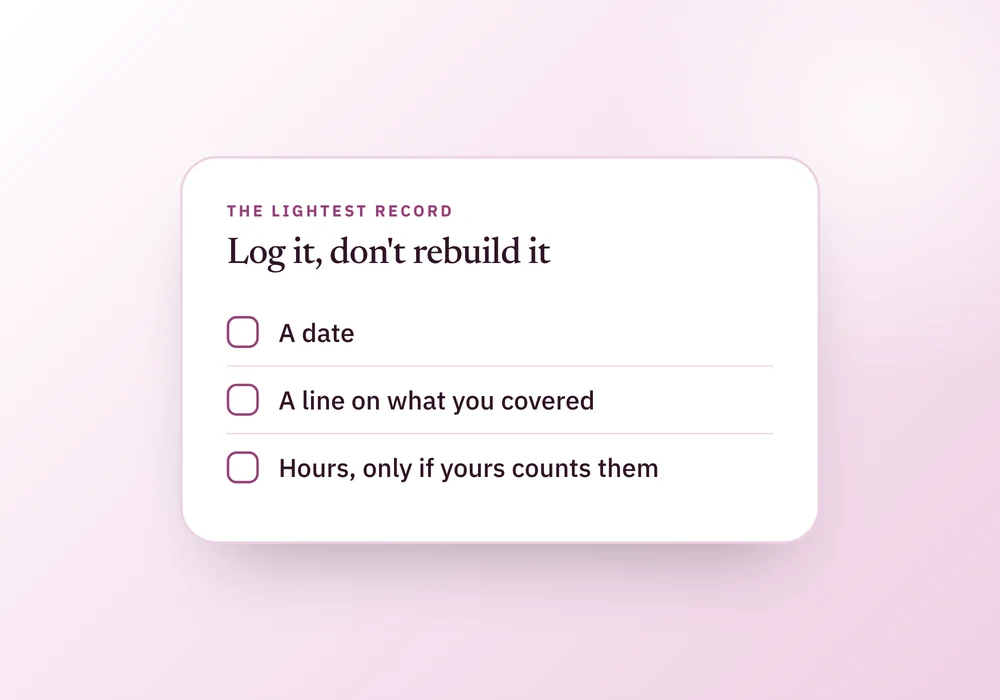
The lightest record that holds up
If your state counts days, hours, or nothing at all, this is enough to start from.
3 things to do
Ticks are for this visit only. Nothing here is saved anywhere.
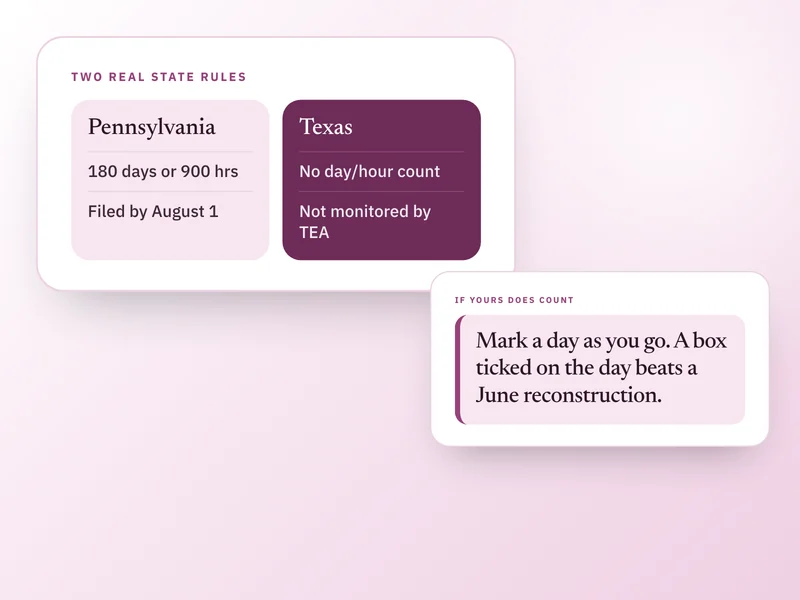
If your state counts hours, not days
A handful of states set a specific hour total instead of, or alongside, a day count. Where that's the rule, add up time spent on planned instruction across a week rather than logging a start and stop time for every subject. A rough weekly total is far less work than a stopwatch kept on each lesson, and it's what most hour-based reporting actually asks for. Confirm with your own state whether several short sessions can be added together, since that detail varies.
Our own summary in homeschool record keeping requirements by state shows which states' notes mention attendance or hours at all, though it undercounts a few strict ones, so treat it as a starting point rather than a final answer. For a place to write the number once you know it, homeschool record keeping template: three columns to copy has the columns.
What to show if someone asks
If an evaluator, a district, or your state ever asks for proof, what holds up is the dated log itself, not a summary written after the fact. Bring the record as it stands, gaps included, rather than filling gaps in the night before.
A log with a few ordinary gaps across a steady year reads as normal. A perfect log with no gaps at all, built the week before a review, usually reads as exactly that.
Where this goes wrong
The record that fails is the one built after the fact. A stack of undated worksheets doesn't show how many days you taught, and a year reconstructed from memory in June is rarely accurate. A date logged the day it happens takes seconds and holds up better than any total rebuilt later.
The other common mistake is over-building: logging start and stop times when a state only asks for a day count, or tracking which parent taught when no state has ever asked for it. Every extra field is a reason the habit stops in October rather than June. Do you have to count homeschool days or hours covers how to find out what your own state actually wants before you build around a guess.
Questions people ask
Does a field trip count as a homeschool day?
In most states, yes, as long as it had a learning purpose you can name afterward: a museum, a historical site, a nature walk with a specific focus. Log it the same way as any other day, a date and a line on what it covered. Confirm the exact rule with your own state if you're relying on the day.
How many hours make a full homeschool day?
Where states count hours rather than days, four to six hours is the range used most often, though the total and how it's split between subjects varies by state. If your state counts days instead, hours usually don't matter at all. Check your state's own page rather than assuming a number from another state applies to yours.
Do sick days or travel count toward attendance?
Only if instruction actually happened. A sick day with no planned learning generally doesn't count, and neither does a travel day spent entirely in transit. A travel day that included reading, a planned stop at a historic site, or a workbook page in the back seat usually does, the same as any other day.
What if my state doesn't require attendance records at all?
Some states file nothing and set no day count, though that's separate from whether any records are worth keeping for yourself: several "no filing" states still expect a course of study even without a specific count. A day count kept for yourself is still useful for noticing a pattern, even where no one will ever ask to see it.
How do I catch up if I haven't logged any days this year?
You can't reconstruct exact days with confidence, but you can build a reasonable estimate from what you do have: a curriculum's own pacing guide, dated photos, receipts, or a calendar of what the family was doing. Start logging from today regardless, since every day forward is one you won't have to reconstruct later.
What the Companion does with a day
Homeschooling Companion records a subject as done the day you tap it, and a day counts on the printed record as any date with at least one recorded entry, math, reading, a field trip logged as a subject, any of it. It doesn't ask for hours and it has no attendance counter of its own: the count on the printed state page is just the number of distinct days something was recorded. For the habit that keeps a log like this going past the first month, see a simple homeschool record keeping system you will keep. See it on the Homeschooling Companion page.
Sources and how we checked
- HSLDA, Types of Homeschool Records: Backs that attendance means actual days of instruction rather than simply days at home, and that records kept as you go are more reliable than records reconstructed later.Checked 26 September 2026.
- Homeschool Planning, Homeschool Attendance Records: Days and Hours: Backs the four to six hour range commonly used where a state counts hours, and that field trips and hands-on activities generally count as instruction.Checked 26 September 2026.
Where to go next
 If this is where you areDo you have to count homeschool days or hours?Before you log every day, check whether your state counts days or hours at all with this guide.
- Homeschool requirements by state: what records to keep
Attendance rules vary by state. This table shows which level yours sits in and where to confirm it.
- Homeschool record keeping template: three columns to copy
Attendance can be one column among four. This template shows how to keep it inside the daily record.
- A simple homeschool record keeping system you will keep
Attendance works best inside a habit you keep. This covers a system with three things per entry.