A homeschool notice of intent is a form that tells your state or district a child will be taught at home. It goes to a state education department or a district superintendent depending on where you live, is due once or every year, and by one tracking group's count, 12 US states ask for none at all.
This explains what the phrase usually covers and how to find your own state's version. It is not legal advice, it cannot tell you your state's current requirement, and the official source for your state is the only one that decides.
What two real states actually ask for
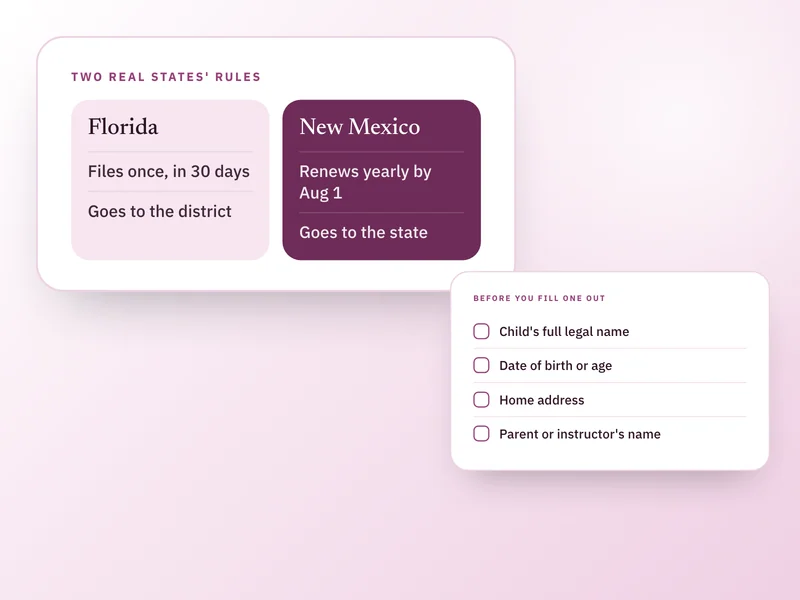
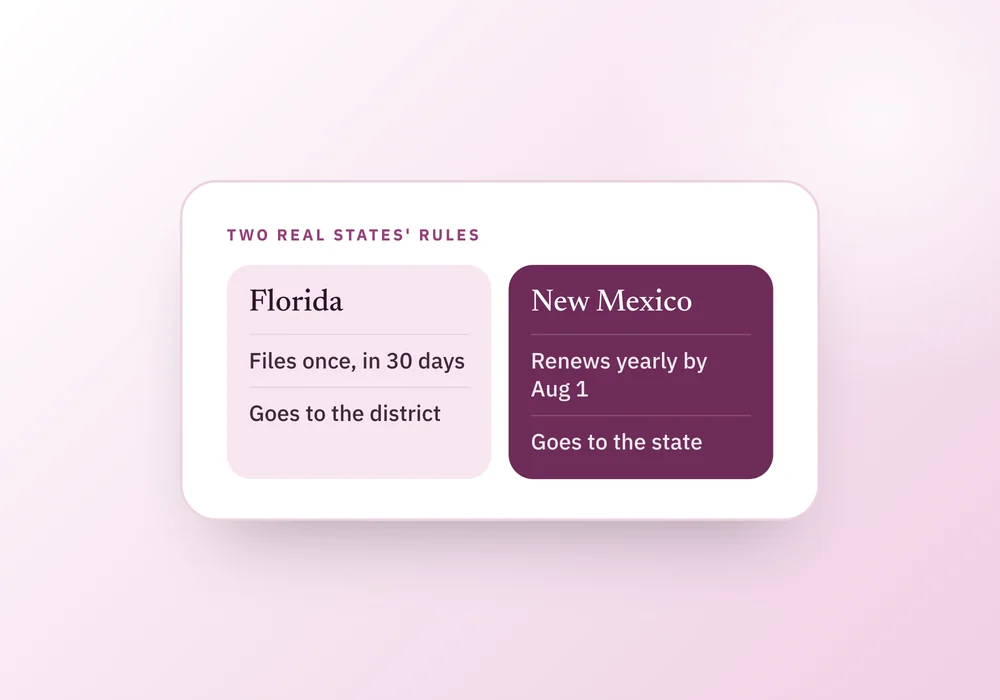
Take Florida. Under Florida Statute 1002.41, a parent files the notice with the district school superintendent's office where they live, within 30 days of starting the home education program. It has to include each child's name, date of birth and address, and it is filed once, not every year, for a child who will be six or older by February 1 of that school year.
New Mexico works differently. The state's Public Education Department wants a home school registered within 30 days of starting, then renewed every year between June 1 and August 1, filed with the state, not the local district, either online or on paper. For a paper filing, the department recommends certified mail with a delivery receipt, since a lost form with no proof of sending is a hard thing to argue about later.
Both are real, current rules from two state agencies. Neither is yours unless you live there. They show the two shapes a notice can take: a one-time filing to a district, or an annual filing to the state.
Two real states, side by side
- Name, date of birth, address
- Filed within 30 days of starting
- Goes to the district superintendent
- Registered online or on paper
- Renewed every year, June 1 to August 1
- Goes to the state education department
Florida: one-time, to the district
- Name, date of birth, address
- Filed within 30 days of starting
- Goes to the district superintendent
New Mexico: annual, to the state
- Registered online or on paper
- Renewed every year, June 1 to August 1
- Goes to the state education department
What to have ready before you fill one out
5 things to do
Ticks are for this visit only. Nothing here is saved anywhere.
How to find yours
5 things to do
Ticks are for this visit only. Nothing here is saved anywhere.
A notice is not the whole of it
Filing the wrong document is the most common mistake. A notice of intent tells your state you are starting to homeschool. It is not the same thing as a withdrawal letter, which tells your child's current school you are taking them out, and some families need to send both. A state that asks for no notice at all can still expect a withdrawal letter if a child was already enrolled somewhere.
Filing late is the second mistake. Some states expect the notice before you begin, and treat homeschooling that starts without one as a truancy problem until it is filed, so do this early if your state requires it at all.
Assuming a state with no filing has no rules at all is the third. By the Coalition for Responsible Home Education's tracking, 12 US states ask for no notice, but several of those still expect a parent to teach a specific set of subjects or keep basic records. No notice is not the same as no requirements.
Questions people ask
What is the difference between a notice of intent and a withdrawal letter?
A notice of intent tells your state or district that a child will be taught at home going forward. A withdrawal letter tells a school your child is currently attending that you are taking them out. If your child is already enrolled somewhere, you may need to send both, and they often go to different places.
Is a notice of intent the same as an affidavit?
Often, yes, just under a different name. Some states call it a notice, some a declaration, and some an affidavit, which usually means it has to be signed under oath or notarized. The name your state uses is on its own homeschool page, and it changes what the form actually requires.
What happens if I do not file a required notice of intent?
It depends on your state, but it can range from nothing enforced in practice to a truancy referral if a district notices a school-age child not enrolled anywhere. Filing on time, and keeping a copy, is the simplest way to avoid the question ever coming up.
Can a homeschool organization file the notice for me?
Some states let you homeschool under a private school umbrella or association that files on your behalf instead of you filing directly, and some do not allow that structure at all. Check your state organization's own page for whether this option exists where you live.
Do I have to file a notice of intent every year?
It depends on the state. New Mexico, for one real example, wants it renewed annually between June 1 and August 1. Florida, another real example, wants it once, when you start. Your own state's page is the only way to know which pattern applies to you.
What Homeschooling Companion shows about your state
Homeschooling Companion includes a summary of what each state typically asks, shown on the Kids tab as None, Low, Moderate or High. It is the product's own summary, not the law, and every state page repeats the same line: laws change, confirm with your state before relying on this. It does not file anything on your behalf and does not check whether you have met a requirement. See Homeschooling Companion.
Sources and how we checked
- Florida Homeschooling: Notice of Intent: Florida Statute 1002.41: notice to the district superintendent within 30 days of starting; name, date of birth, address; filed once.Checked 26 September 2026.
- New Mexico Public Education Department: Home Schooling: Registration within 30 days of starting, renewed annually June 1 to August 1, online or on paper, certified mail recommended for paper filings.Checked 26 September 2026.
- Coalition for Responsible Home Education: Inside Homeschool Policy: 12 states require no notice of intent at all, per CRHE's tracking, used instead of an unverifiable annual/one-time split.Checked 26 September 2026.
Where to go next
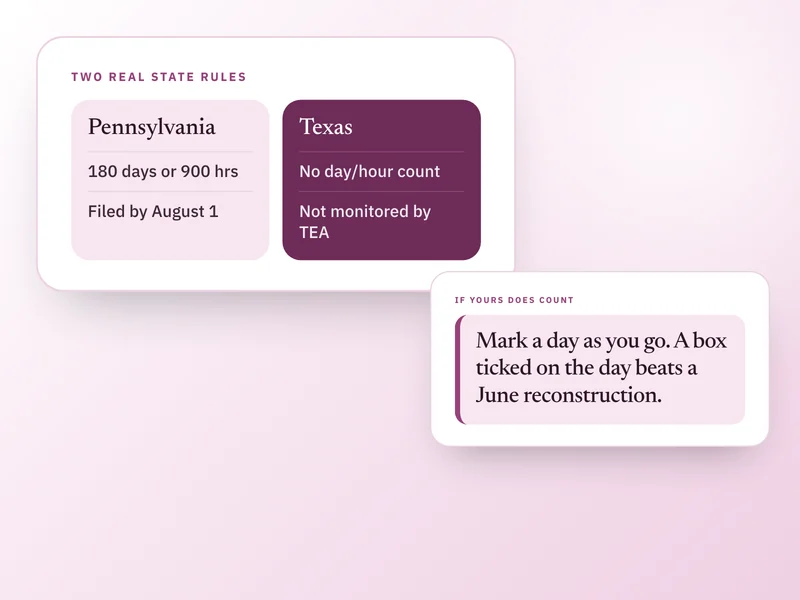 If this is where you areDo you have to count homeschool days or hours?After the notice is filed, find out whether your state also wants a count of days or hours.
- Homeschool requirements by state: what records to keep
To see what your state asks beyond the notice, look up your level in the state table.
- How to start homeschooling: what to do in the first month
Filing is one step of several. This orders the first month, from rules to a first week.
- How to catch up on homeschool records you did not keep
Missed a filing or a record from the start? This covers how to rebuild what you can and label it.