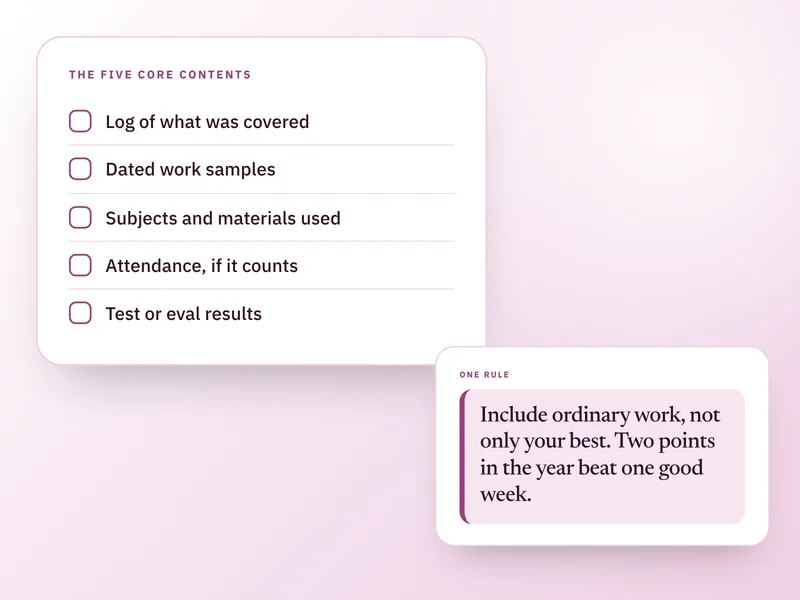
A homeschool portfolio usually holds five things: a log of what you covered, dated work samples from two or more points in the year, your curriculum list, attendance where your state counts it, and test or evaluation results where required. Build it through the year, not in April.
This is for a parent putting one together for the first time, or checking an existing one before it goes in front of an evaluator. It can't tell you your own state's exact requirement, because states differ and change: confirm what yours expects at its official source, and see homeschool requirements by state for our state-by-state summary, if you homeschool in the United States.
Example: one child's folder by October
Say your fourth grader is working through a math curriculum and a reading list you put together yourselves. By the end of October, her folder holds: two math pages showing a problem worked two different ways, a two-paragraph book report on a chapter book finished in September, a photo of a volcano model with a caption she dictated, and a running list of eleven books read or abandoned since school started. None of it is polished. That's the point: it shows a normal three months, not a highlight reel. This is an example, not a real child's file.
The core contents
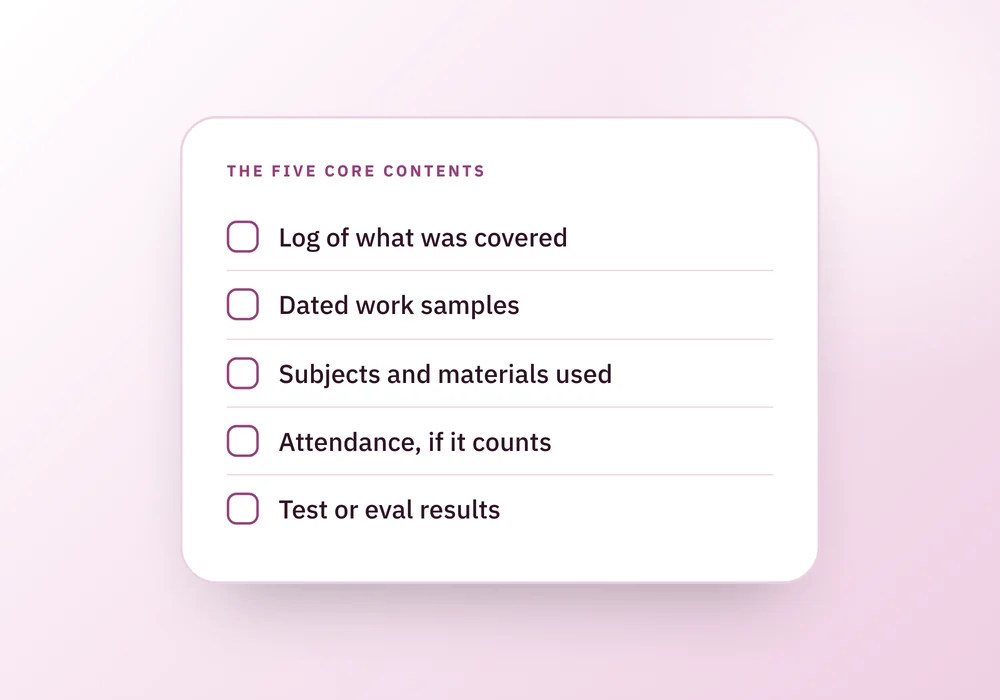
A typical portfolio holds these five things.
5 things to do
Ticks are for this visit only. Nothing here is saved anywhere.
What to keep per subject
A rough guide. Adjust to what your state and your evaluator ask for.
Math
- Worth keeping
- Worked problems showing the method, not just the answer
- How often
- A few pieces per term
Writing
- Worth keeping
- A first draft and the finished version of the same piece
- How often
- Two or three per year
Reading
- Worth keeping
- A running list of books, finished and abandoned
- How often
- Ongoing
Science
- Worth keeping
- Photos of experiments, plus what was concluded
- How often
- Per topic
History and geography
- Worth keeping
- Anything with a date and an argument in it
- How often
- Per topic
Art and practical subjects
- Worth keeping
- Photos, since the work itself rarely fits in a folder
- How often
- As produced
| Subject | Worth keeping | How often |
|---|---|---|
| Math | Worked problems showing the method, not just the answer | A few pieces per term |
| Writing | A first draft and the finished version of the same piece | Two or three per year |
| Reading | A running list of books, finished and abandoned | Ongoing |
| Science | Photos of experiments, plus what was concluded | Per topic |
| History and geography | Anything with a date and an argument in it | Per topic |
| Art and practical subjects | Photos, since the work itself rarely fits in a folder | As produced |
Which states specifically ask for a portfolio
In our summary of state requirements, a portfolio or work samples are flagged for ten jurisdictions: the District of Columbia, Florida, Louisiana, Maine, Maryland, Missouri, New Hampshire, Ohio, Pennsylvania and South Carolina. In Louisiana, Maine and Ohio, a portfolio can stand in for a test rather than sitting alongside one.
If your state isn't on that list, a light portfolio still isn't wasted effort: it's the plainest answer you have if anyone, a future school, a relative, your own memory in ten years, ever asks what the year looked like.
How much is enough
More samples are not automatically a stronger portfolio. One breakdown of portfolio contents by grade level recommends choosing a few pieces that show real growth over including everything a child produced, and calls this quality over quantity. Two or three dated pieces per subject, picked because they show a change, do more work than a folder stuffed with worksheets.
The contents shift by age
What belongs in the folder changes as your child gets older. Early elementary portfolios lean on early writing and math, ordinary spelling errors included, plus nature notes and photos. Middle school work runs to real projects and research pieces. By high school, the portfolio starts doing double duty for many families: it can support both whatever your state asks for and, later, a college application, which is one more reason to add course descriptions and outside test results as they happen rather than trying to reconstruct them senior year.
A binder or a digital folder
Either works. Pick the one you'll actually keep filling in.
- Tabbed by subject, one tab per child
- Easy to hand over exactly as it is
- Needs a shelf, not a login
- Photos and scans in dated subfolders
- Easy to duplicate or send by email
- Needs a backup you actually trust
A binder
- Tabbed by subject, one tab per child
- Easy to hand over exactly as it is
- Needs a shelf, not a login
A digital folder
- Photos and scans in dated subfolders
- Easy to duplicate or send by email
- Needs a backup you actually trust
Include ordinary work, not only the best
The instinct is to save only the pieces you're proud of. Resist it. A portfolio of nothing but finished, polished work tells an evaluator very little, and can even read as curated rather than complete.
Include something from early in the term and something from later on the same subject. Progress across the year is one of the clearest things a portfolio can show, and it disappears if every sample came from the same good week.
Keep the reading list, skip the duplicate work
A reading log belongs in the portfolio: book, when it was started, and when it was finished or set aside. The homeschool reading log covers what to write in it and why an abandoned book still belongs on the list.
Build it as you go, or it won't exist
The usual failure mode: nothing goes in the folder until spring, and then a weekend disappears into reconstructing a year from undated worksheets and memory.
A folder per child and a habit of dropping things in as they happen is enough. It doesn't need a system. It needs to take under a minute, so it survives a bad week. If yours has already gone quiet, how to catch up on homeschool records covers what's actually recoverable.
Questions people ask
What does a homeschool portfolio need to include?
Most portfolios hold five things: a log of what was covered, dated work samples from more than one point in the year, a list of curriculum and materials used, attendance or days schooled where your state counts them, and test or evaluation results where required. Exactly what counts as enough depends on your state and, often, on the specific evaluator or reviewer you use.
Do I need a portfolio if my state doesn't require one?
Not legally, but it's still worth keeping a light one. A folder with a reading list and a few samples per subject takes a few minutes a month and gives you something real if a curious relative, a future school, or your own memory ever asks what a school year actually looked like.
Should a portfolio include grades or test results?
Include test or evaluation results only where your state asks for them. Otherwise, a portfolio that shows the work itself, an early attempt next to a later one, tells an evaluator more than a grade does. Grades and letter marks are optional add-ons, not a required part of the folder.
How many work samples per subject is enough?
Two or three dated pieces per subject, chosen because they show a change over the year, count for more than a folder stuffed with every worksheet. Pick samples from more than one point in the term rather than reaching for whatever is on top of the pile in April.
Can a homeschool portfolio be digital?
Yes, for most states and most evaluators. Photos and scans in dated folders work as well as a binder, as long as you keep them backed up somewhere you actually trust and can hand over or share easily if asked.
Homeschooling Companion keeps this running as you go: tap a subject done and it's dated for you, and an occasional note stays attached to that day, yours to mark private or shareable. When you want the folder itself, Homeschooling Companion prints a My Homeschool Record page per child, covering what was done and what you noted, to go in the folder alongside your own work samples, not instead of them.
Sources and how we checked
- Homeschool Picks: Homeschool Portfolio Examples by Grade: Backs the quality-over-quantity guidance and how portfolio contents shift from early elementary to high school.Checked 26 September 2026.
- HSLDA: Recordkeeping: Backs that what to keep depends on your state's law, your child's age, and their future plans, and that high school records lean toward transcript material.Checked 26 September 2026.
- TheHomeSchoolMom: Homeschool Evaluation Instead of Testing: Backs collecting work samples from more than one point in the year rather than a single stretch.Checked 26 September 2026.
Where to go next
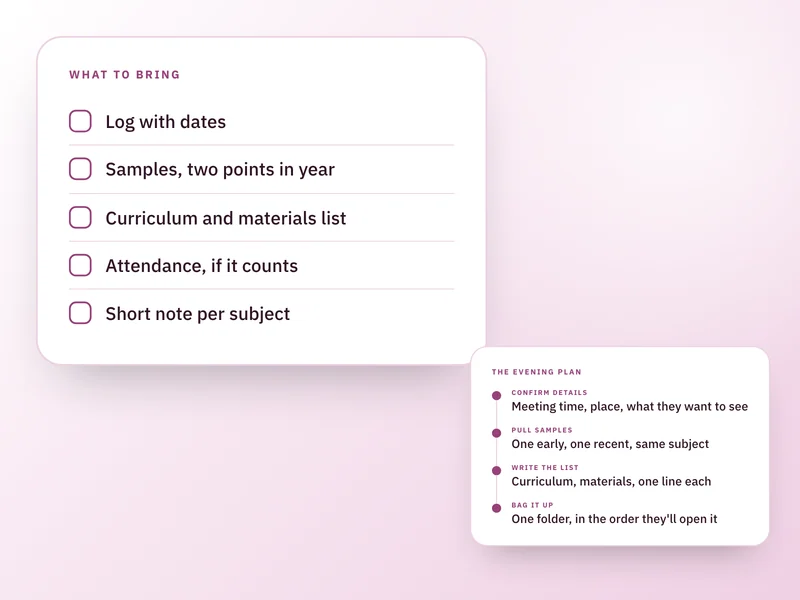 If this is where you areHomeschool evaluation: what to bring and how to prepareWhen the portfolio is going to an evaluator, this covers what to bring and how to get ready in one evening.
- Homeschool reading log: three columns, quit books included
The reading list is one of the five portfolio contents. This shows what to write in it.
- How long to keep homeschool records, and what to throw away
Wondering how long a portfolio needs to stay in the drawer? This covers what to keep, photograph or recycle.
- Homeschool requirements by state: what records to keep
Some states ask for a portfolio and some do not. This table shows which level yours falls in.