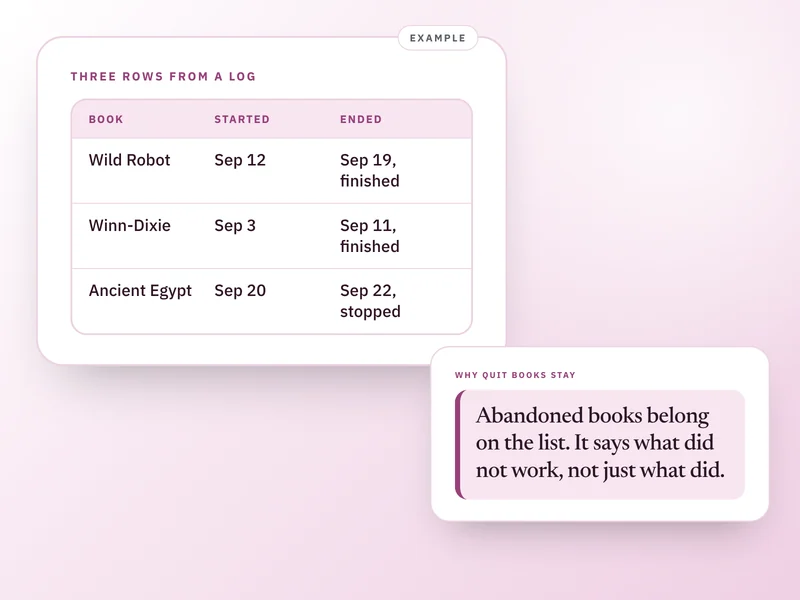
A homeschool reading log needs three columns: the book, when it was started, and when it was finished or stopped. That is the whole list.
This is for a family who wants a record of what got read, for a portfolio, for a review, or just for their own memory. It cannot tell you whether a book was understood. For that, ask a question a week after the last page, not the day it closes.
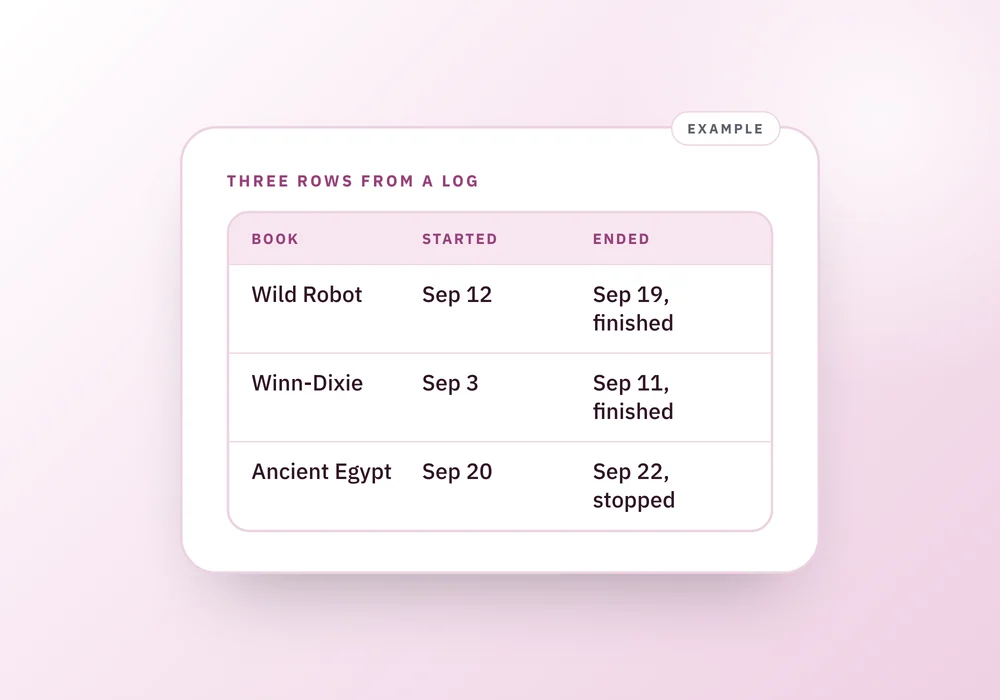
Three rows from a log (example)
Made-up dates and titles, to show the shape. Nothing here happened to a real family.
Winn-Dixie
- Started
- Sep 3
- Finished or stopped
- Sep 11, finished
Wild Robot
- Started
- Sep 12
- Finished or stopped
- Sep 19, finished
Ancient Egypt
- Started
- Sep 20
- Finished or stopped
- Sep 22, stopped
| Book | Started | Finished or stopped |
|---|---|---|
| Winn-Dixie | Sep 3 | Sep 11, finished |
| Wild Robot | Sep 12 | Sep 19, finished |
| Ancient Egypt | Sep 20 | Sep 22, stopped |
The three columns, and what goes in each
Book
- What goes in it
- Title, and the author if you feel like it
- Why it is there
- Enough to find it again or tell someone what your child read
Started
- What goes in it
- A date, roughly is fine
- Why it is there
- Shows the reading happened over days, not all at once
Finished or stopped
- What goes in it
- A date, and one of those two words
- Why it is there
- The plain ending. Not every book gets finished, and that is fine to write down
| Column | What goes in it | Why it is there |
|---|---|---|
| Book | Title, and the author if you feel like it | Enough to find it again or tell someone what your child read |
| Started | A date, roughly is fine | Shows the reading happened over days, not all at once |
| Finished or stopped | A date, and one of those two words | The plain ending. Not every book gets finished, and that is fine to write down |
Quit books belong on the list
Leave abandoned books on the log instead of leaving them off it. Teacher and reading researcher Pernille Ripp keeps a two-part log with her students for this exact reason, one section for books finished and one for books abandoned, because what a reader chose to put down says as much about them as what they finished. A log with only finished titles tells a slightly false story: it hides the false starts that are a normal part of a child working out what they actually like.
Write the word "stopped" in the last column and move on. No explanation is required unless your child wants to give one.
Let your child fill it in once they can write
Once a child can write, handing them the log turns it into ten seconds of handwriting practice instead of one more thing on your list. They write the title, the date, and the last word themselves. Read them what goes where a few times, then step back.
Below writing age, ask what they read, or what you read together, and write it down yourself. A read-aloud counts. So does an audiobook and a library book that never got renewed.
What can go wrong
A log built to impress someone gets abandoned fastest. A column for a rating or a grade turns a ten-second entry into a decision your child has to weigh, and it adds a judgment where none is needed: the finished-or-stopped column already carries the plain information, either the book held attention to the end or it did not.
Pages read or minutes spent do not need a column either, unless a specific evaluator has asked for one. The log answers what your child read, not how much, and a growing list across a school year makes the case for volume on its own.
Questions people ask
Should I log audiobooks and books we read together?
Yes. Write them the same way: title, when you started, when you finished or stopped. Audiobooks and read-alouds are still reading, and a log that only counts books read alone leaves out most of what happens with a younger reader.
Do I need to write down how many pages or minutes my child read?
No, unless a specific evaluator has asked for it. The three columns already show that reading happened regularly and over time. Adding pages or minutes turns a ten-second entry into a longer one, for information almost no one reading the log later will ask about.
How do I include a book my child gave up on?
Write "stopped" and the date in the last column, the same as you would "finished." No reason is needed on the page. Leaving abandoned books off the list hides real information about what did not work for your reader, which is worth more than a perfect completion rate.
How does a reading log fit into a homeschool portfolio?
It is one of the easiest pieces to include, since it shows breadth without extra work at portfolio time. Add the finished list, or the whole log if your evaluator wants started dates too, and check with whoever is reviewing it about what they actually want to see. See what actually goes in a homeschool portfolio for the rest of it.
Should the reading log include a rating for each book?
We would leave it off. A rating adds a judgment call to a fast entry, and the finished-or-stopped column already says the plain thing: the book held attention to the end or it did not. If your child wants to rate books for their own reasons, keep that separate from the log.
What Homeschooling Companion does with reading
Homeschooling Companion has no separate reading log screen, and that is worth knowing before you build a habit around one. Reading works the way every other subject does: tap it done on Today, and answer Easy, About right or Difficult if it is worth saying. For the book title itself, use "Note something" on the Record tab, dated the day you write it, and choose whether that note appears on the printed record or stays private. It will not keep a running, searchable list of titles on its own; a notebook, a spreadsheet, or the table above is the more reliable way to hold that list. See it at Homeschooling Companion.
Sources and how we checked
- Pernille Ripp, How We Can Help Our Book Abandoners: Backs logging abandoned books separately from finished ones, and treating abandonment as useful information rather than a failure.Checked 26 September 2026.
- Treehouse Schoolhouse, 5 Favorite Ideas for Using Reading Logs: Example of a typical reading log format (date, title, author, rating), used to contrast with this guide's position of skipping a rating column.Checked 26 September 2026.
Where to go next
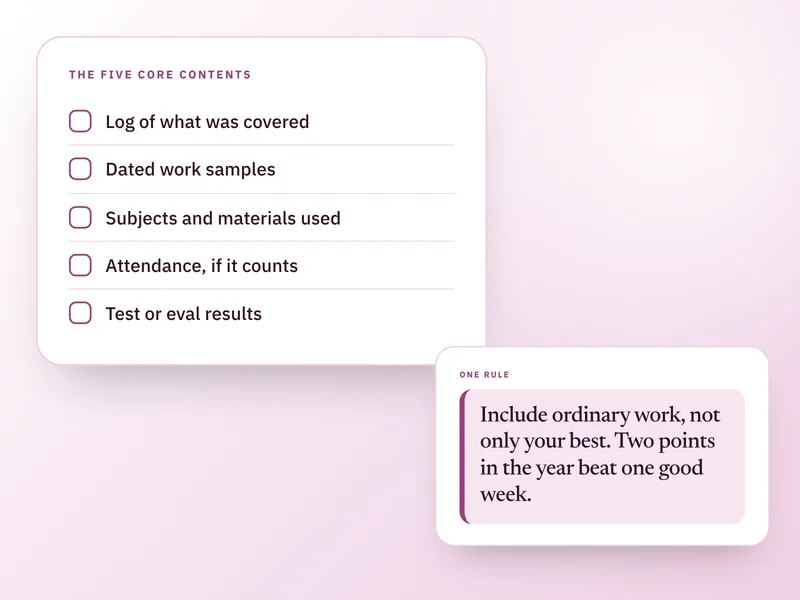 If this is where you areWhat to include in a homeschool portfolio, by subjectTo turn the list into portfolio evidence, this covers the contents and what to keep per subject.
- Homeschool record keeping template: three columns to copy
Books are one column of the wider record. Here are four columns for the daily entries.
- How to tell if your homeschooler actually learned it
A book list invites the next question. This gives four ways to check what your child kept.
- Homeschool subject not working? What to change first
Reading stalled? This gives the cheapest-first order for changing a subject that is not working.