You covered fractions in October. It's March, and you can't say for sure whether it stuck. That not-knowing is normal and doesn't mean you did anything wrong: covering material and keeping it are two different things, and homeschooling puts you in charge of checking both.
This is for a parent who wants a quick, plain read on whether something landed, not a formal assessment. It won't tell you a grade level or whether your child is ahead of or behind anyone else, and it isn't a stand-in for whatever your own state asks you to show, if you homeschool in the United States (see preparing for a homeschool evaluation).
An example: checking fractions in March
Say you taught equivalent fractions in October and haven't touched the topic since. Over breakfast in March, you ask four questions: What is one half the same as, written a different way? If you have three sixths, what's the simplest way to write that? Draw two fractions that look different but are equal. Why does multiplying the top and bottom of a fraction by the same number not change its value?
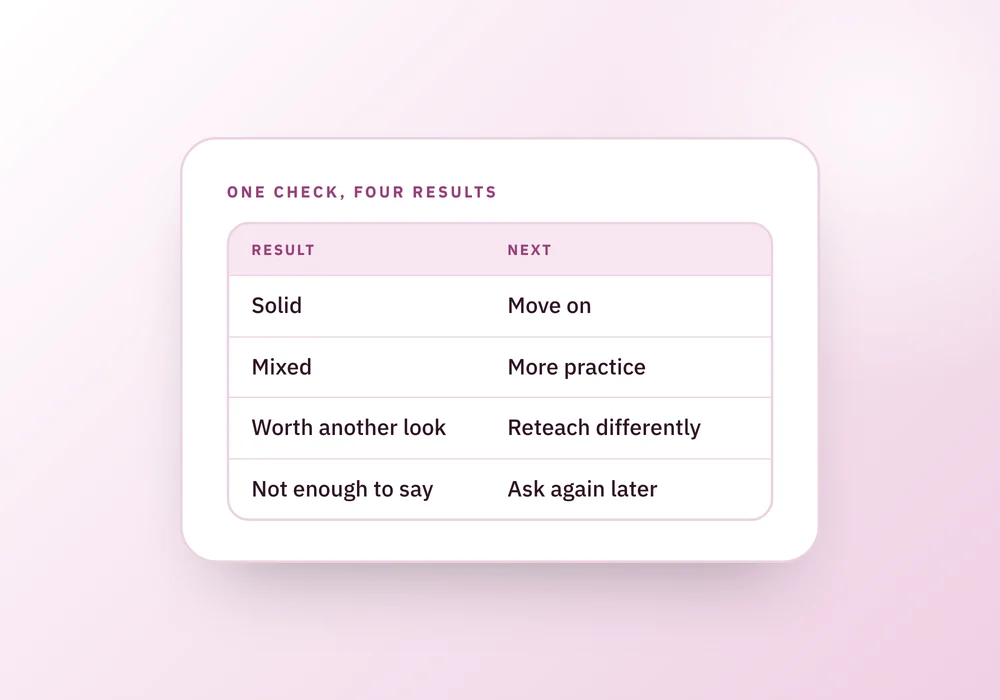
Two answers come fast and correct. One is close but the reasoning wobbles. One draws a blank. That's three of four answered, with a mixed result: worth going back over the why question, fine to move on from the rest.
Five ways to check it landed
- Ask them to teach it back to you. If they can explain a step to a stuffed animal or a younger sibling, they understand it. If they can only repeat a memorized line, they don't yet.
- Have them narrate what they just read or did, in their own words, without looking. A summary that includes why something happened, not just what happened, is the stronger sign.
- Ask a few oral questions that mix recall and reasoning. "What's 6 times 7" checks recall. "Why does that work" checks understanding.
- Do a short spot check from the workbook itself: cover the answer, have them solve it again a different way than the book showed.
- Ask for a two-minute demonstration: build it, draw it, or show the step on paper. Watching them do it catches things a spoken answer hides.
Asking by age
Early elementary
- Ask for
- A quick retelling or a demonstration
- A strong answer sounds like
- Two or three sentences, or showing you rather than telling you
Upper elementary
- Ask for
- One explain-it question per topic
- A strong answer sounds like
- Reasoning in their own words, not only the answer
Middle grades
- Ask for
- A mix of recall and one why question
- A strong answer sounds like
- They can defend the answer when you push back a little
High school
- Ask for
- A short explanation or a worked example on paper
- A strong answer sounds like
- They can teach the step to someone younger
| Age | Ask for | A strong answer sounds like |
|---|---|---|
| Early elementary | A quick retelling or a demonstration | Two or three sentences, or showing you rather than telling you |
| Upper elementary | One explain-it question per topic | Reasoning in their own words, not only the answer |
| Middle grades | A mix of recall and one why question | They can defend the answer when you push back a little |
| High school | A short explanation or a worked example on paper | They can teach the step to someone younger |
Four results, not two
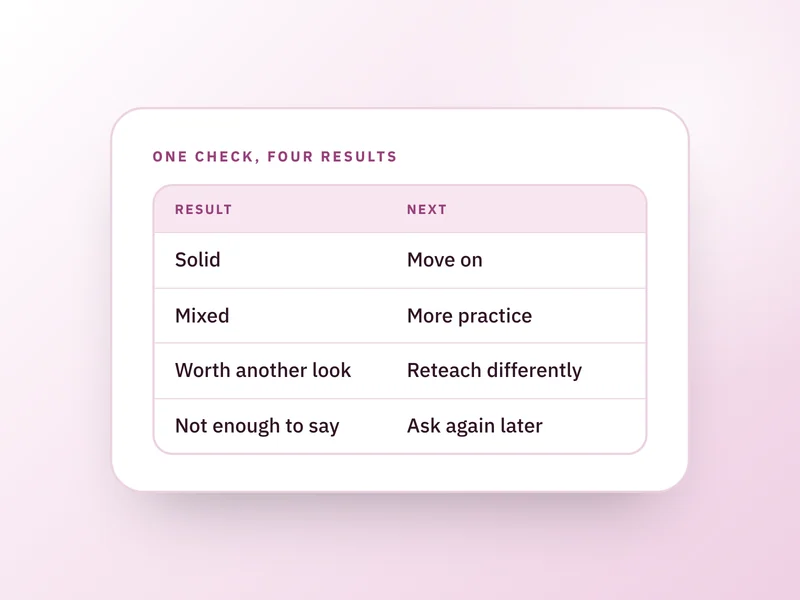
There's a middle ground between knows it and doesn't, and a fourth option worth naming plainly: not enough to tell.
Solid
- What it looks like
- Right answers, with reasoning attached, not just the number
- What to do next
- Move on. Revisit it only if it comes up again on its own.
Mixed
- What it looks like
- Some right, some shaky reasoning
- What to do next
- More practice on the same material, not a new lesson yet.
Worth another look
- What it looks like
- Mostly wrong or guessed
- What to do next
- Reteach it, but change the approach before repeating it word for word.
Not enough to say
- What it looks like
- Too few questions answered to conclude anything
- What to do next
- Ask again, differently, another day. It isn't a fail, it's a small sample.
| Result | What it looks like | What to do next |
|---|---|---|
| Solid | Right answers, with reasoning attached, not just the number | Move on. Revisit it only if it comes up again on its own. |
| Mixed | Some right, some shaky reasoning | More practice on the same material, not a new lesson yet. |
| Worth another look | Mostly wrong or guessed | Reteach it, but change the approach before repeating it word for word. |
| Not enough to say | Too few questions answered to conclude anything | Ask again, differently, another day. It isn't a fail, it's a small sample. |
What throws off a check
- Asking right after the lesson. That measures short-term recall, which is almost always good and tells you very little about what will still be there in March.
- Asking one question. One right answer could be luck, and one wrong answer could be a bad morning. Four is closer to a real read.
- Turning three answers into a percentage. Three of four right isn't seventy-five percent understanding, it's a sample too small to grade at all.
- Making it feel like a test. A tense kid gives you tense answers, not their actual understanding.
- Grading the delivery instead of the reasoning. A shaky voice or a long pause isn't a gap; a wrong reason for a right answer is.
Questions people ask
How do I know if my homeschooler is actually learning?
Ask a small number of questions, weeks after you covered the material, not right after the lesson. Mix recall with at least one question that makes them explain their reasoning, and write down what came back. If the answers hold up weeks later, it landed.
What is narration, and does it work for checking understanding?
Narration means having your child tell back what they just read or did, in their own words, without prompts. It works because a child who only memorized a line can't reorganize it into their own sentences, while a child who understood it usually can.
How many questions should I ask to check understanding?
Four on one topic is about the fewest that tells you anything real. Fewer than that, and one lucky guess or one bad morning skews the whole result. You don't need many more; a handful of good questions beats a long quiz.
Is it a problem if my child can't answer any questions?
Not on its own. A blank morning happens for reasons that have nothing to do with understanding: tiredness, an off day, a question that's oddly worded. Ask again, a different way, on a different day, before you decide anything has actually changed.
Should I check understanding right after a lesson or later?
Later. Checking straight after teaching mostly measures short-term recall, and short-term recall is almost always good. A check a week or more later tells you what actually stayed, which is the question you're really asking.
Where a Companion fits
Homeschooling Companion runs a version of this check inside the app. You choose or write the questions per topic, mark each one right, not right or skipped as your child answers, and it reports one of the same four results above, including not enough to say when too few were answered. It never turns the result into a percentage or a grade, and it never compares your child to anyone else. It keeps the standing against the topic, so if the same result turns up twice, it tells you that too.
Sources and how we checked
- 8 Ways to Assess (and Document) Your Child's Learning (Sonlight): Backs the named non-test techniques (narration, projects, spot checks) as ways to check what a homeschooled child has learned.Checked 26 September 2026.
- Narration: Evaluating Your Homeschooled Student's Learning (Triumphant Learning): Backs narration, telling back what was read or done in the child's own words, as a way to reveal whether understanding is present.Checked 26 September 2026.
Where to go next
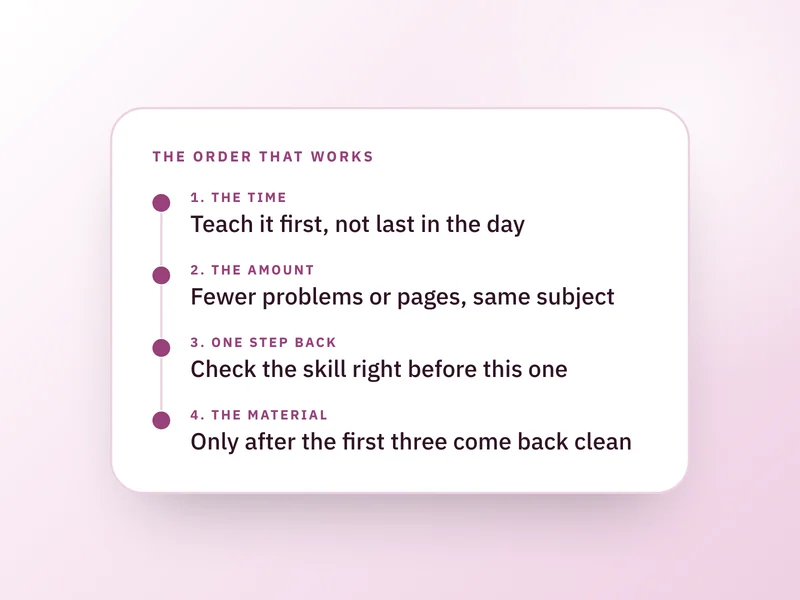 If this is where you areHomeschool subject not working? What to change firstIf the check shows something did not stick, this gives the cheapest-first order for changing a stalled subject.
- Homeschool reading log: three columns, quit books included
A reading log gives you something to ask about later. This shows the three columns and why quit books stay on it.
- What to include in a homeschool portfolio, by subject
Write-ups of what your child can do belong in a portfolio. This covers what to keep for each subject.
- Homeschool weekly schedule with a spare day built in
Checks a week later need slack in the schedule. This weekly plan leaves a spare day on purpose.