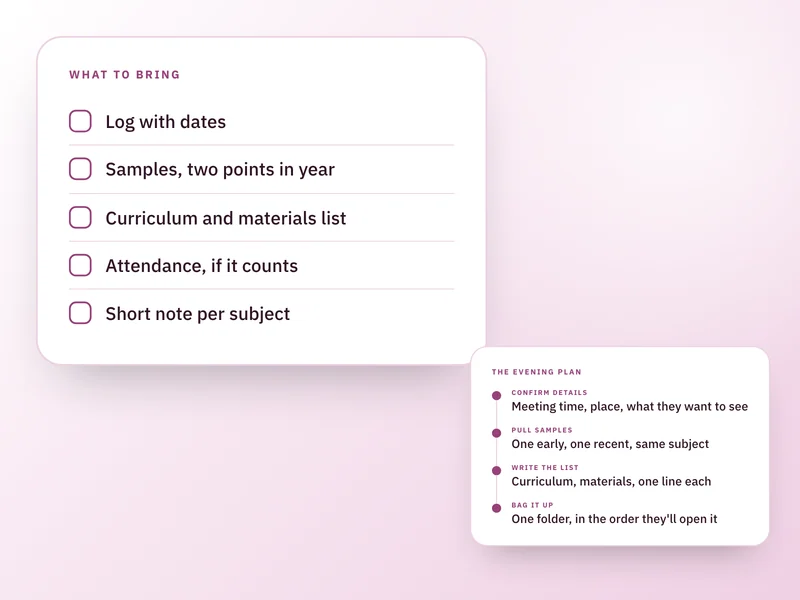
A homeschool evaluation is usually a review, not a test: someone confirms that real learning happened across the year and, in most cases, writes a short letter saying so. Bring a folder with your log, dated work samples from more than one point in the year, your subject and curriculum list, and anything else your own evaluator specifically asks for.
This is for a parent with an evaluation, review or portfolio check coming up, not a fixed legal checklist. It can't tell you what your own evaluator or state wants: ask them directly, and see homeschool requirements by state for our state-by-state summary, if you homeschool in the United States.
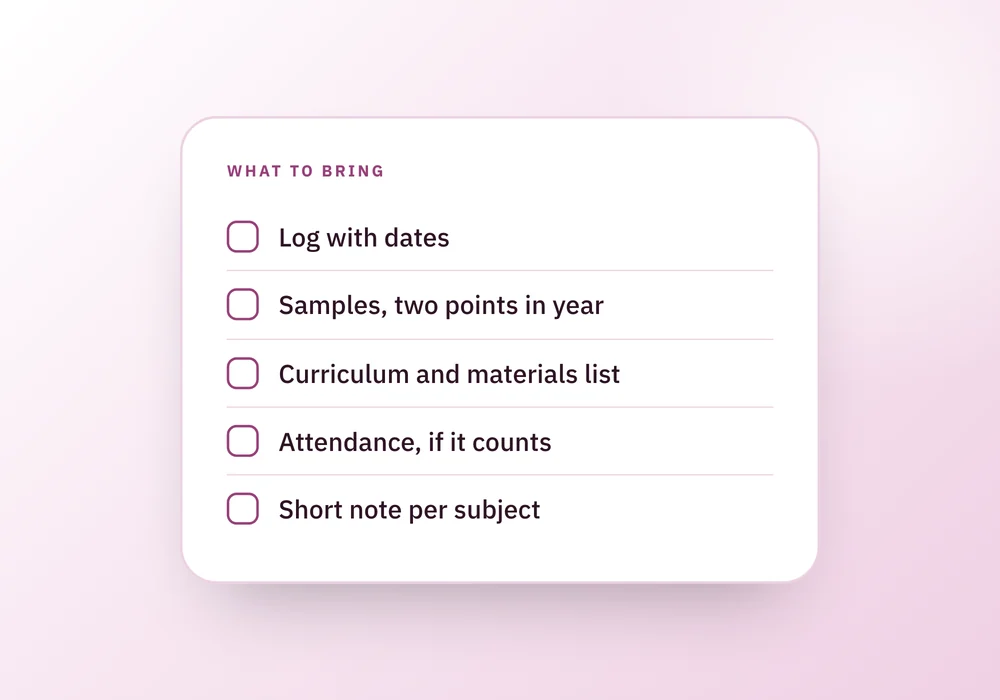
Example: one folder, ready the night before
This is an example folder, not a real family's records.
The log
- What's in it
- Sep 3 to May 20, dated by week, math and reading noted separately
Work samples
- What's in it
- A September math page and a May math page, same kind of problem
Reading list
- What's in it
- Fourteen books, two marked as stopped partway
Curriculum list
- What's in it
- A math curriculum, a library-built reading list, a co-op science class
A short note per subject
- What's in it
- Math: struggled with fractions until January, steady since
| In the folder | What's in it |
|---|---|
| The log | Sep 3 to May 20, dated by week, math and reading noted separately |
| Work samples | A September math page and a May math page, same kind of problem |
| Reading list | Fourteen books, two marked as stopped partway |
| Curriculum list | A math curriculum, a library-built reading list, a co-op science class |
| A short note per subject | Math: struggled with fractions until January, steady since |
One evening, in order
This assumes you already have work sitting around the house. If you're rebuilding months of records first, see how to catch up below.
First 15 minutes
Confirm with your evaluator: meeting time, location, and anything specific they want to see.
Next 20 minutes
Pull one dated work sample per subject from early in the year and one from recently.
Next 15 minutes
Write a subject and curriculum list, one line each.
Next 15 minutes
Add a short note per subject: what changed, what was hard, what you'd do differently.
Last 10 minutes
Put it all in one folder, in the order your evaluator will likely go through it.
What to bring
6 things to do
Ticks are for this visit only. Nothing here is saved anywhere.
Show progress, not just a pile of finished work
One of the clearest things a folder can show is the same subject at two points in the year. A September math page next to a May one can say more than a stack of finished worksheets from one good week, and it's the thing most people accidentally leave out by only keeping what they were proud of.
Say what didn't go well
Saying that math was difficult until January, that you changed curriculum, and that it improved afterward is a stronger position than implying everything went smoothly. It shows you were paying attention and adjusting, which is closer to what an evaluator is actually checking for than a folder with no rough patches in it.
If your records have a gap
Reconstruct without inventing precision. Mark approximate dates as approximate, October to December rather than a specific day you can't verify. A clearly reconstructed stretch is a normal thing to hand over. The full method is in how to catch up on homeschool records.
Check what your evaluator and your state actually ask for
Requirements differ a lot, and preparing for a stricter standard than yours wastes an evening. See homeschool requirements by state for the level yours falls in, then ask your own evaluator what they specifically want to see, since that can be narrower or wider than the state minimum.
When a general folder isn't what they want
Some evaluators or states ask for something specific this general list doesn't cover: a particular test, a set number of hours logged, or a form in their own format. A folder built from this guide won't satisfy that on its own, which is why confirming with your own evaluator before you assemble everything, not after, saves the most time.
If your evaluator asks for something you don't have, an hours log you never kept, say so plainly rather than estimating a number. A stated gap is easier for most evaluators to work with than a figure that turns out to be wrong.
Questions people ask
What does a homeschool evaluator actually look for?
Evidence that real learning happened across the year: a dated log, work samples from more than one point in the year, and a sense of what your child covered and how they grew. Most evaluators then write a short letter describing that progress, which you submit wherever your state asks for it. Ask your own evaluator what else they specifically want, since expectations vary.
Is a homeschool evaluation the same as a test?
Usually not. A review or evaluation is typically a conversation and a look through your child's folder, not a timed test with a pass-or-fail outcome. Some states offer a standardized test as an alternative path instead of a review, so check which one applies to you and confirm it with your state.
How far in advance should I prepare for a homeschool evaluation?
The strongest preparation happens through the year, a few minutes at a time. If you're starting from nothing, most of a basic folder, a log, a few samples, a curriculum list, can be pulled together in one evening. It takes longer if you're reconstructing months of records rather than gathering what's already in a drawer.
What if my child had a rough year?
Bring it anyway, with a short plain note about what changed. A folder that shows a hard stretch and an adjustment reads as more credible than one that implies nothing was ever difficult, and it's closer to what most evaluators are actually trying to confirm.
Homeschooling Companion prints a My Homeschool Record page per child covering what was done, when, and what you noted, which gives an evaluator something to read alongside your own work samples. Entries are always dated the day you make them, and its short checks report one of four plain outcomes, including not enough to say, rather than a percentage you'd then have to explain. See it on the Homeschooling Companion page.
Sources and how we checked
- TheHomeSchoolMom: Homeschool Evaluation Instead of Testing: Backs the evaluator process described: work samples from more than one point in the year, a booklist, and a letter the evaluator writes describing progress.Checked 26 September 2026.
- Coalition for Responsible Home Education: Homeschool Record Keeping: Backs that some states offer a portfolio review by a certified teacher or a narrative assessment as an alternative to a standardized test.Checked 26 September 2026.
- HSLDA: Recordkeeping: Backs that what an evaluation actually requires depends on your own state's law, not one fixed national process.Checked 26 September 2026.
Where to go next
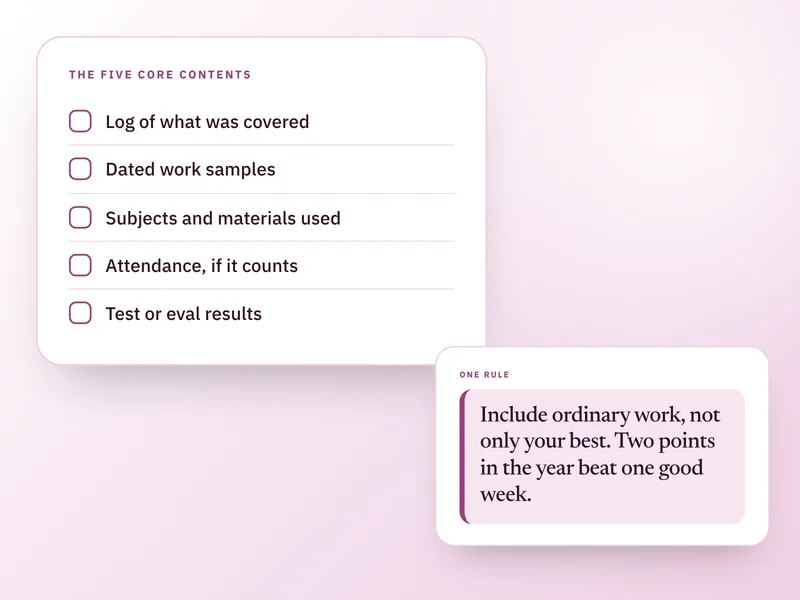 If this is where you areWhat to include in a homeschool portfolio, by subjectMost of the folder is the portfolio. This covers the five contents and why October and March samples work.
- How to catch up on homeschool records you did not keep
Behind on records with a review coming? This shows what you can rebuild and how to mark it as reconstructed.
- How long to keep homeschool records, and what to throw away
After the meeting, decide what stays in the folder. This covers how long to keep records and what to recycle.
- Homeschool attendance records: what counts as a school day
Evaluators often ask about days. This shows what counts as a school day and the lightest record.