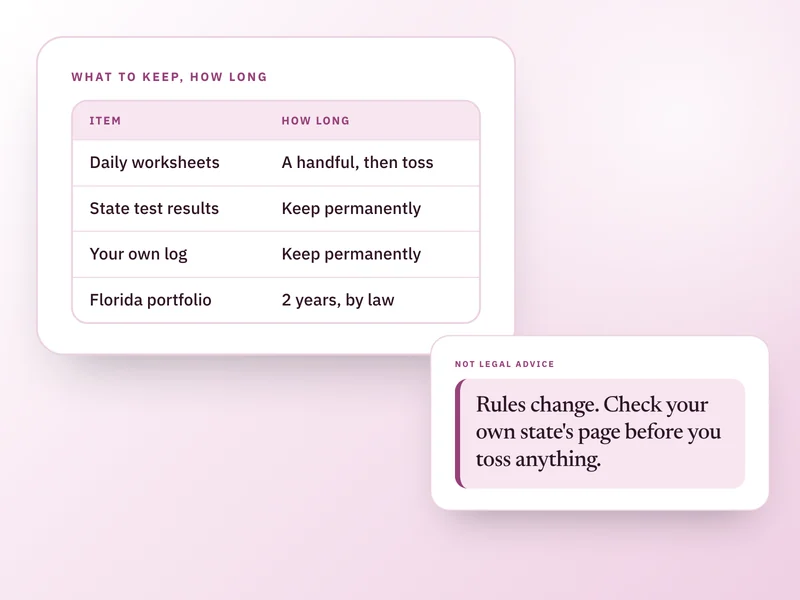
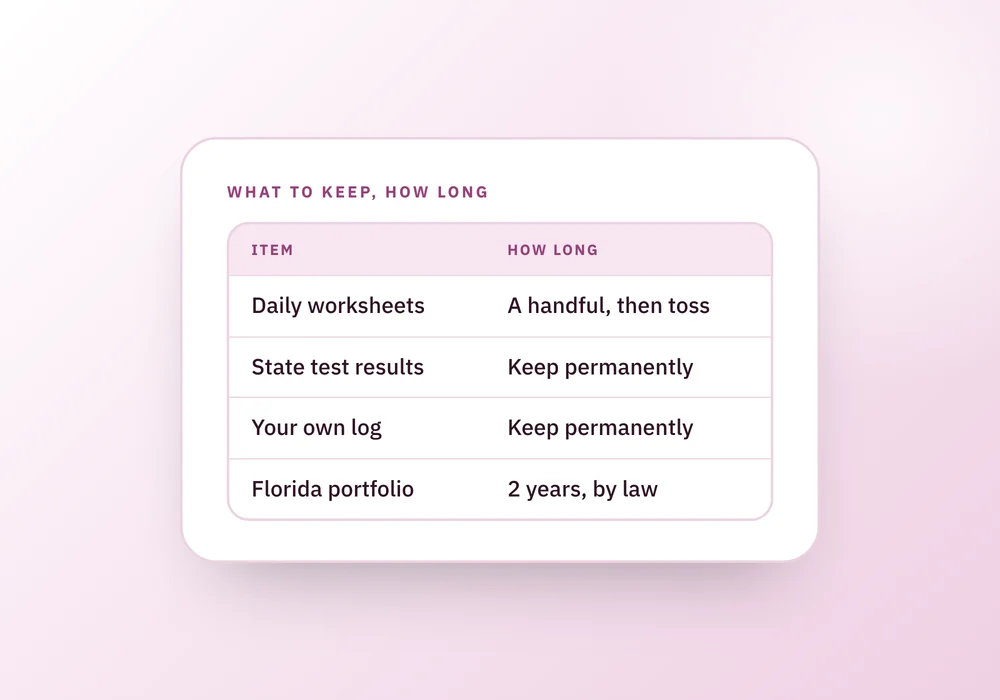
For most homeschool paperwork, a rolling window works: this year's samples plus the two years before them. A shorter list goes in the keep-forever pile instead: any state-required test or evaluation result, any letter to or from a school official, and your own log. Florida sets an actual number in law: two years for a portfolio.
This is for a homeschooling parent in the United States staring at a stack of paper and wondering what has to stay. It can't tell you your own state's exact number, and it isn't legal advice: check your state's own page before you recycle anything a rule might cover.
An example: a third-grade stack in June
Say it's June and you're holding a banker's box from third grade: forty worksheets, two photos of a baking-soda volcano, a spelling test with a mark on it, and the notebook you used as a log all year. You don't need all forty worksheets. You need a handful that show progress, the photos (the volcano itself already went in the recycling), the test if your state asked for one, and the log, which stays no matter what your state requires.
What to keep, and for how long
A representative sample of daily work
- How long
- 2 to 3 years
- Why
- HSLDA's rule of thumb: this year plus the two before it
A state-required test or evaluation result
- How long
- Permanently
- Why
- HSLDA recommends keeping these for good; a state can ask about an earlier year
Any letter to or from a school official
- How long
- Permanently
- Why
- It's your proof of what was filed and when
Your own log of what you did
- How long
- Permanently
- Why
- It's the record that ties every other paper to a date
Large projects, models, science builds
- How long
- Photograph, then let go
- Why
- A dated photo proves what happened; the object doesn't have to survive to March
Curriculum you're finished with
- How long
- Sell, donate, or recycle
- Why
- Another family may want it, and it isn't part of any record
| Item | How long | Why |
|---|---|---|
| A representative sample of daily work | 2 to 3 years | HSLDA's rule of thumb: this year plus the two before it |
| A state-required test or evaluation result | Permanently | HSLDA recommends keeping these for good; a state can ask about an earlier year |
| Any letter to or from a school official | Permanently | It's your proof of what was filed and when |
| Your own log of what you did | Permanently | It's the record that ties every other paper to a date |
| Large projects, models, science builds | Photograph, then let go | A dated photo proves what happened; the object doesn't have to survive to March |
| Curriculum you're finished with | Sell, donate, or recycle | Another family may want it, and it isn't part of any record |
Check your own state's number
Florida puts an actual figure on it: the portfolio has to be preserved by the parent for two years, and made available to the district school superintendent on fifteen days' written notice. That isn't a suggestion. It's written into the statute.
Most other states either list required items with no stated retention period, or ask for nothing to be filed at all. Our record keeping requirements by state summarizes what each state's page says today, and it says plainly that it's a summary, not a citation. Confirm anything you're relying on at your own state's source.
Where this goes wrong
The most common mistake isn't throwing too much away. It's keeping one pile that does two jobs at once: the record a state or evaluator might ask to see, and the box holding the first story they wrote and the drawing that made you laugh. Mix them and neither job gets done well. The sentimental pile gets thinned because it looks like clutter, and the compliance pile gets so full nobody can find the one report that actually counts.
A second mistake: keeping the object instead of photographing it. A poster board or a diorama takes up a shelf and proves nothing by itself. A dated photo, filed with that year's samples, proves exactly as much and takes no room.
A third: moving states mid-year and treating the move as a clean break. Keep everything from the transition year longer than you otherwise would. A new state's page, or the district that reviews your file, may ask how the year started, not just where it ended up.
Rules also change under you. New Hampshire required a portfolio, kept two years, for years. A law that took effect in mid-2026 removed that requirement along with the annual evaluation and the notification. A summary written even a few months earlier would have been wrong. Check your own state's current page, even for a rule you're sure you already know.
Questions people ask
How long should I keep homeschool records after graduation?
Keep high school transcripts, course lists, standardized test results and immunization records permanently. Colleges, employers and licensing boards can ask for them years later, and there's no state process to replace a lost one. Earlier grades can follow the shorter rolling window; high school is the stretch worth treating as forever.
Can I throw away completed workbooks?
Yes, once you've pulled a handful of representative pages. A page from early in the year and one from later shows more progress than the whole book, and it takes a fraction of the space. Keep the ones with a date on them if the workbook itself doesn't have one printed.
What if my state doesn't require a portfolio at all?
Some states list nothing to keep. That doesn't mean nothing is worth keeping: a light record still helps if you move to a state that does ask, if an evaluation ever comes up, or if you just want to remember what a school year looked like. HSLDA's rolling window is a reasonable default even where nothing is required.
Do I need to keep every standardized test result?
Keep the ones a state actually required, and keep those permanently. A test you took out of curiosity, with no state requirement behind it, can follow the shorter general window instead.
What should I photograph instead of keep?
Anything three-dimensional or too large to file: models, posters, science builds, art projects. Take a dated photo, add a line about what it was for, and file the photo with that year's samples. The object can go once the photo exists.
Homeschooling Companion keeps the one piece of paper on that list you can't reconstruct from memory: the log. Every subject you record is dated the day you record it, and the record prints per child, covering what was done and when, for up to the most recent 400 entries in your account. It doesn't store your test results, photos or projects, and it isn't an archive. What it gives you is the dated log to keep alongside whatever paper you decide to hold on to.
Sources and how we checked
- HSLDA: Types of Homeschool Records: Rolling three-year window for general work samples; permanent retention recommended for state-required test/evaluation results and correspondence with school officials.Checked 26 September 2026.
- HSLDA: The Essentials of High School Recordkeeping: Permanent retention recommended for report cards, transcripts, standardized test results, college entrance test results and immunization records.Checked 26 September 2026.
- Florida Statutes § 1002.41: Portfolio must be preserved by the parent for 2 years and made available to the district school superintendent on 15 days' written notice.Checked 26 September 2026.
- HSLDA: New Hampshire's HB 1268: New Hampshire's 2026 Home Education Freedom Act eliminated the state's former portfolio, notification and annual evaluation requirements.Checked 26 September 2026.
Where to go next
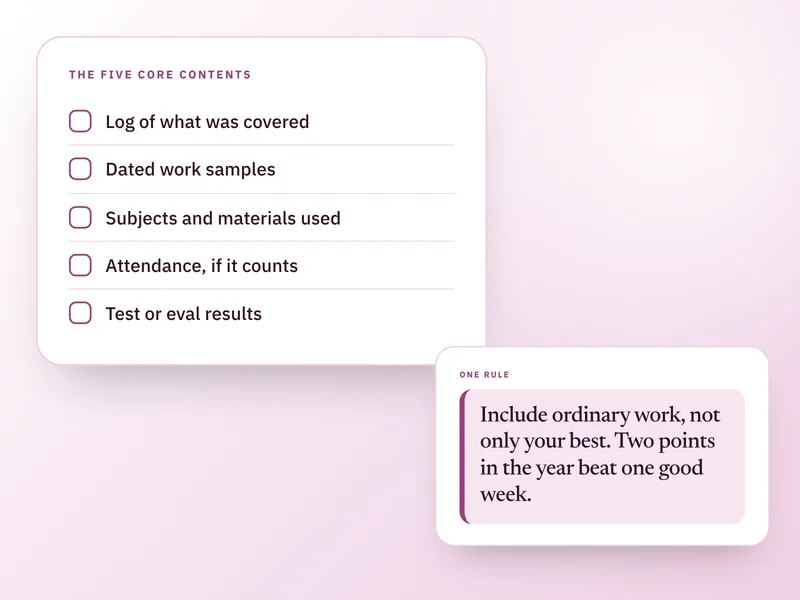 If this is where you areWhat to include in a homeschool portfolio, by subjectTo know what belongs in the keep pile first, see the five portfolio contents and per-subject samples.
- Homeschool evaluation: what to bring and how to prepare
If an evaluator may ask to see last year's work, this covers what to bring.
- How to catch up on homeschool records you did not keep
Threw something out too soon, or never kept it? This shows how to reconstruct the record.
- Homeschool requirements by state: what records to keep
Retention depends on your state. Look up your level in this table and confirm at the source.