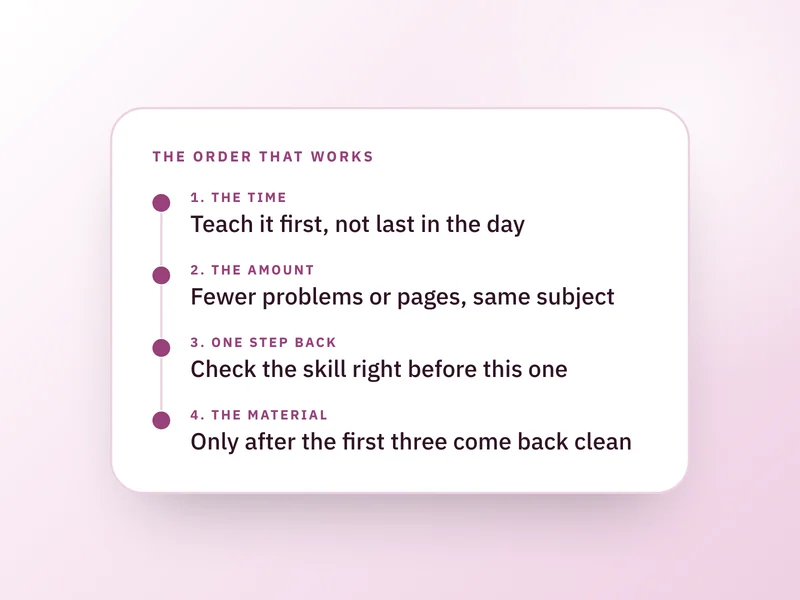
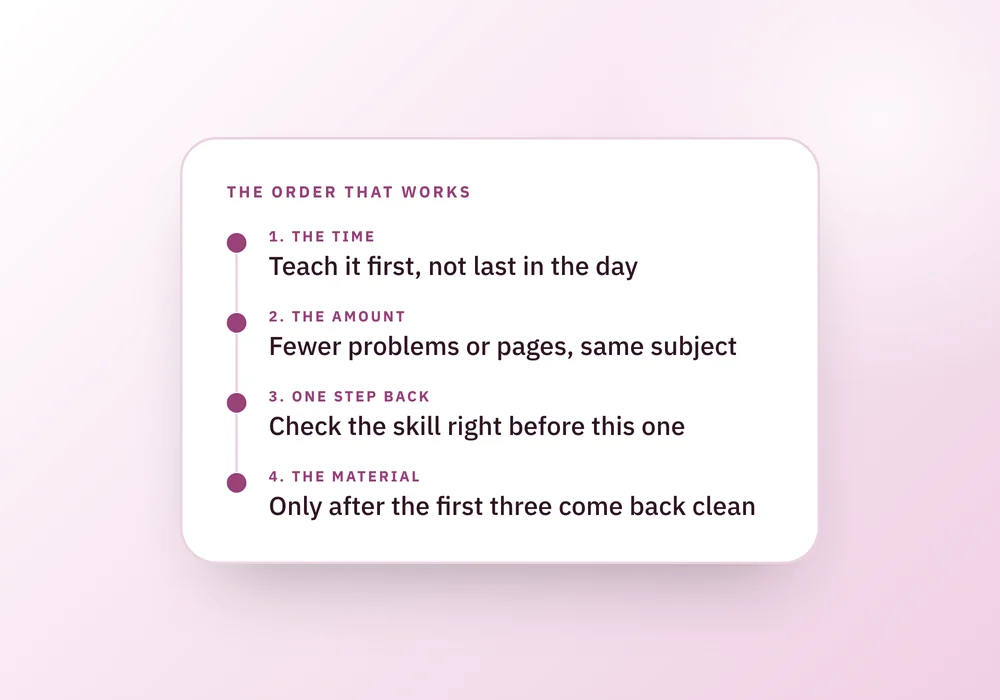
When a subject stops working, change it in this order: the time of day first, then how much you're asking for, then the step just before the one that's stuck. Look at new material last. It's the cheapest change, and the one most likely to fix an ordinary rough patch.
This order works for any subject, whether it's long division, reading comprehension or spelling, and for a child of six or sixteen. If you're not sure it's really not working, checking what actually stuck a week later beats guessing from one hard afternoon. It can't tell you whether something more than a rough patch is going on: if two or three weeks of really trying this changes nothing, that's a reason to ask someone else, not a reason to try harder alone.
An example: division, four sessions in a row
Say long division has gone from fine to a fight: three of the last four sessions ended in frustration, on the same kind of problem each time. Move it to the first thing you teach that day instead of the last, before either of you is worn down. A weekly plan with a spare day already built in makes that easier to do without reshuffling everything else. If that changes nothing in a week, cut the amount: five problems instead of fifteen for the next week. Still stuck? Check the step behind it. In the Companion's own topic list, Division sits right before Long division, and Multiplication sits before that, so that's where to look first. Only after the time, the amount and that step have all come back clean do you have a real reason to think the material itself is the problem.
The same order, three subjects
Illustrative examples. Swap in your own subject and numbers.
1. Change the time
- Long division
- Teach it first, not last
- Reading comprehension
- Read together earlier, before energy drops
- Spelling
- Five minutes right after breakfast
2. Change the amount
- Long division
- 5 problems instead of 15
- Reading comprehension
- One chapter instead of three
- Spelling
- 5 words instead of 15, for a week
3. Go back one step
- Long division
- Check division, then multiplication facts
- Reading comprehension
- Check vocabulary: can they explain the hard words first
- Spelling
- Check letter sounds out loud, no writing
4. Look at the material
- Long division
- Try a different explanation of the same method
- Reading comprehension
- Try a shorter or easier book on the same topic
- Spelling
- Build a list from words they actually misspell
| Step | Long division | Reading comprehension | Spelling |
|---|---|---|---|
| 1. Change the time | Teach it first, not last | Read together earlier, before energy drops | Five minutes right after breakfast |
| 2. Change the amount | 5 problems instead of 15 | One chapter instead of three | 5 words instead of 15, for a week |
| 3. Go back one step | Check division, then multiplication facts | Check vocabulary: can they explain the hard words first | Check letter sounds out loud, no writing |
| 4. Look at the material | Try a different explanation of the same method | Try a shorter or easier book on the same topic | Build a list from words they actually misspell |
Cutting minutes inside a day is the amount step above. If a subject needs more room than that, cutting a day out of the week is the next lever: see how a four-day week spreads subjects across the days you actually teach. For a comprehension pattern like the one in the table, a reading log makes it easier to see which books are landing and which keep getting abandoned partway through.
When this order doesn't fix it
- You changed two things at once. You won't know which one worked, so change one, give it a real week, then move to the next.
- You judged it after one session. One hard day is noise. A pattern across two or three weeks is a signal.
- You skipped straight to new material. That's the expensive change. It's still worth trying last, not first, even when it turns out to be the right call eventually.
- You went back a step but decided too fast. Wait a week, then run a short check on that one topic before deciding it's solid or not.
- The trouble doesn't move no matter what changes. That's worth a conversation with your pediatrician, a tutor or an evaluator, not a longer version of this list.
Where the Companion fits
Homeschooling Companion tracks the first two steps for you without extra work: mark a session difficult on Today, and it comes back later under "Worth going over again," with the reason "Last time you said this was difficult" attached, so you're not relying on memory for which session went badly.
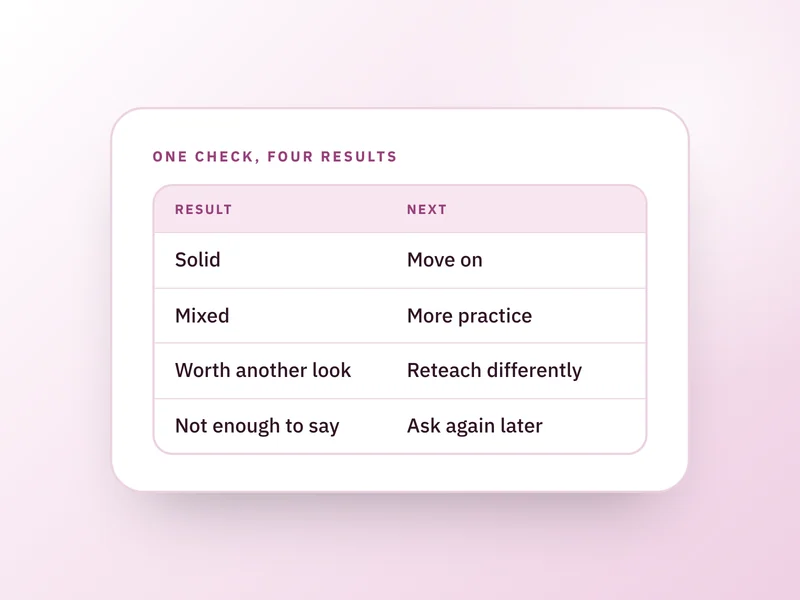
For the "go back one step" step, tick the exact topic on your child's page, write four or more questions from your own head or your curriculum's test, and mark each answer yourself. The result says a topic looked solid, was mixed, is worth another look, or that there wasn't enough to say yet. It doesn't pick the order for you and it doesn't tell you what's wrong. It only holds what came back, so you can look at the pattern instead of guessing from one bad afternoon.
Questions people ask
How long should I try each change before moving to the next one?
Give each change a real week, not one session. One hard day tells you almost nothing; a pattern across five or six sessions tells you something. If a full week doesn't move anything, go to the next step in the order, and don't skip ahead to see if a later step would work faster.
What if my child says they hate the subject, not just this lesson?
It's still worth trying the order. A subject a child says they hate is often a subject where one piece never got solid, and the frustration shows up as dislike of the whole thing. Go back a step and check that piece before deciding the subject itself is wrong for them.
Should I switch curriculum if none of this works?
It's a reasonable move once you've tried the time, the amount and the step behind it, in that order, each for a real week. Switching first is common and usually doesn't answer much, because a new set of books still has the same step behind it that the old one did.
Is it normal for a subject to just stop working for a while?
Yes. A subject that was fine for months and then isn't happens in most homeschools at some point, and it doesn't automatically mean something is wrong with your child or your teaching. It's still worth working through the order rather than waiting for it to pass on its own.
When should this be more than a rough patch to me?
If the same subject stays stuck after you've tried the time, the amount and the step behind it, each for a real week, and the pattern doesn't move, raise it with your pediatrician or a tutor who can look closer than a parent teaching from home usually can.
Where to go next
 If this is where you areHow to tell if your homeschooler actually learned itNot sure it is not working? First check what actually stuck, with four questions asked a week or more later.
- Homeschool weekly schedule with a spare day built in
Changing the time of day is the first fix. This plan puts the hard subject first and leaves a spare day.
- Homeschool reading log: three columns, quit books included
For comprehension trouble, a reading log shows what your child finishes and what they quit.
- Four-day homeschool week: how many days each subject gets
Reducing the amount is the second fix. This shows how many days each subject gets in a four-day week.