To keep a parent's and your children's health information in one place, give each person their own page with the same headings: allergies, medicines, doctors, insurance and who to call. Keep the pages together, note the date each was last checked, and print one person at a time.
This is for an adult looking after both generations in the United States. It covers paperwork, not care, and it can't tell you what a clinic will let you do on a parent's behalf. It isn't medical or legal advice.
Two phone calls in one morning
Say it's a Tuesday. At 8:15 the pediatric office wants your daughter's insurance group number for a school form. At 8:40 your mother's cardiologist calls back and asks which blood thinner she is on now. You know both answers exist somewhere. They are on two different paper stacks, and a third is in your head.
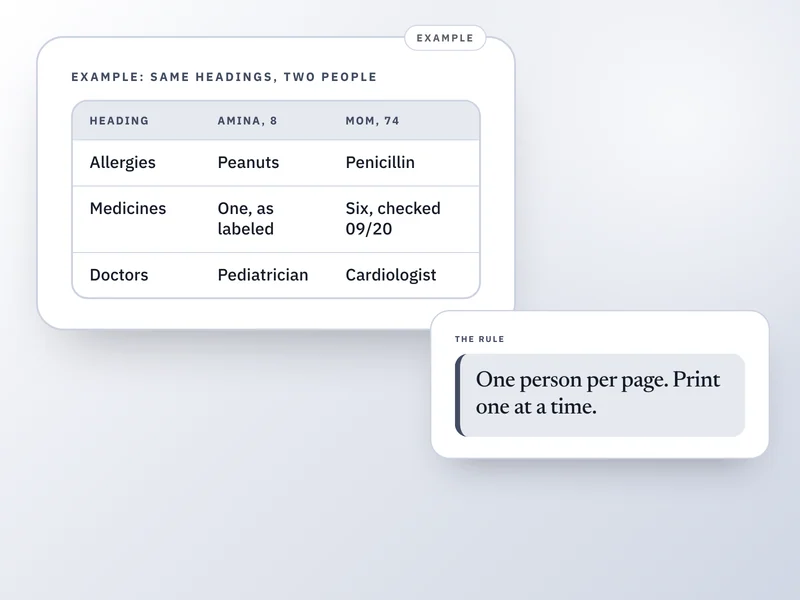
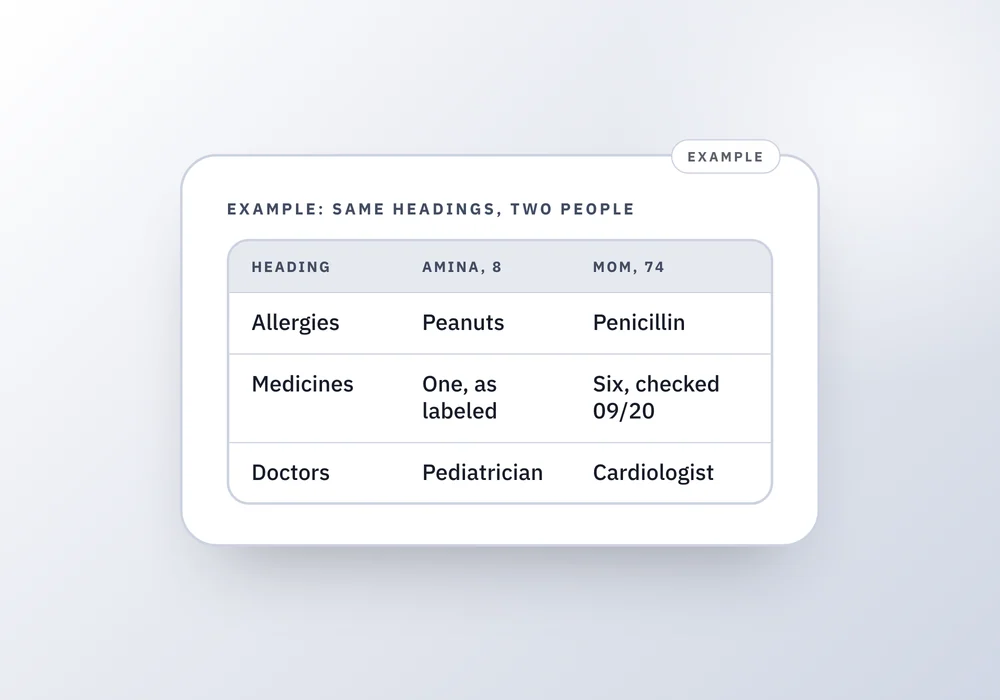
Example: same headings, two people
An invented child and an invented parent. Every heading is identical, so you always know where to look.
Allergies
- Amina, 8
- Peanuts, hives
- Mom, 74
- Penicillin, rash
Medicines
- Amina, 8
- Cetirizine 5 mg, once a day, as labeled
- Mom, 74
- Six on the list, checked 09/20
Doctors
- Amina, 8
- Pediatrician, dentist
- Mom, 74
- Cardiologist, primary doctor, pharmacy
Insurance
- Amina, 8
- Through your plan
- Mom, 74
- Medicare card, plus a supplement
Who to call
- Amina, 8
- You, then Dad
- Mom, 74
- You, then your brother
How often it changes
- Amina, 8
- A few times a year
- Mom, 74
- Every appointment
| Heading | Amina, 8 | Mom, 74 |
|---|---|---|
| Allergies | Peanuts, hives | Penicillin, rash |
| Medicines | Cetirizine 5 mg, once a day, as labeled | Six on the list, checked 09/20 |
| Doctors | Pediatrician, dentist | Cardiologist, primary doctor, pharmacy |
| Insurance | Through your plan | Medicare card, plus a supplement |
| Who to call | You, then Dad | You, then your brother |
| How often it changes | A few times a year | Every appointment |
Set it up in an evening
- Write each person's name at the top of a separate page. Don't put two people on one page. A form for one should never carry the other's allergy.
- Use the same headings on every page: allergies, medicines, doctors, insurance, who to call. The family medical binder guide lists what goes under each.
- For your parent, copy the medicine list from the labels, including over-the-counter pills, vitamins and supplements. The National Institute on Aging's advice for caregivers is to list every medicine, vitamin, herbal remedy and supplement, with dose and schedule.
- Add every doctor your parent sees, with phone number and why. Their list is longer than a child's. Write the pharmacy, too.
- Put the insurance details for each person on their own page, copied from the card.
- Write a checked date beside each medicine list. A parent's list changes at every appointment, and a date tells you how far to trust it.
- Keep all the pages in one place you can reach fast, and tell one other person where that is.
Asking your parent
Some parents hear "can I keep your information" as "I'm taking over." Say what it's for.
Pick the one you are facing
“When you see the cardiologist, I'd like the medicine list right in my hand, so you don't have to remember it.”
“It's only what you tell me. You can tell me to take anything off.”
“Would you sign the form that lets their office talk to me, or would you rather I ask them what it needs?”
“Here's what I have. Is anything wrong or out of date?”
Permission, and the legal papers
A clinic may not discuss your parent's care with you unless your parent has given permission, and each clinic has its own form for that. Ask the office what it uses, and have your parent sign it while they can. The National Institute on Aging advises giving that permission in advance so a doctor can talk with a caregiver when needed.
Advance directives, powers of attorney and who speaks for your parent about medical care are legal documents. A health page can note who the person is and where the papers are kept, but it doesn't replace them. Who speaks for you about medical care explains the roles, and talking to your parents about their affairs covers starting the conversation.
What can go wrong
- The list drifts. A parent's medicines change more than a child's. If the checked date is old, treat the list as a draft and check the bottles.
- Your siblings can't see it. The pages live under your account, and your parent has no access to them. Print a page and hand it over when a brother or a neighbor needs one, and say the date on it.
- You print the wrong person. Two people on one page is how the wrong allergy lands on the wrong form. Print one person at a time and read the name at the top.
- Your parent doesn't want it written down. Then keep only what they've agreed to, and the phone numbers. A partial page with the date is still more useful than none.
Questions people ask
What should be in a caregiver binder for an elderly parent?
Start with a medicine list (including over-the-counter pills and supplements), every doctor with a phone number, allergies, insurance details, emergency contacts and a note on where legal papers are kept. The National Institute on Aging also suggests a notebook of medical care, contacts and other details, on paper or electronic, kept in a central place.
Do I need my parent's permission to talk to their doctor?
Often, yes, in the form of a signed authorization the clinic keeps on file. Each clinic has its own form. Ask the front desk what it needs, and have your parent sign it ahead of time. If your parent is unable to sign, ask the clinic what it accepts.
How do I keep my parent's and my kids' medical information separate?
One page per person, with the person's name at the top, and printed one at a time. Use the same headings on each page so a form for either is quick to fill in. Don't combine pages just to save paper.
Can my siblings see the same binder?
That depends on where you keep it. With a paper binder, whoever holds it can read it. In Family Health Binder, the pages sit under one account and can't be shared, so you print a page for a sibling. Agree on who updates it, so two copies don't disagree.
Where do I keep power of attorney and advance directive papers?
Keep the originals with your other important papers, and tell your family where. Write the location on your parent's page instead of copying the document. If you're not sure which roles your parent has named, the guide linked above explains them.
Where the Family Health Binder fits
In Family Health Binder, every person you look after gets their own card under your account: a child, a parent, a partner or you. You choose "Parent" or "Child" under Who are they to you, and each card has the same sections: allergies, conditions, medicines, vaccines, doctors, insurance and caregiver notes. You can print a Forms sheet, Caregiver sheet, Emergency card, Visit page and Intake summary for one person at a time, and each medicine list can be stamped with the date it was last checked. It has no separate accounts for children, no way to share the binder with a sibling, no upload of legal papers, and it sends no reminders. It only shows what you type in.
Sources and how we checked
- Getting Your Affairs in Order checklist (National Institute on Aging): Medical files list every doctor and every medicine, vitamin, herbal remedy, over-the-counter drug and supplement with dose and schedule.Checked 26 September 2026.
- Getting Started With Caregiving (National Institute on Aging): A caregiving notebook of medical care and contacts, paper or electronic, kept in a central place.Checked 26 September 2026.
- Taking Someone to a Doctor's Appointment: Tips for Caregivers (National Institute on Aging): Giving permission in advance for a doctor to talk with a caregiver.Checked 26 September 2026.
Where to go next
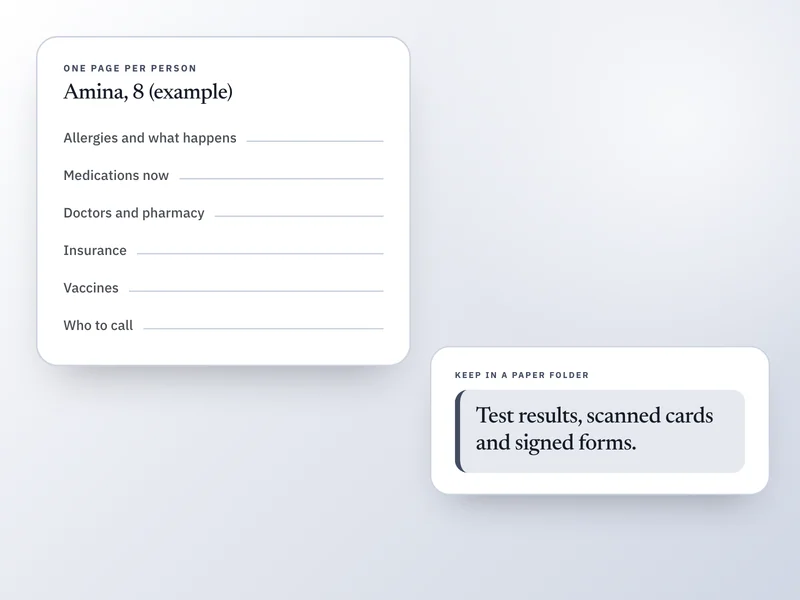 If this is where you areWhat to put in a family medical binderFor the basic setup of one health page per person, start with the family medical binder.
- How to keep a family medication list
Two generations means two medicine lists, and this shows how to keep each one exactly as labeled.
- Emergency contact information sheet: what to include
Anyone might need to reach the right person fast, and this covers an emergency sheet for each household member.
- What health information to share with a sitter or school
When a sibling or helper needs some but not all of the information, this helps you choose what to share.