Write down every medicine the person takes, prescription or not: the name and strength, what it's for, and when and how much, copied from the label. Add vitamins and supplements. Date the list, and change it the day anything does.
This is for whoever keeps track for a household. It's a record of what the labels say, not advice about doses, and your prescriber or pharmacist is the one to ask when a label and your list disagree.
The list, filled in
You're at a desk with a form that says "current medications" and a pen that's running out. You know the little white one is for blood pressure, or possibly cholesterol. A list you wrote last week takes that guess away. The U.S. Food and Drug Administration says a medicine list should have four things for each medicine: its name, its strength, what you take it for, and instructions for when, how and how much.
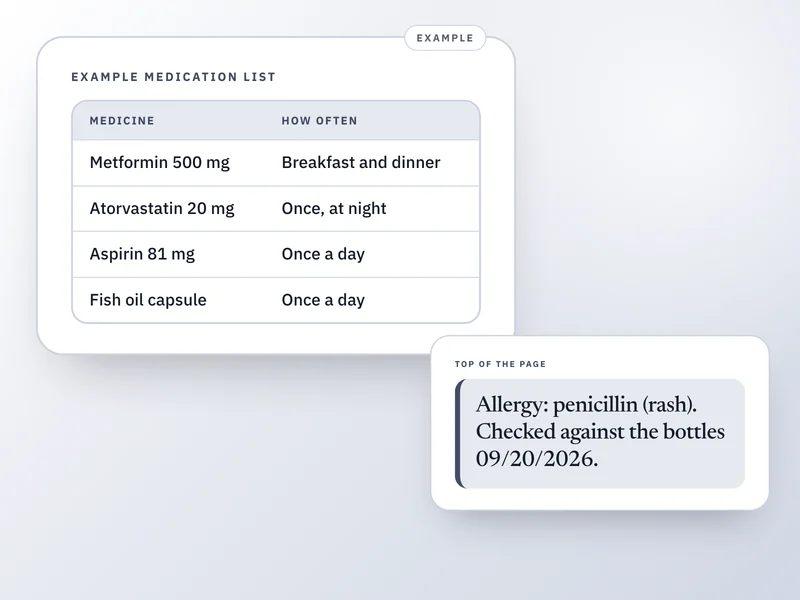
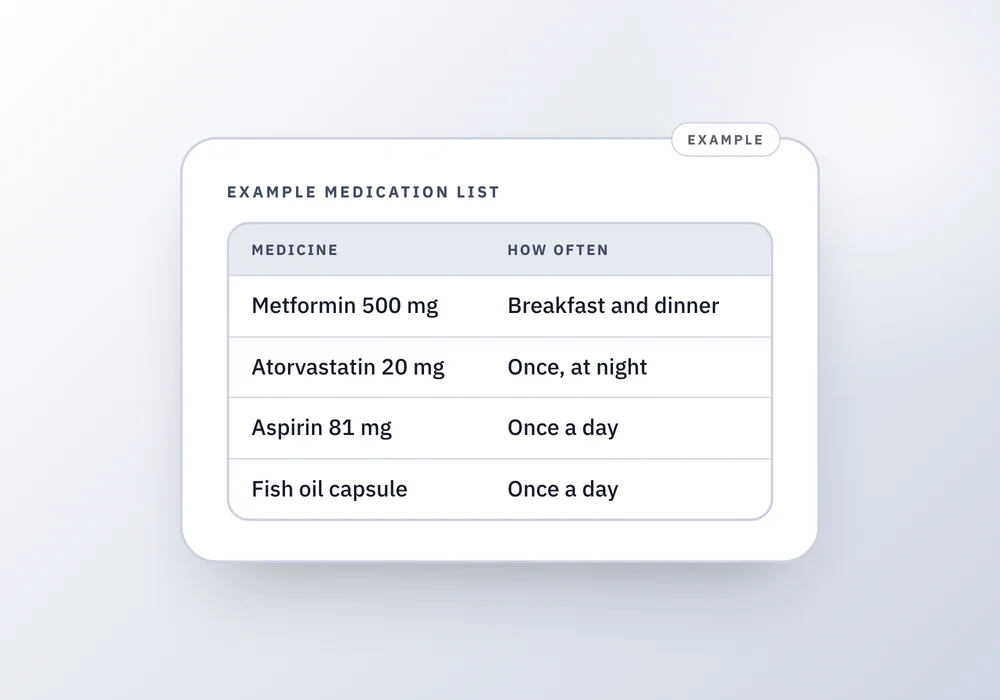
An example for a made-up person, Grandpa Joe, not a suggestion for anyone to take anything. Above it, in bigger type: "Allergy: penicillin (rash). Checked against the bottles 09/20/2026."
Metformin 500 mg
- What it's for
- Blood sugar
- How and when
- Breakfast and dinner
- Started
- 03/2022
Atorvastatin 20 mg
- What it's for
- Cholesterol
- How and when
- Once, at night
- Started
- 03/2022
Aspirin 81 mg
- What it's for
- Heart
- How and when
- Once a day
- Started
- 11/2023
Fish oil capsule
- What it's for
- Supplement
- How and when
- Once a day
- Started
- 01/2025
| Medicine and strength | What it's for | How and when | Started |
|---|---|---|---|
| Metformin 500 mg | Blood sugar | Breakfast and dinner | 03/2022 |
| Atorvastatin 20 mg | Cholesterol | Once, at night | 03/2022 |
| Aspirin 81 mg | Heart | Once a day | 11/2023 |
| Fish oil capsule | Supplement | Once a day | 01/2025 |
How to write it
- Line up everything the person takes: prescriptions, inhalers, eye drops, creams, patches, over-the-counter pills, vitamins and herbal products. The FDA says to include the ones used only some of the time.
- Copy the name and strength from the label, letter for letter. If the label says "500 mg," write 500 mg.
- Copy the directions the same way. Don't shorten "with food" to nothing.
- Write what it's for in the prescriber's or pharmacist's words. If you don't know, ask them at the next visit and leave the space empty until then.
- Put allergies at the top, and say what the reaction was.
- Write today's date on the page, and the words "checked against the bottles" if you did.
- When something stops, move it to a separate line marked "stopped" with the date, and take it off the list you hand over.
When to update it
A list goes out of date without telling you, and an old list at a desk is worse than no list because it looks right. The FDA's advice is to review and update it often, including when a medicine is stopped or a dose changes. The schedule below is ours.
The day something changes
New prescription, new dose or a stop: update the page that day.
Before any visit or form
Look at the bottles and correct the list.
Every few months
Read it against the bottles, even if nothing changed.
When a list is replaced
Recycle the old copy so two versions don't exist.
What goes wrong
Copy, don't paraphrase. A list that repeats the label is easier to check than one you've rewritten from memory, and a child's liquid medicine is where this counts most: copy the amount and the unit exactly as printed, and don't convert it. If a label and your list ever disagree, the label and your prescriber win. Call the pharmacy and ask.
Don't keep two lists. One in the drawer and one on the phone will drift within a month. Pick one home, and take a photo or printout of it for the bag. The FDA suggests carrying a copy, whether a photo on your phone, an app or a printout, alongside your insurance card.
Common questions
What should be on a medication list?
For each medicine: its name, strength, what it's for, and when, how and how much you take. The FDA also suggests adding allergies and emergency contacts. Include over-the-counter medicines, vitamins and supplements, not just prescriptions.
Do I include vitamins and over-the-counter medicines?
Yes. The FDA says to list them, including any you use only some of the time. A doctor or pharmacist can only look at the whole picture if the whole picture is on the page.
How often should I update my medication list?
The day anything changes, and again before any visit. The FDA says to review and update it often. Our own habit would be to also read it against the bottles every few months, so a quiet change doesn't slip by.
Should I keep the list on paper or on my phone?
Either works. The FDA suggests a photo on your phone, an app or a printout carried with your insurance card. The point is one current copy you can reach quickly. Whichever you pick, put the date on it.
Who should I show my medication list to?
Doctors, pharmacists and anyone else who treats you, at every visit, according to the FDA. A sitter or grandparent minding a child who takes something regularly needs it too, in a shorter form.
What if the label and my list don't match?
Trust the label and ask your pharmacist or prescriber which is right. Then fix the list. This guide can't tell you which dose is correct; it only helps you keep what the labels say.
What the Companion does with the list
Family Health Binder gives each person a medication list with name, dose, how often and a start date. "Stopped taking it" moves a medicine into a Stopped fold and takes it off every printed page. "This list is right today" stamps the date you last checked it against the bottles. The list prints on the forms sheet, sitter sheet, emergency card, visit page and intake summary. There's no "what it's for" field, so add that to the name if you want it. It doesn't remind you, or check doses or interactions. See the Family Health Binder.
What to do next
Once the list is right, read what to bring to a new doctor appointment or the doctor appointment prep checklist. The same facts go on an emergency contact sheet. For dated notes about how someone has been feeling, see symptom notes for a doctor visit. Next step: gather the bottles onto one table tonight and write the first line.
Sources and how we checked
- U.S. Food and Drug Administration: Create and Keep a Medication List for Your Health: Four things per medicine, include OTC and supplements, update often, carry a copy as a photo, app or printout.Checked 26 September 2026.
Where to go next
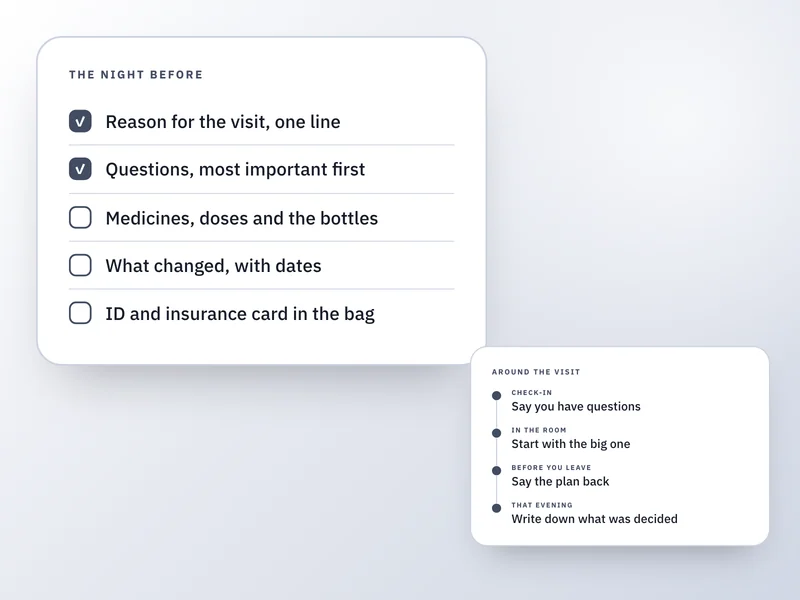 If this is where you areDoctor appointment checklist for the day beforeOnce the list is right, this shows what else to gather the day before a doctor visit.
- Symptom log for a doctor visit: what to write down
Alongside the medicines, dated notes about how someone has been feeling give the appointment more to work from.
- Emergency contact information sheet: what to include
The same medicine facts can go on an emergency sheet, and this covers what else belongs there.
- What to bring to a new doctor appointment
For a first visit with a new doctor, this shows where the medication list fits among the other papers.