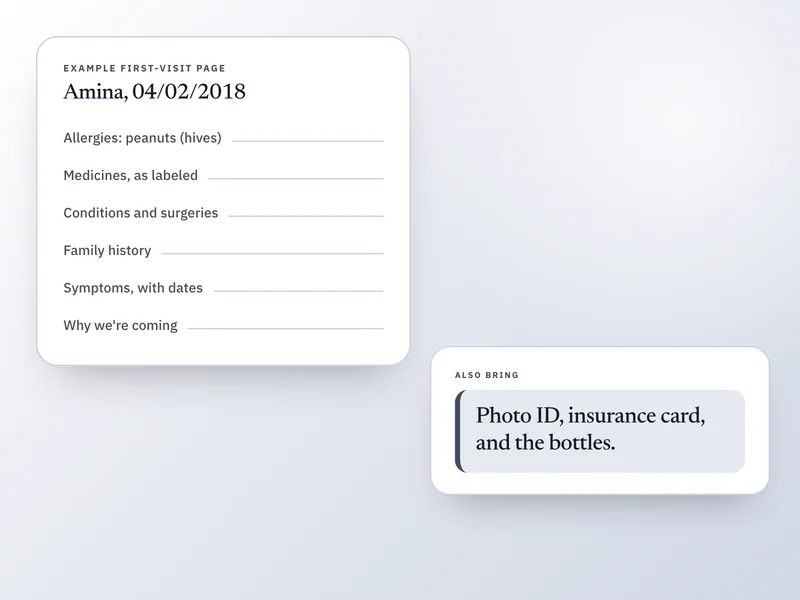
For a first visit with a new doctor, bring a photo ID, your insurance card, every medicine you take (a written list, or the bottles), your allergies, your conditions and past surgeries, family history, and a few dated lines on why you're coming. Records from your old doctor help, and the new clinic can tell you how to get them.
This is for an adult or a parent booking for a child. It can't tell you what your clinic requires, so call and ask. It isn't medical advice.
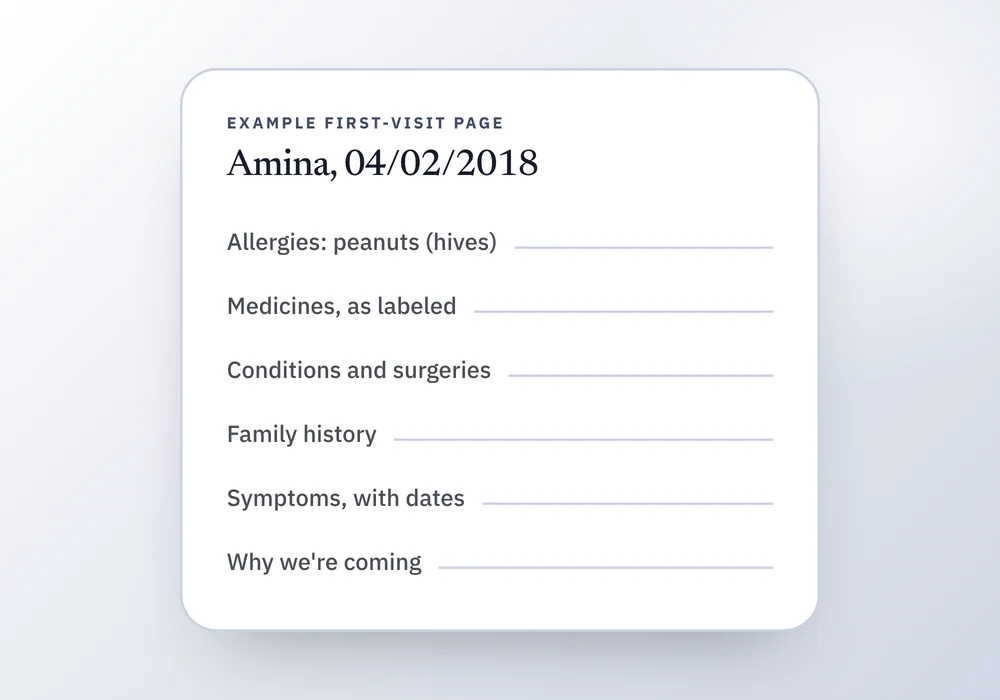
Example: one page for a first visit
Say you booked the appointment three weeks ago. This morning the clinic's form arrives with a box that says "List all current medications," and you are standing in the kitchen trying to remember whether the allergy pill is 5 or 10 milligrams. Below is the page that would have saved you that minute, filled in for an invented eight-year-old.
This is an example. The child and every detail are made up.
Name and birth date
- What the page says
- Amina, 04/02/2018
Allergies
- What the page says
- Peanuts (hives)
Medicines now
- What the page says
- Cetirizine 5 mg, once a day, as labeled. Inhaler, 2 puffs when needed, as labeled.
Conditions
- What the page says
- Asthma. Tonsils removed, 2023.
Family history
- What the page says
- Asthma runs in the family.
Recent symptoms
- What the page says
- Night cough since 09/14, mild. Rest and fluids helped.
Why we're coming
- What the page says
- New pediatrician after a move. Yearly checkup.
| Section | What the page says |
|---|---|
| Name and birth date | Amina, 04/02/2018 |
| Allergies | Peanuts (hives) |
| Medicines now | Cetirizine 5 mg, once a day, as labeled. Inhaler, 2 puffs when needed, as labeled. |
| Conditions | Asthma. Tonsils removed, 2023. |
| Family history | Asthma runs in the family. |
| Recent symptoms | Night cough since 09/14, mild. Rest and fluids helped. |
| Why we're coming | New pediatrician after a move. Yearly checkup. |
Notice what is not on it: the doctor's own name, the insurance number, the vaccine dates. Those belong on a separate sheet, because a new clinic asks for them at a different moment, usually at the front desk rather than in the exam room.
Gather it in this order
Do this the week before, not the night before.
- Call the clinic and ask two things: what to bring, and whether new-patient forms come ahead of time. Some clinics send them by email or through a portal, and filling them in at home beats a clipboard in the waiting room.
- Write the medicine list from the labels, not from memory. Name, dose and how often, exactly as printed. Include the ones you don't think of as medicine: over-the-counter pills, vitamins, supplements and herbal products. The medication list guide shows the layout.
- Put the bottles in a bag as well. The Agency for Healthcare Research and Quality's advice is to bring all your medicines, prescription and non-prescription, to the appointment. We'd bring the list and the bottles, and if they disagree, show the bottle.
- Write allergies with what happens, in your words: "peanuts, hives" says more than "nut allergy."
- List conditions and past surgeries or hospital stays with the year. Roughly right is fine. Family history goes below it, as far as you know it.
- Add the reason for the visit and any symptom with the date it started. If it's a symptom visit, symptom notes for a doctor visit has a four-line format.
- Ask your old office how to transfer records and vaccine history, and start that now. See the next section.
- Pack photo ID and your insurance card, and read the clinic's paperwork when it arrives instead of relying on this page.
Records from the old doctor
A written summary can't hold a lab result, a scan or a discharge paper. If your new doctor will want those, they come from the office or hospital that made them. Ask that office how it sends records to a new clinic. Many want a signed release, and some take days or longer, which is why the request belongs in week one.
For a child, vaccine history is the record clinics and schools ask for most. If you don't have it, your old clinic is the first place to ask. Write on your page where the record came from and the date.
A schedule that works backwards from the visit
A week before
Call the clinic. Ask what to bring and whether forms come first.
Six days before
Ask the old office how to send records. Start the release if one is needed.
Three days before
Write the medicine list from the labels. Add allergies and conditions.
The night before
Print the page. Put it, the bottles, ID and insurance card in one bag.
At the desk
Hand over the page. Ask them to check it against their form.
After the visit
Fix anything the doctor changed, and date the page.
What can go wrong
- The page and the clinic's form disagree. The clinic's form is the record they keep, so fix your page to match what you actually take, and tell the front desk.
- Several doctors are involved. A summary of your health doesn't list them, so keep a separate line with each doctor's name, phone number and why you see them.
- You're going for a parent. Bring the same things, plus whatever permission their clinic wants before it talks to you. Caring for a parent and kids in one place covers that part.
- The page is old. A list that was right in March is a guess in September. Write "checked" and the date at the top each time.
Questions people ask
Do I bring my pill bottles to a new doctor?
It's worth doing. The Agency for Healthcare Research and Quality advises bringing all your medicines, including non-prescription ones like aspirin or antacids. A written list saves time, and the bottles settle any doubt about a dose or a name. If you can't bring bottles, photograph the labels.
What is a new patient packet?
It's the set of forms a clinic gives a first-time patient: contact details, insurance, medical history, medicines and consent forms. Some clinics send it ahead by email or portal. Ask when you book, and fill in what you can at home from your own page.
How do I get my records sent to a new doctor?
Ask the office that holds them how it transfers records. Many require a signed release form naming the new clinic, and some take days. Ask for immunization history at the same time. Start before the appointment, not after it.
Should I bring a list of my past surgeries?
Yes, with the year and, if you know it, the hospital. Exact dates are less important than getting the procedure and rough timing right. If a surgery was long ago and you're unsure, say so on the page instead of guessing.
What should I write for family history?
Write what you know, in plain words: which relative, and what condition, such as "my mother, asthma." If you don't know a side of the family, write "unknown." A short honest note is more use to a clinic than a long guess.
Where the Family Health Binder fits
Family Health Binder keeps the answers this page needs for each person, and its Intake summary prints them for a new doctor: allergies, current medicines, conditions, family history and the latest symptoms, with the person's name and birth date at the top. Doctors, dentists, pharmacies and insurance are kept too, but they print on its separate Forms sheet, not on the Intake summary. It only holds what you type in, it doesn't hold records or scans, and it doesn't fill in the clinic's own form. You can mark a record private so it stays off the printed page, and the page says how many it left off.
Sources and how we checked
- Please bring ALL your medicines to your next appointment (AHRQ fact sheet): Advice to bring all medicines, prescription and non-prescription, to an appointment and to carry a medicine list to a new appointment.Checked 26 September 2026.
- Getting Your Affairs in Order (National Institute on Aging): Medical files list every doctor and every medicine, vitamin, herbal remedy, over-the-counter drug and supplement.Checked 26 September 2026.
Where to go next
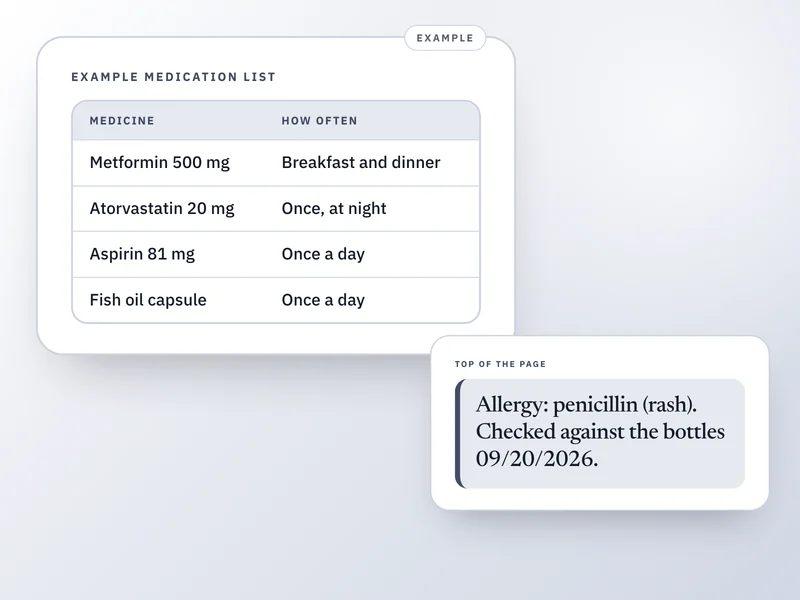 If this is where you areHow to keep a family medication listThe medicine list is the item a new doctor asks for first, so write it out before you go.
- Doctor appointment checklist for the day before
For the rest of the paperwork to gather before any visit, use the appointment checklist.
- Symptom log for a doctor visit: what to write down
If the reason for the visit is a symptom, this shows how to write it down with dates.
- Caregiver binder for a parent and kids: one page each
When the new patient is your parent, this covers keeping their information next to your children's.