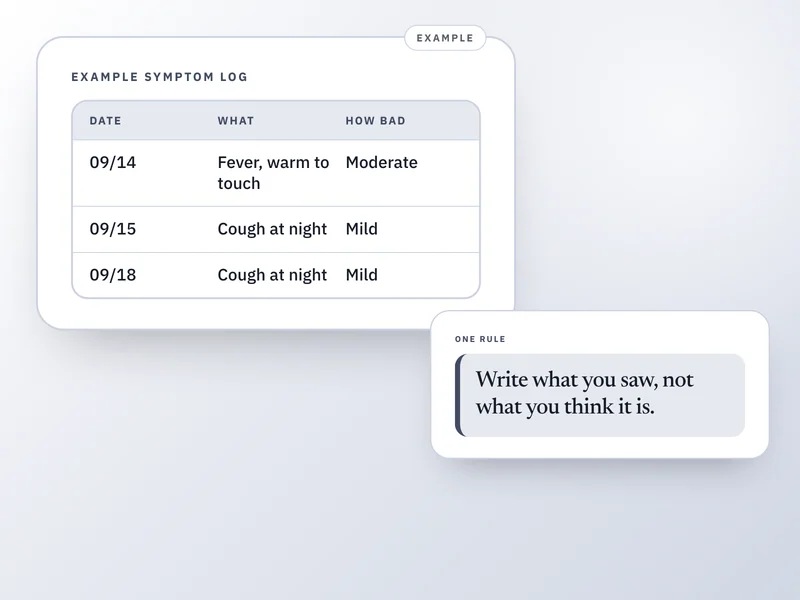
Write one line each time: what it is, the date it started, how long it lasted, how bad it was in your own words, and what helped. Do it the day it happens, not the night before the visit. Bring the page.
This is for anyone keeping notes on themselves or a child before an appointment. It can't tell you what a symptom means or whether to wait. Your clinic can, and in an emergency call 911.
What a few days of notes look like
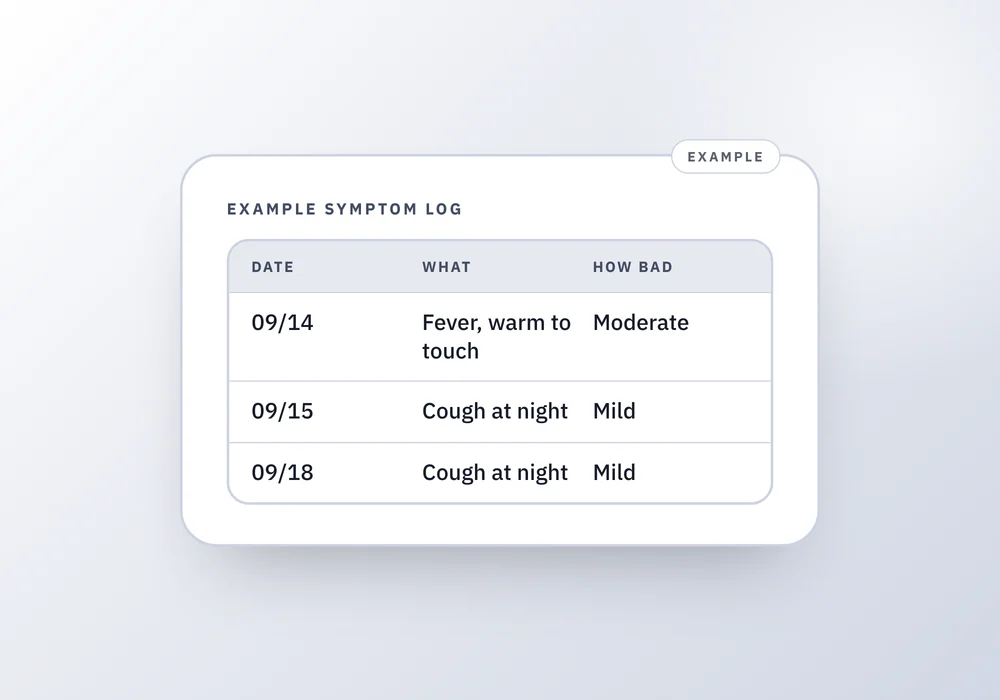
The doctor asks, "When did this start?" and you both look at the ceiling. It was after the weekend. Or before. A note with a date on it ends that conversation in one second. Here's a log for Amina, 8, with three lines in it.
An example, not a real record. Nothing in it is a suggestion for what to do about a symptom.
09/14
- What
- Fever, warm to touch
- How long
- 1 day
- How bad
- Moderate
- What helped
- Rest and fluids
09/15
- What
- Cough at night
- How long
- All night
- How bad
- Mild
- What helped
- Sat up in bed
09/18
- What
- Cough at night
- How long
- 2 hours
- How bad
- Mild
- What helped
- Nothing yet
| Date | What | How long | How bad | What helped |
|---|---|---|---|---|
| 09/14 | Fever, warm to touch | 1 day | Moderate | Rest and fluids |
| 09/15 | Cough at night | All night | Mild | Sat up in bed |
| 09/18 | Cough at night | 2 hours | Mild | Nothing yet |
Notice what the lines don't say. There's no guess at a cause and no "probably a cold." Only what you saw, when, for how long, and how it went. The doctor decides what it means.
What to write each time
- What it is, in a few plain words: "Cough at night," "stomach pain after lunch."
- The date it started, as close as you know. Write the day, not "last week."
- How long it lasted: hours, days or weeks.
- How bad it was: mild, moderate or severe, your own view.
- What helped, in your own words. If nothing did, write that.
- Anything else that stood out: time of day, what was going on, whether it came with something else.
Extra detail for the fuller picture
- If you take a temperature, write the number, the time, and how you took it.
- If it comes and goes, write each time as its own line rather than one long note.
- If it follows a medicine, note the medicine and when it was taken, copied from the label.
Reading it out
A page doesn't replace the conversation. It gives you the first sentence.
Pick the one you are facing
“It started on the 14th. It comes and goes, and it's worst at night.”
“I'd say mild most nights, moderate the first day. I've got it written down.”
“Sitting up seemed to help. Nothing else made a difference.”
When it doesn't work
A log fails when it becomes a chore. Keep it to a line, and skip a day if nothing happened. It also fails when it turns into a diary of worry, with each line a little longer than the last. If you notice that, stop writing and call the clinic. A page can't decide anything for you, and it can't tell you when to wait. Say the ordinary limit out loud: if you don't know whether something needs attention, your clinic can tell you, and in an emergency, call 911.
A child who can't describe it yet needs you to write what you can see, and the words they use, in quotation marks. Keep one page per person, so two children's coughs don't end up on the same page.
Common questions
How do I describe my symptoms to a doctor?
Say what it is, when it started, how long it lasts, how bad it is and what helps or doesn't. Reading from a written page is fine. The date is the part memory loses first, so write it down the day it happens.
What should I write in a symptom log?
One line each time: the date, what it is, how long it lasted, how bad it was, and what helped. Add the time of day or what you were doing if it stood out. Write what you saw, not what you think it is.
How long should I keep a symptom log?
From the first day until the visit. There's no set length. What matters to a doctor is the dates and how things went, so a few dated lines beat a long page written from memory the night before.
Should I write down what I think is wrong?
No, or keep it apart from the notes. "Started Tuesday, lasted three days, mild" gives the doctor something to work with. A guess like "probably a cold" can point the conversation the wrong way. Leave the meaning to them.
Can I keep symptom notes on my phone?
Yes. What counts is that each note has a date and can be shown at the visit. A note on your phone is easy to add to in the moment. A printed page is easier to hand over. Many people keep both.
What the Companion does with your notes
Family Health Binder has a symptom form with four fields: what it is, when it started, how long (hours, days or weeks) and how bad (mild, moderate, severe), plus what helped. Records show as a dated list, newest first. There's no chart, no trend and no advice, and it can't tell you what anything means. Put extra detail, like time of day, into the "What is it?" line. The last five print on the visit page and the last eight on the intake summary. See the Family Health Binder.
What to do next
Turn the notes into questions to bring to the doctor, and put the medication list beside them. For a first visit, see what to bring to a new doctor appointment, and for the rest of the day before, the doctor appointment prep checklist. Next step: write today's date and one line about how it is right now.
Where to go next
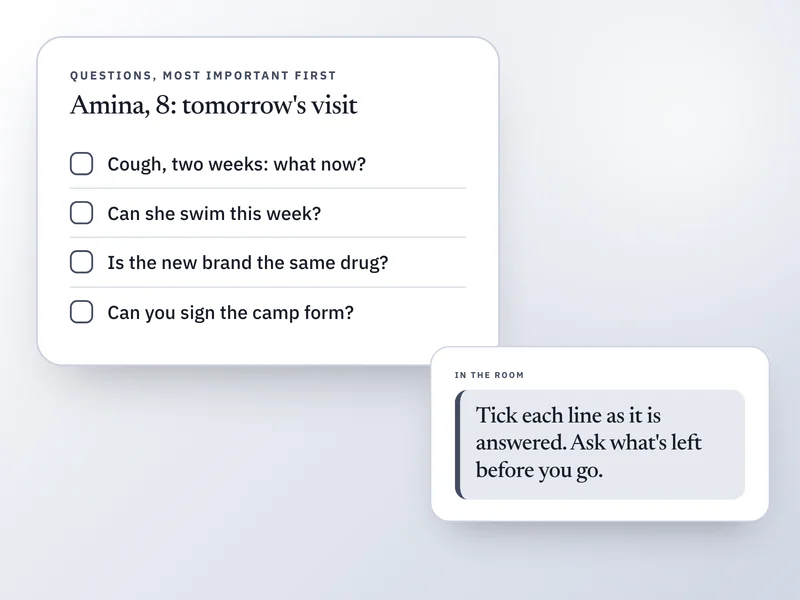 If this is where you areQuestions to ask the doctor: how to write them downAfter you have the notes, turn them into short written questions to ask before time runs out.
- Doctor appointment checklist for the day before
To fit the symptom page into a full visit routine, use the checklist for the day before.
- What to bring to a new doctor appointment
A new doctor has none of your history, and this shows how to bring symptoms and background on one page.
- How to keep a family medication list
Doctors often ask what has been taken as well, so this shows how to keep the medicine list current.