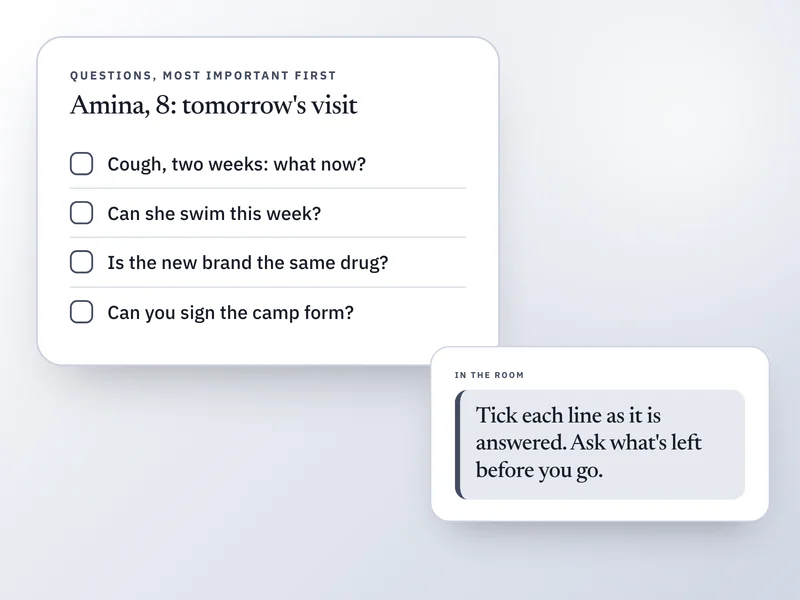
Write each question as one line, put the one you can't leave without first, and leave a gap under each for the answer. Bring the page and tick lines off as they're answered. Keep the list to what a short visit can hold.
This is for anyone heading into an appointment for themselves or a child. It covers how to write questions, not what to ask about anyone's health, and it can't tell you whether a question is worth asking. Your doctor can.
A worked example: from a pile to a page
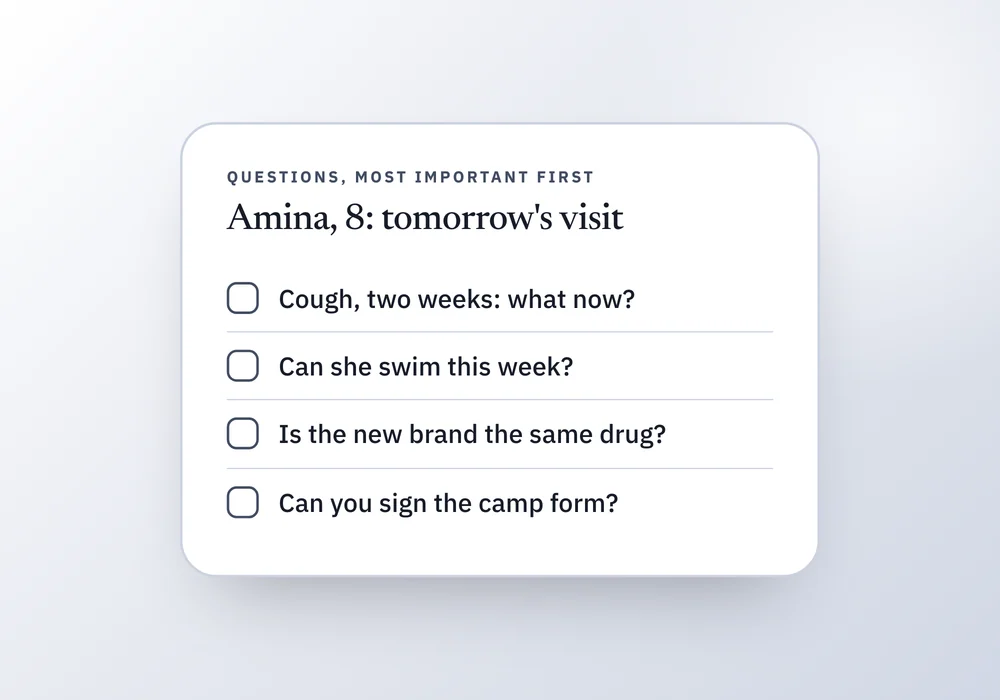
Say you've been keeping a note on your phone about Amina, 8, and the appointment is tomorrow. The note is a pile: her cough, swimming, something about the pharmacy, the camp form. Left like that, you'll get to the door with the pile still in your pocket. Here it is turned into lines you can read out.
An example, not a list to copy. Each line is short enough to say in one breath, and each one can be answered in a sentence or two.
her cough again
- The question line
- Cough, two weeks: what now?
swimming?
- The question line
- Can she swim this week?
pharmacy gave something different
- The question line
- Is the new brand the same drug?
camp form
- The question line
- Can you sign the camp form?
| What the note says | The question line |
|---|---|
| her cough again | Cough, two weeks: what now? |
| swimming? | Can she swim this week? |
| pharmacy gave something different | Is the new brand the same drug? |
| camp form | Can you sign the camp form? |
Now put them in order. The cough goes first, because it's the reason for the visit. The camp form goes last, because it can be handled at the desk if time runs out. If a question would still nag you on the drive home, it belongs near the top.
How to write the list
- Empty your head onto one page the day before, or the moment a question occurs to you. Don't sort yet.
- Turn each item into a question that ends in a question mark. "Swimming?" becomes "Can she swim this week?"
- Make it specific. A question with a name, a date or a number in it gets a shorter answer than a vague one.
- Put the one you can't leave without at the top. Number the rest.
- Cut to what fits. If you have nine and the visit is short, keep the top four or five and say so at the start.
- Leave two blank lines under each question for the answer.
- Bring the page, a pen, and the medicine list if the visit involves anything Amina takes.
If you don't know what to ask
The Institute for Healthcare Improvement runs a program called Ask Me 3, built around three questions for any health visit:
- "What is my main problem?"
- "What do I need to do?"
- "Why is it important for me to do this?"
We'd copy those three onto the bottom of every question page. They cost three lines, and they still work on a day when your own questions fail you. They're about understanding an answer, so they sit beside your own specific questions rather than replacing them.
In the room, in your own words
You don't need to be polished. Reading from a page is a normal way to run a visit. These lines are here for the moments when you feel rushed.
Pick the one you are facing
“I've got three questions. The first is the one I most need answered.”
“Can I say that back to you, to make sure I've got it right?”
“Could you write the name of that down for me?”
“Before we finish, I've got two questions left on my page.”
After each answer
Write the answer under the question, in the words you heard, not the words you'd have chosen. "Call back if it's still there Friday" is a note you can act on. "She said it's fine" isn't. Before you leave, look at the page: any line still blank is what you ask now, at the desk or the door.
When the list doesn't work
A long list can crowd out the one question you came for, which is why the order matters. Some visits are booked for one problem only, so if you have five, mention it when you book and ask what fits. If you hear an answer you can't follow, a second question is fine, and saying it back is a good way to check. And if you think of something after you leave, ask the clinic how to send a question in. This page can't tell you whether a question is urgent. If you're worried, call the clinic, and in an emergency call 911.
Common questions
What questions should I ask my doctor?
It depends on the visit, and that's for you and the doctor to decide. If you're stuck, the three Ask Me 3 questions are a place to start: what is my main problem, what do I need to do, and why is it important to do it. Then add the specific ones only you know, like what changed and when.
How many questions should I bring?
As many as you'll get through, ranked. If you have more than four or five, tell the clinic when you book and ask how long the visit is. Put the one you can't leave without at the top, so that if time runs out you've already asked it.
Is it okay to read my questions from a list?
Yes. A page is the easiest way to keep the important question from getting lost when you're nervous or the room is busy. Hold it where you can see it, and tick each line off as it's answered so you both know what's left.
What if I forget to ask something?
Ask the clinic how to send a question after the visit, such as a phone call or a message through their patient portal, if they have one. Write the question on your page anyway, so it's ready the next time or when you call.
Should I write down the doctor's answers?
Yes, briefly, under each question and in the words you heard. It turns the page into a record you can read later or hand to another caregiver. Some people take a second person to the visit partly for this.
Where the page comes from
Family Health Binder has a "Questions to ask" field on each planned visit. You type one per line, and the Visit page prints them with a tick box each, next to allergies, what the person takes now, their last five symptoms and ruled lines for notes. After the visit you can add what was said or decided. It doesn't suggest questions or answer them, and it doesn't send a reminder about the visit. It's a record you print and carry.
What to do next
For the rest of the day before, see the doctor appointment prep checklist. Your questions land better with dated notes behind them, so read symptom notes for a doctor visit next, and bring the medication list alongside. Next step: open a note, write down every question you have right now, and put a star by the first.
Sources and how we checked
- Institute for Healthcare Improvement: Ask Me 3: The three Ask Me 3 questions and what the program is.Checked 26 September 2026.
Where to go next
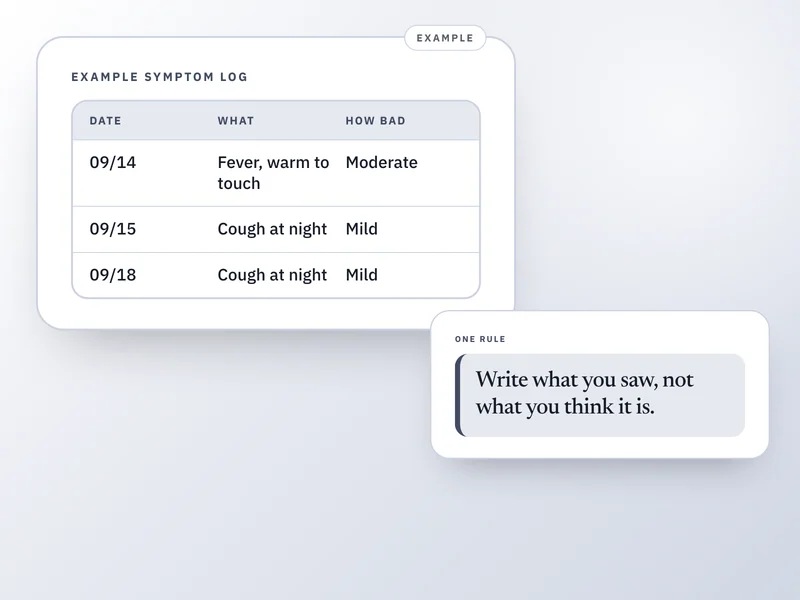 If this is where you areSymptom log for a doctor visit: what to write downYour questions land better with dated notes behind them, and this shows what to write about a symptom.
- Doctor appointment checklist for the day before
For everything else to gather the day before, the appointment checklist covers the whole paperwork list.
- What to bring to a new doctor appointment
If you are seeing a doctor for the first time, this lists what a first visit tends to ask you for.
- How to keep a family medication list
Bring the current medicine list alongside your questions, and this explains how to write one.