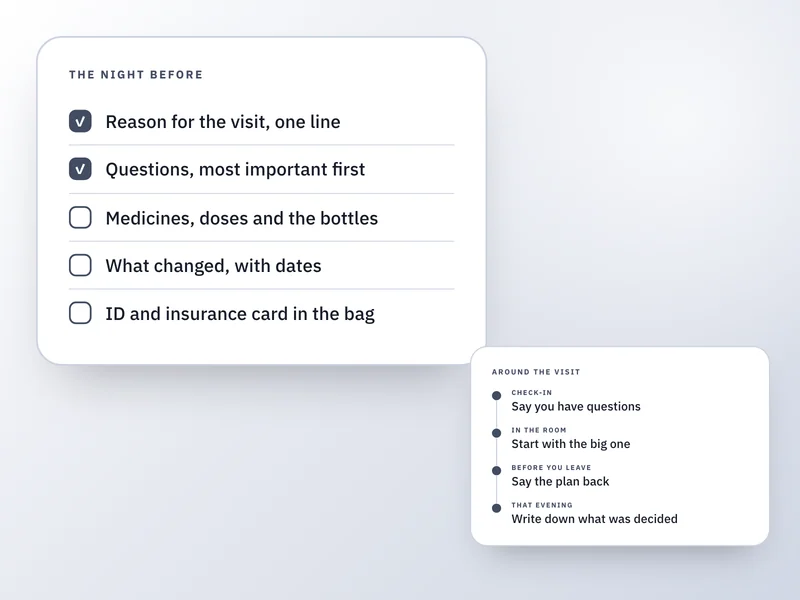
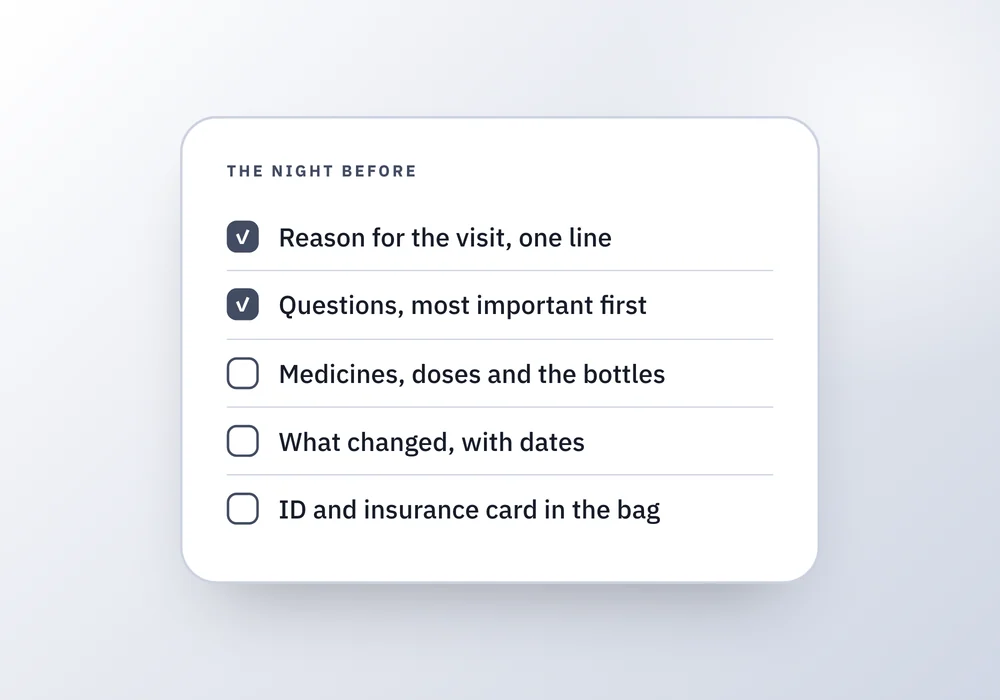
The day before a doctor visit, write your reason for going and your concerns in order, list every medicine and supplement, note what has changed with dates, and put photo ID, your insurance card and the list in one bag. In the room, start with the concern you most want answered. Afterward, write down what was decided.
This is for adults and for parents booking for a child. It can't tell you what to ask about your own health, and it isn't medical advice. Your clinic's own instructions come first.
Example: one page for a cough visit
Say it is Tuesday night and the appointment is Wednesday at 9:15. You know you'll walk in with five worries and walk out having said two. The table below is the page you'd want in your hand, filled in for an invented eight-year-old. Every detail is made up.
A filled prep page (example, invented child)
9 of 9 rows shown
Reason for the visit
- What you write
- Cough at night for a week. Follow-up on the inhaler.
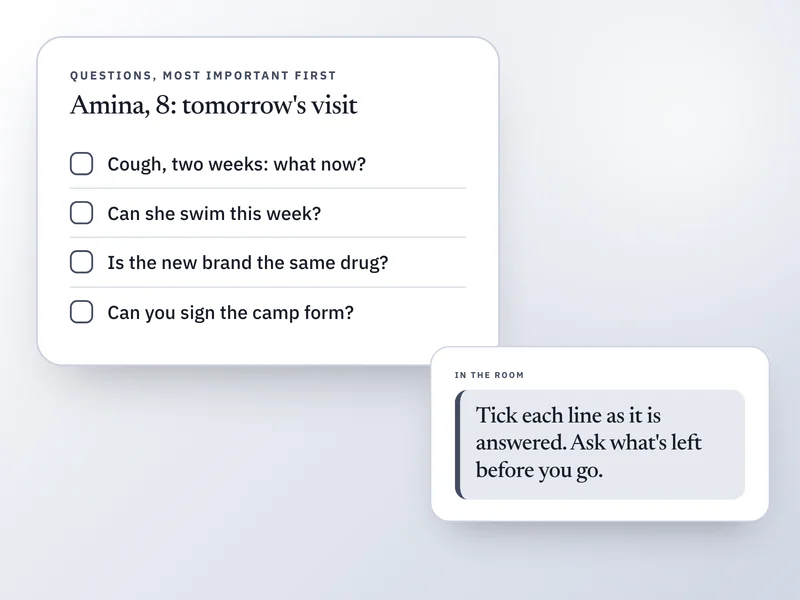
Question 1 (most important)
- What you write
- Why is the cough worse at night?
Question 2
- What you write
- Can she swim this week?
Question 3
- What you write
- Do we need to change how she uses the inhaler?
What changed since last time
- What you write
- Cough started 09/14, mild. Rest and fluids helped. Three days of it waking her.
Medicines now
- What you write
- Cetirizine 5 mg, once a day. Inhaler, 2 puffs when needed. Both as labeled.
Allergies
- What you write
- Peanuts, hives.
In the bag
- What you write
- Photo ID, insurance card, the bottles, this page.
Notes from the visit
- What you write
- Five blank lines, filled in the room.
| Line | What you write |
|---|---|
| Reason for the visit | Cough at night for a week. Follow-up on the inhaler. |
| Question 1 (most important) | Why is the cough worse at night? |
| Question 2 | Can she swim this week? |
| Question 3 | Do we need to change how she uses the inhaler? |
| What changed since last time | Cough started 09/14, mild. Rest and fluids helped. Three days of it waking her. |
| Medicines now | Cetirizine 5 mg, once a day. Inhaler, 2 puffs when needed. Both as labeled. |
| Allergies | Peanuts, hives. |
| In the bag | Photo ID, insurance card, the bottles, this page. |
| Notes from the visit | Five blank lines, filled in the room. |
Nothing on this page is an answer. It's the facts a doctor asks for and the questions you'd otherwise lose in the waiting room.
Before, during and after
The order follows the Agency for Healthcare Research and Quality's advice to prepare questions, ask the most important ones first, understand the answers and know the next steps.
The night before
Write the reason, then your questions in order. Write what has changed, with dates.
Same evening
List every medicine, vitamin and supplement from the labels. Put the bottles in the bag.
Morning of
Add photo ID and your insurance card. If someone is coming with you, tell them the top question.
At check-in
Tell the desk or the nurse you have questions, so the time can be planned around them.
In the room
Start with your most important question. Take notes, or let the person with you take them.
Before you leave
Say the plan back in your own words. Ask for written instructions if there are any.
That evening
Write down what was said and decided while you still remember it.
What to gather, in order
- One line for the reason you're going. If a symptom brought you, write when it started, how long it lasts, how bad it is and what helped. Symptom notes for a doctor visit has the four-line format.
- Your questions, one per line, the most important first. AHRQ's advice is to ask those first. The Institute for Healthcare Improvement's Ask Me 3 offers a fallback set for any visit: what is my main problem, what do I need to do, and why is it important for me to do this.
- Every medicine, including over-the-counter ones and supplements, from the labels: name, dose, how often. See the medication list guide. Bring the bottles too, or a list.
- Allergies with the reaction, and anything that changed since the last visit, with dates.
- Photo ID and your insurance card. If you can, write down the pharmacy's name and phone as well.
- Room for notes. Leave at least five blank lines under the questions.
- Someone to come with you, if you can. AHRQ suggests taking notes or bringing a person to help you understand and remember what you heard.
Adjust it for the kind of visit
For a child, you're the one who asks and remembers, so write the questions in your own words and bring what the child takes and is allergic to. For a video visit, do the same preparation: the list, the bottles and the notes are still in reach, only the waiting room changes. For a first visit with someone new, what to bring to a new doctor adds history and records. For an elderly parent, add whatever their clinic needs before it talks to you, and see caring for a parent and kids.
What can go wrong
Too many worries for one visit is the common one. You can't fix that with a longer list. Put the most important first, tell the desk you have questions when you check in, and if you still run out of time, ask when the best time is to ask the rest, as AHRQ suggests, or whether a follow-up visit or call would be the right place.
Guesses are another. If you think you know what's wrong, we'd write it under the facts and mark it as your guess. Doctors decide what it is, and your guess can be useful to them, but it shouldn't replace what happened and when.
And the list can be out of date. A medicine list right in March is a guess in September. Check it against the bottles the night before.
Questions people ask
What should I bring to a doctor's appointment?
Photo ID, your insurance card, your questions on paper, a list of everything you take (or the bottles) and your allergies with the reaction. Add notes on what has changed, with dates, and something to write on. Your clinic may ask for more, so read its instructions.
How do I prepare for a doctor's appointment?
Write the reason for the visit, your questions with the most important first, and what has changed with dates. List your medicines from the labels. Pack ID, insurance card and the list in one bag. Tell the desk or nurse you have questions. After the visit, write down what was decided.
How many questions can I ask in one visit?
There's no rule, and time is short. AHRQ advises asking the ones most important to you first and telling the nurse or front desk you have questions. If you're left with more, ask when the best time is to ask them. Don't drop the top one.
Should I bring someone to a doctor's appointment?
It can help. AHRQ suggests taking notes or bringing someone to help you understand and remember what you heard. Tell them your top question beforehand and what you want them to write down. Check with the clinic if it limits visitors.
What is Ask Me 3?
It's an education program from the Institute for Healthcare Improvement with three questions for any visit: what is my main problem, what do I need to do, and why is it important for me to do this. They suit a short visit as a fallback. Your own questions still come first.
Where the Family Health Binder fits
In Family Health Binder, you can plan a visit with a reason, a day and who it's with, write your questions one per line, and add what was said afterward. Its Visit page prints those questions with tick boxes, plus allergies, what is taken now, the latest five symptom notes, and five ruled lines for notes from the visit. It doesn't print insurance, which lives on the separate Forms sheet. It only holds what you type, and it doesn't remind, schedule or book anything. You can mark a record private so it stays off the printed page, and the page counts what it left off. For the questions page itself, see questions to bring to the doctor.
Sources and how we checked
- Ask Your Doctor: questions and preparing for your appointment (Agency for Healthcare Research and Quality, as reproduced in a university handout): Prepare questions, ask the most important first, tell the nurse or desk you have questions, take notes or bring someone, ask for explanations and written instructions.Checked 26 September 2026.
- Ask Me 3: Good Questions for Your Good Health (Institute for Healthcare Improvement): The three Ask Me 3 questions.Checked 26 September 2026.
Where to go next
 If this is where you areQuestions to ask the doctor: how to write them downWith the paperwork gathered, turn to the questions themselves and how to write them so the important one comes first.
- How to keep a family medication list
Doctors ask what is taken now, and this shows how to write the medication list so it matches the labels.
- Symptom log for a doctor visit: what to write down
If the visit is about something that comes and goes, this covers noting when it started and what helped.
- What to bring to a new doctor appointment
When the doctor is someone new, this covers the extra history worth bringing to a first visit.