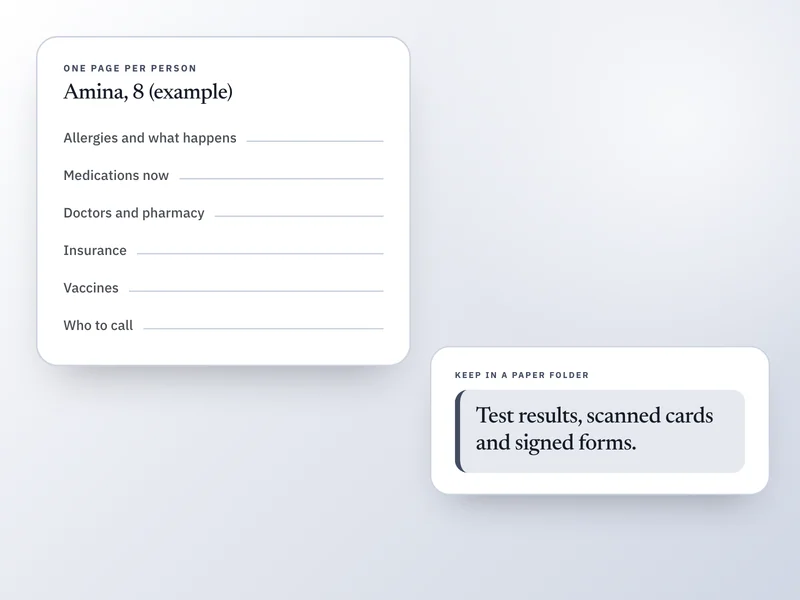
Give each person one page with eight things on it: date of birth, allergies and what happens, current medications with the dose and how often, conditions in your own words, doctors and pharmacy with phone numbers, insurance member and group numbers, vaccine names and dates, and who to call. Print it or keep it where you can open it fast.
This is for anyone who ends up answering health questions for a household: kids, a partner, a parent. It can't tell you what any entry means or what anyone should do about it, and it doesn't replace the paperwork a clinic, school or camp gives you. It's paperwork help, not medical advice.
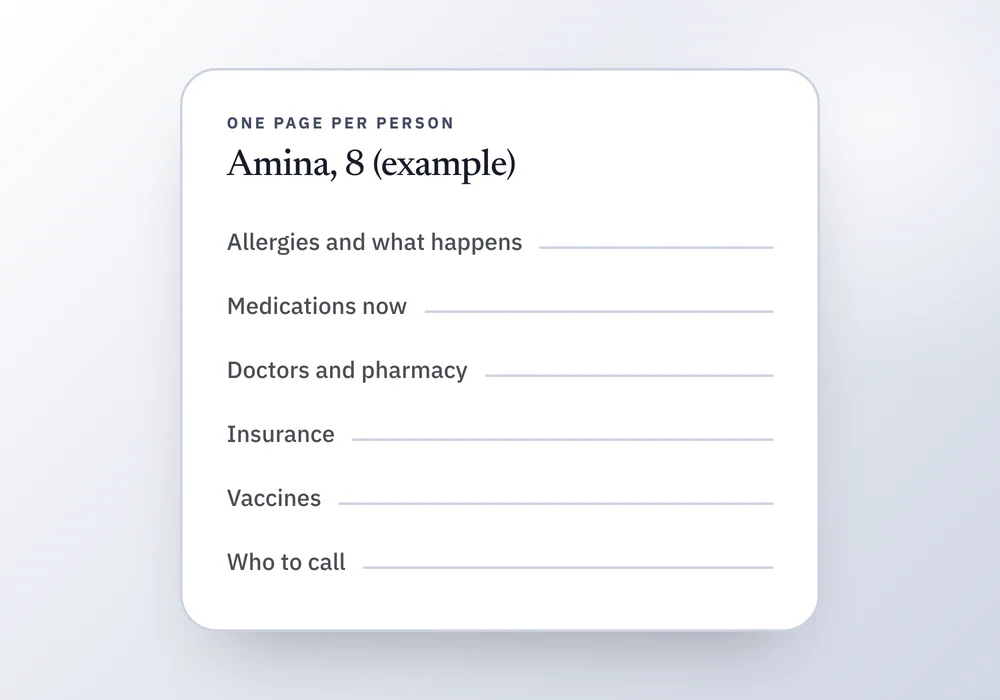
An example: one filled page
Say Amina is eight and you've been handed a clipboard at a new dentist. This is the page you'd want in your bag. Every name, number and date here is made up for the example.
8 of 8 rows shown
Date of birth
- What's written
- 04/02/2018
- Where the answer comes from
- Any form you've filled in before
Allergies
- What's written
- Peanuts (hives). Penicillin (rash).
- Where the answer comes from
- Her doctor's office, or the label of anything she reacted to
Conditions
- What's written
- Asthma
- Where the answer comes from
- Her doctor, in the words they used
Medications now
- What's written
- Cetirizine, 5 mg, once a day, started 09/01/2026
- Where the answer comes from
- The label on the bottle or box
Doctors and pharmacy
- What's written
- Dr. Patel, pediatrics, (555) 010-0100. Corner Pharmacy, (555) 010-0177.
- Where the answer comes from
- Your phone contacts, the pharmacy receipt
Insurance
- What's written
- Acme Health. Member ID XYZ123456. Group G77.
- Where the answer comes from
- The card, front and back
Vaccines
- What's written
- MMR 05/01/2019, 06/02/2023
- Where the answer comes from
- Her vaccine record, copied exactly
Who to call
- What's written
- Sam (dad), (555) 010-0142
- Where the answer comes from
- You decide, then tell them
| What | What's written | Where the answer comes from |
|---|---|---|
| Date of birth | 04/02/2018 | Any form you've filled in before |
| Allergies | Peanuts (hives). Penicillin (rash). | Her doctor's office, or the label of anything she reacted to |
| Conditions | Asthma | Her doctor, in the words they used |
| Medications now | Cetirizine, 5 mg, once a day, started 09/01/2026 | The label on the bottle or box |
| Doctors and pharmacy | Dr. Patel, pediatrics, (555) 010-0100. Corner Pharmacy, (555) 010-0177. | Your phone contacts, the pharmacy receipt |
| Insurance | Acme Health. Member ID XYZ123456. Group G77. | The card, front and back |
| Vaccines | MMR 05/01/2019, 06/02/2023 | Her vaccine record, copied exactly |
| Who to call | Sam (dad), (555) 010-0142 | You decide, then tell them |
Why one page per person
Keep each person on their own page, with the same eight headings every time. Adults and children are the same kind of record. When two people share a page, the wrong allergy ends up on the wrong form, and it happens at exactly the moment you're rushing.
Same headings also means you always know where to look. If you're also looking after a parent, one place for a parent and kids shows how to run both generations the same way.
Filling in the answers you don't have
Most pages get filled in over a week, not in one sitting. Here's the order that takes the least effort.
- Start with what's in your wallet: the insurance card gives you the insurer, the member ID and the group number. Copy it exactly, letters and zeros included.
- Pull the medicine names from the labels, not from memory. Write the name, the dose as printed, and how often. Include over-the-counter medicines, vitamins and supplements, because MedlinePlus lists them among the things to have written down before a visit. The medication list guide covers the details.
- Ask the doctor's office and the pharmacy for their phone numbers if you don't have them saved, and write down which one is which.
- For vaccines, ask the clinic that gave them for a copy of the record, then type the names and dates in as written. If a clinic is gone, the CDC says it doesn't hold vaccination records itself, and points you to your state's immunization information system, your provider or your state health department.
- Add allergies last, and add what happens as well as what they're allergic to. "Peanuts" is a fact. "Peanuts (hives)" is something a sitter can use.
- Choose who to call in an emergency, ask them, and put their number down. A name with no number isn't much help at 2 a.m.
What belongs in a paper folder instead
A binder page is a list of answers. It isn't the place for test results, scanned insurance cards, discharge papers or signed forms. Those live better in a paper folder or in the clinic's own portal, and you copy the answers out of them onto the page.
Advance directives and the question of who speaks for you if you can't are a different job with its own paperwork. Who would speak for you about medical care covers choosing that person and noting where the documents are kept. Rules vary by state.
Paper binder or a screen
Both work. They fail in different ways.
- Nothing to sign in to at the front desk
- Every change means recopying the page
- A page can be handed over as it is
- Change it once and every printout is current
- Needs a phone or laptop and a sign-in
- One place holds everyone, so nobody gets a stale copy of their own page
Paper binder
- Nothing to sign in to at the front desk
- Every change means recopying the page
- A page can be handed over as it is
On a screen
- Change it once and every printout is current
- Needs a phone or laptop and a sign-in
- One place holds everyone, so nobody gets a stale copy of their own page
Keeping it current
A page goes stale in a few predictable places. Update it at these moments and it stays useful.
After any visit
Add what changed: a new medicine, a stopped one, a new allergy.
When a medicine starts or stops
Change the line the same day, while the label is in your hand. Keep the stop date.
Each August and each spring
Check dates of birth, insurance and phone numbers before school and camp forms arrive.
When insurance changes
Replace the member and group numbers. An old card is worse than none.
Before a sitter or a trip
Reprint the pages you're handing over, and leave off what they don't need.
What goes wrong with these pages
- A stopped medicine stays on the page. Someone reads it as current. Mark the stop date or take it off.
- Insurance is last year's. Forms get refused or the wrong ID gets copied over.
- Vaccine dates were typed from memory. Copy them from the record, or leave the line and ask for one.
- The full page goes everywhere. A sitter doesn't need your insurance ID, and a school doesn't need every note. What to leave off a page you hand over has the rule of thumb.
- Nobody knows the page exists. Tell the one other adult where it lives.
Questions people ask
What is the difference between a medical binder and a medical ID?
A binder is a set of pages you print or open and hand over. A medical ID is something worn or carried so it's found without you. A printed emergency card from your binder doesn't replace a medical ID, and the binder can't make anything appear on a locked phone.
How often should I update a family medical binder?
Update it when something changes, not on a schedule alone: a new or stopped medicine, a new allergy, a new insurance card, a change of doctor. Then do one sweep before school and camp forms arrive each year, checking every line against the card, label or record it came from.
Do I need a separate binder for each child?
One binder, one page per person, is easier to carry and keep current. The page is what stays separate, so a form for one child never picks up another child's allergy. If your children share a doctor, the phone number simply appears on each page.
Should I put a photo of my insurance card in the binder?
Copy the insurer, member ID and group number onto the page and keep the physical card in your wallet. A photo of a card is a document, and documents belong in your paper folder or wherever you already keep them. The page only needs the numbers a form asks for.
What should I leave out of a family medical binder?
Leave out guesses about what something means and anything you wouldn't want a sitter or school to read on a printout. Keep test results and signed papers in a folder, and copy only the answers forms ask for onto the page. Ask the clinic when you're unsure what a result says.
Family Health Binder is the version of this page that you type in once. Each person gets a card with allergies, conditions, medications, vaccines, doctors, insurance and an emergency contact, and it prints from that card as a forms sheet, a caregiver sheet, an emergency card, a visit page and an intake summary. Anything you mark private stays in the app and is left off every printed page. It only records what you enter: it doesn't check a dose, say what's due or send a reminder, and it holds no documents, so the paper folder stays.
Sources and how we checked
- CDC: Keeping track of childhood vaccine records: Vaccine record advice; the CDC does not hold records; records come from the clinic, state registry or school.Checked 26 September 2026.
- CDC: Contacts for IIS immunization records: Where to ask for a copy of a vaccine record (state immunization information system, provider, state health department).Checked 26 September 2026.
- MedlinePlus: Making the most of your doctor visit: Writing down all medicines, vitamins and supplements including over-the-counter, and bringing an insurance card.Checked 26 September 2026.
Where to go next
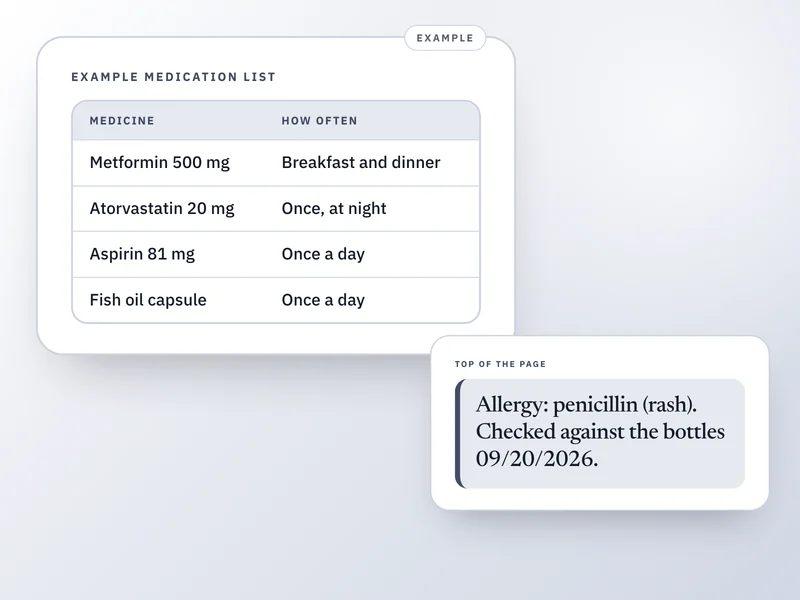 If this is where you areHow to keep a family medication listOnce each person has a page, the medicine list is the section that goes stale fastest, and this shows how to write it.
- Camp and school health forms: what to have ready
When a camp or school form arrives asking for the same details, this shows how to pull them from your binder page.
- Babysitter information sheet: what to put on it
To hand part of the binder to a sitter or grandparent, this covers the one-page version and what goes on it.
- Caregiver binder for a parent and kids: one page each
If you also look after a parent, this sets up the same binder with one page per person across both generations.