A babysitter sheet is one printed page: allergies in a box at the top, medicines with the dose and how often, two people to call, the doctor's number, your home address, and a few lines on bedtime and comforts. Put it where the sitter will look before you leave, usually the fridge.
This is for parents handing a child to a sitter, a grandparent or a neighbor. It can't tell you what care your child needs, and it isn't medical advice. The 911 line is for the US.
Example: the moment the sheet earns its place
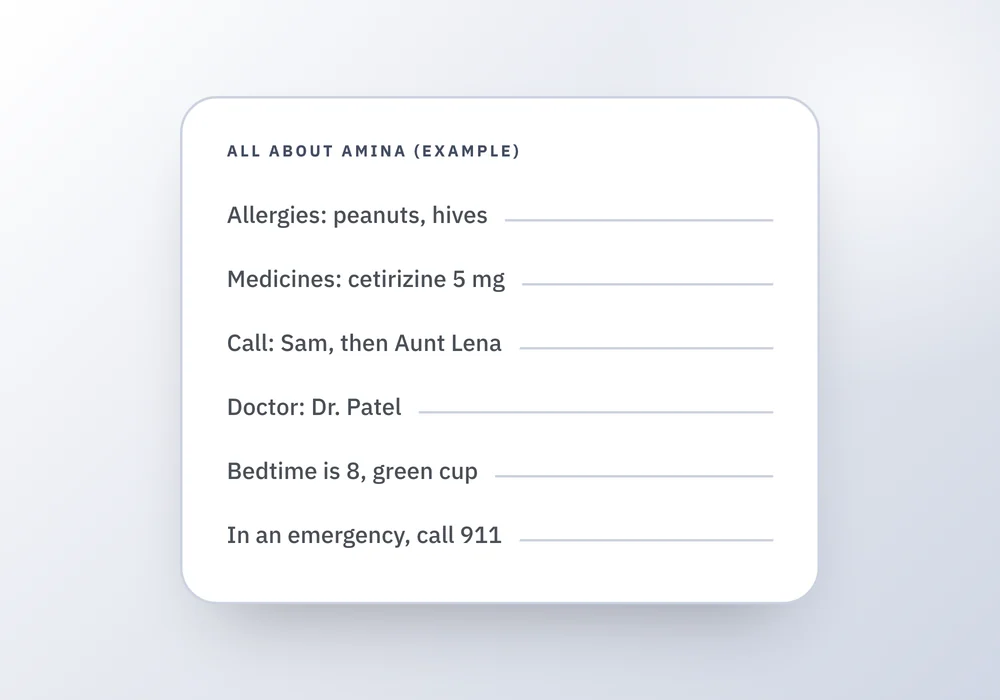
Say a sitter is on her first night with an eight-year-old, and at 7:40 the child says her throat feels funny after a snack. The sitter has your cell number and no idea whether anything in that snack is a problem. Below is a filled sheet for an invented child. If it's on the fridge, the first thing she reads is the allergy box, not a text thread. Everything here is made up.
A filled sheet (example, invented child)
Name
- What the sheet says
- All about Amina, 8
Allergies (big box, top)
- What the sheet says
- Peanuts. Reaction: hives.
Medicines now
- What the sheet says
- Cetirizine 5 mg, once a day, morning. Inhaler, 2 puffs when needed. Both as labeled.
Who to call
- What the sheet says
- Sam (dad), (555) 010-0142. Second: Aunt Lena, (555) 010-0177. Doctor: Dr. Patel, (555) 010-0100.
Where we are
- What the sheet says
- 14 Alder Lane, cross street Pine. Out at the Rivera house until 10.
Good to know
- What the sheet says
- Bedtime is 8. Green cup. Night light on, door open. Afraid of dogs.
Bottom line
- What the sheet says
- In an emergency, call 911.
| Section | What the sheet says |
|---|---|
| Name | All about Amina, 8 |
| Allergies (big box, top) | Peanuts. Reaction: hives. |
| Medicines now | Cetirizine 5 mg, once a day, morning. Inhaler, 2 puffs when needed. Both as labeled. |
| Who to call | Sam (dad), (555) 010-0142. Second: Aunt Lena, (555) 010-0177. Doctor: Dr. Patel, (555) 010-0100. |
| Where we are | 14 Alder Lane, cross street Pine. Out at the Rivera house until 10. |
| Good to know | Bedtime is 8. Green cup. Night light on, door open. Afraid of dogs. |
| Bottom line | In an emergency, call 911. |
Notice "as labeled" on the medicine row. The sheet should never be the only source for a dose, and the bottle in the cupboard is the source. The sheet just tells the sitter which bottles to look for.
What a printed health sheet covers, and what you add by hand
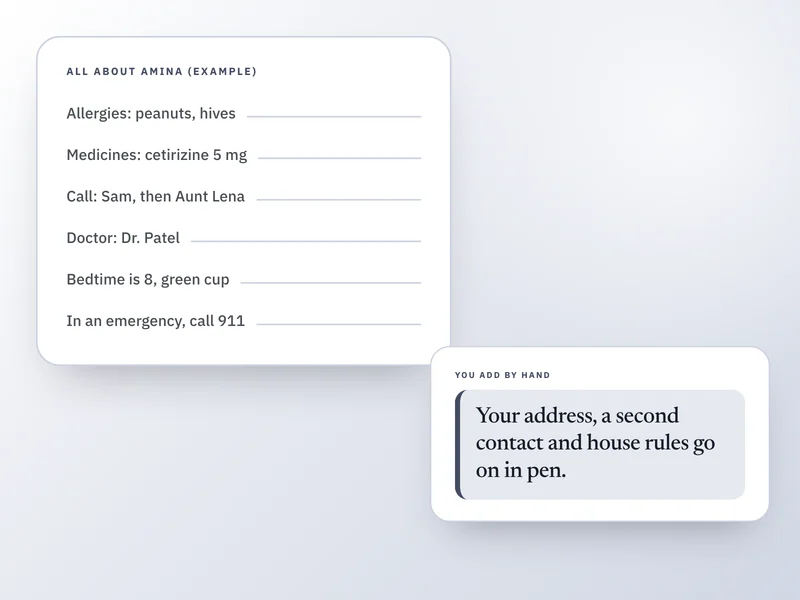
Family Health Binder's Caregiver sheet covers the left side. The right side is yours, in pen, on the same page.
- Allergies in a big box, with the reaction
- Medicines now, dose and how often
- Conditions, if you've entered any
- One emergency contact and the doctor
- Your notes on routines and fears
- In an emergency, call 911
- Your home address and cross street
- A second person to call
- Where you'll be, and when you're back
- House rules: screens, snacks, bedtime
- Where the first aid kit and spare key are
- Pets and any visitors expected
On the printed sheet
- Allergies in a big box, with the reaction
- Medicines now, dose and how often
- Conditions, if you've entered any
- One emergency contact and the doctor
- Your notes on routines and fears
- In an emergency, call 911
Write by hand
- Your home address and cross street
- A second person to call
- Where you'll be, and when you're back
- House rules: screens, snacks, bedtime
- Where the first aid kit and spare key are
- Pets and any visitors expected
Set it up in this order
The house half comes from State Farm's babysitter checklist, which lists address and cross streets, safety equipment locations, screen time and food rules. The health half is yours.
- Write the allergies first and put them in a box. Say what happens in your own words: "peanuts, hives" is clearer than "nut allergy."
- Copy the medicine line from the label, not from memory: name, dose, how often. If a medicine is only given some days, say which. The medication list guide shows the layout.
- Add two numbers for you and a second adult, and say which to call first. A second name helps when your phone is in a movie theater.
- Write the address and the nearest cross street. A sitter shouldn't have to read the mailbox in a hurry, and a caller to 911 needs it.
- Add the doctor's name and number, and a poison control number. The National Capital Poison Center's site lists 1-800-222-1222 as a free, expert and confidential line.
- Write the small things: bedtime, the cup, the night light, what worries them. These lines are the ones a sitter uses most often, so keep them plain and specific.
- Add where things are: first aid kit, flashlight, spare key. Say what you expect on screens and snacks.
- Print it, put it on the fridge, and walk the sitter through the top box out loud before you go.
What to say when you hand it over
Pick the one you are facing
“The box at the top is allergies. Read it first, and call me for anything on this page you're unsure about.”
“The medicine line changed recently, so please go by the page and the label, not by what you remember from last time.”
“Call 911 first for an emergency, then me. The address is right under the phone numbers.”
For grandparents, and for anyone who knows the child well
A grandparent can know your child better than any sitter and still not know this month's medicine, this term's bedtime, or what the school has asked you to watch for. The page isn't a sign of distrust. It's how the current version reaches someone who wasn't there when it changed. Give a grandparent the same sheet a sitter gets, and add the one thing a stranger doesn't need: anything that has recently changed.
What can go wrong
The page gets old. A list that was right in March is a guess in September, so re-read it before each new sitter and date it. The page also stays where visitors can see it: a fridge is a public wall, and it can show your address and your child's allergies to anyone who comes in. Leave off insurance numbers and a full vaccine record, which a sitter has no use for. What to leave off a health page you hand over has a table for that. And a printed page isn't a plan. If a clinician has given your child a written allergy or asthma plan, keep a copy where the sitter can find it and show them.
Questions parents ask
What should be on a babysitter information sheet?
Allergies first, then medicines with the dose and how often, two people to call, the doctor's number, your home address and cross street, where you'll be, and bedtime and comfort notes. State Farm's checklist adds where the first aid kit is and your rules on screens and snacks. Keep it to one page.
Should I put my home address on it?
Yes. State Farm's checklist lists the home address and nearest cross streets, and a sitter who has to call 911 will be asked where they are. Write it under the phone numbers, in plain print, so it's the next thing the eye lands on.
What do I tell a babysitter about my child's allergies?
Put the allergy in a box at the top of the sheet with what happens, then say it out loud before you leave. If a clinician has given your child a written plan, keep a copy where the sitter can find it. What to do belongs in that plan, not on your own page.
What should I leave for grandparents?
The same sheet a sitter gets, plus anything that has changed since they last looked after the child, such as a new medicine or a new routine. Grandparents may know your child well and still not know this month's details. Hand it over in person and point to the medicine line.
Should I text the sheet or print it?
Print it, and text it as well if you like. A page on the fridge is there when a phone is out of battery or a thread is buried. Family Health Binder makes the PDF for you to print or hand over. It doesn't send anything to anyone.
Where the Family Health Binder fits
Family Health Binder prints a Caregiver sheet titled with the child's name, such as All about Amina. It has the allergies in a large box, what's taken now, who to call, and your own notes on bedtime, comforts and fears. Those notes print on that sheet and nowhere else, and the sheet says in an emergency to call 911. Medicines with a stop date and records you marked private are left off. It doesn't have your address, a second contact or your house rules, so write those in by hand, and it doesn't send the page: you print it and hand it over. For the details a camp or school asks for, see camp and school health forms.
Sources and how we checked
- Prepare a Babysitter Checklist (State Farm): House half of the sheet: location and schedule, backup contact, emergency numbers, home address and cross streets, safety equipment, screen and food rules.Checked 26 September 2026.
- Poison Control (National Capital Poison Center): 1-800-222-1222 described as free, expert and confidential.Checked 26 September 2026.
Where to go next
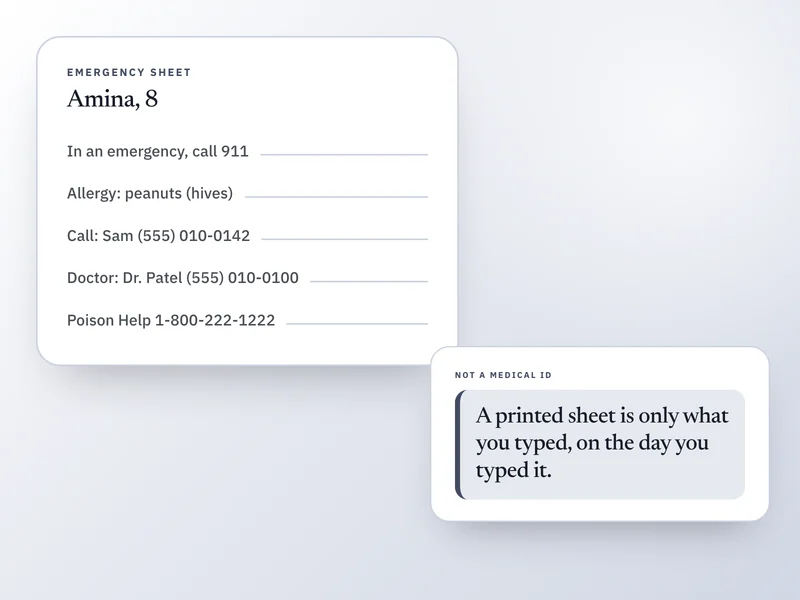 If this is where you areEmergency contact information sheet: what to includeFor the names, numbers and few facts someone needs in a hurry, this covers the emergency sheet to keep beside it.
- What health information to share with a sitter or school
Not everything about your child belongs in a sitter's hands, and this helps you decide what stays off the page.
- How to keep a family medication list
If your child takes something regularly, this shows how to write the medicine line so a sitter can read it.
- Camp and school health forms: what to have ready
For the longer forms a camp or school sends, this lists what to have ready before they arrive.