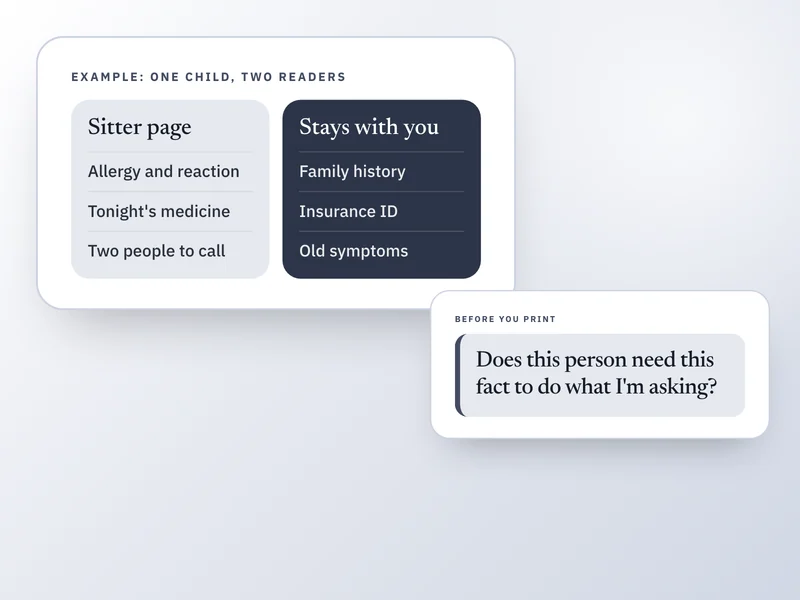
Give a sitter what they would need to act on in the next four hours: allergies and what a reaction looks like, what is taken and when, who to call, and the routines. Give a school or camp what its form asks for, no more. Keep the rest on your own page.
This is for a parent deciding what to print. Once a page is on paper you can't control who reads it, and what a school, camp or clinic is required to ask for is theirs to say. It isn't legal or medical advice.
Ten minutes before the sitter rings the bell
It's 6:20 and the sitter arrives at 6:30. You have the full history open: every allergy, every past symptom, the note about last winter, the family history, the insurance member ID. The fastest thing to do is print all of it. The better thing is to pick.
Example: one child, three pages
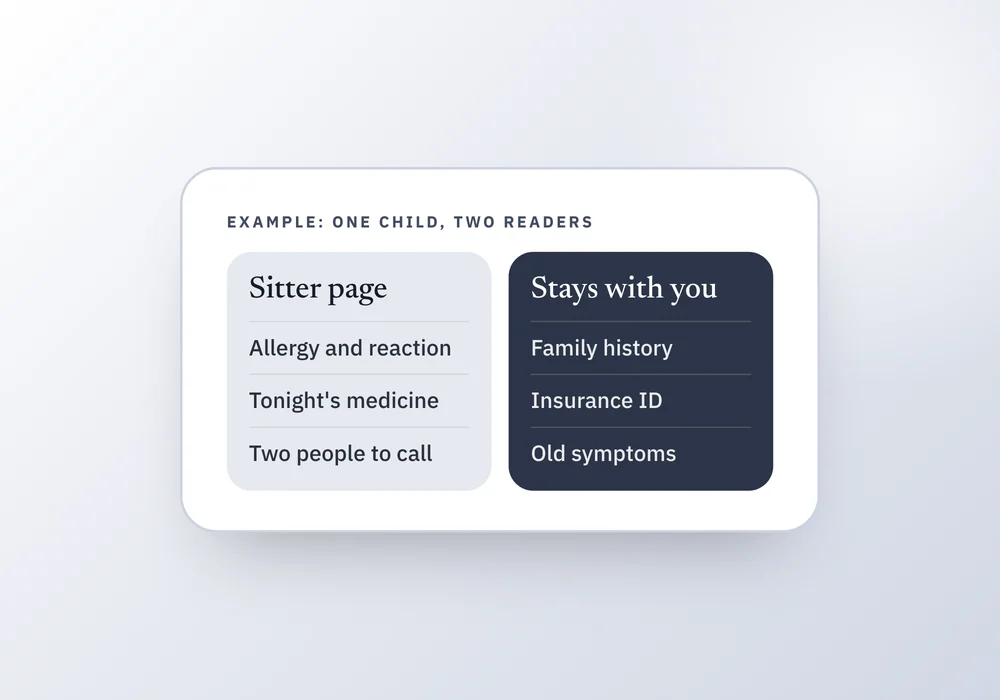
An invented child, Amina, and what each reader gets. The right column stays on your own page.
Sitter
- Goes on their page
- Peanut allergy and hives, what is taken tonight, your cell, bedtime is 8, the green cup
- Stays on yours
- Family history, insurance ID, old symptoms, conditions the sitter can't act on
Camp form
- Goes on their page
- What the form asks: birth date, who to call, allergy, medicines, doctor
- Stays on yours
- Anything the form doesn't ask, including symptom notes
New doctor
- Goes on their page
- Allergies, medicines, conditions, family history, recent symptoms
- Stays on yours
- Home routines, the sitter's bedtime notes
| Reader | Goes on their page | Stays on yours |
|---|---|---|
| Sitter | Peanut allergy and hives, what is taken tonight, your cell, bedtime is 8, the green cup | Family history, insurance ID, old symptoms, conditions the sitter can't act on |
| Camp form | What the form asks: birth date, who to call, allergy, medicines, doctor | Anything the form doesn't ask, including symptom notes |
| New doctor | Allergies, medicines, conditions, family history, recent symptoms | Home routines, the sitter's bedtime notes |
Three questions before you print
- Does this person need this fact to do what I'm asking of them? A sitter who will give a bedtime snack needs the allergy. A sitter probably doesn't need the family history.
- Would I be fine if this page were left on a counter, photographed, or found by another parent? If not, take the line off.
- Is it current? A wrong medicine on a sitter's page is worse than a missing one. Check the date on your list before you print.
What a sitter sheet needs, and what we'd skip
A page for a sitter, grandparent or neighbor. We'd skip insurance numbers here, because the first thing a sitter needs is your phone, not a member ID.
7 things to do
Ticks are for this visit only. Nothing here is saved anywhere.
A page is not a handover
A parent's own advice isn't the same as a plan for a child's allergy. If your child has a food allergy, Kids With Food Allergies suggests going through a written emergency plan with the sitter and showing them how to use any auto-injector trainer, not just leaving a page. A sheet can hold the facts. It can't teach someone to act on them, and the person who prescribed the medicine or wrote the plan is the one to ask about that.
When a form asks for more than seems needed
You can ask before you answer.
Pick the one you are facing
“Is this field required, and who sees the form?”
“Can I list only what affects the program, or do you need the full history?”
“Here's what to do if it comes up tonight. The rest isn't needed.”
“Where is this kept, and can I take my copy back at the end?”
What happens once it is printed
Paper is easy to copy and hard to recall. A form handed to a camp may go to a nurse, a director and a counselor. A sheet left at the house may be seen by anyone who comes in. That is the reason to hand over a selection, and to keep the full record in one place of your own. The full version should never be the one that travels.
Questions people ask
How much medical information should I give a babysitter?
Enough to act on for the hours they are with your child: allergies and what a reaction looks like, medicines taken and when, who to call, and where any supplies are. Skip history they can't act on. Walk through the important parts in person, since a page doesn't replace a conversation.
What health information does a school need?
That is the school's and your state's decision, and it varies. Start from the form the school gives you. Common items are who to call, allergies and medicines taken at school. If a field seems unrelated, ask why it is needed before you fill it in.
Should I list every medicine on a sitter sheet?
List what could come up while the sitter is there: what is taken tonight, and anything the sitter might need to give or watch for. A medicine taken only at home, in the morning, may not need to be on it. When in doubt, write it in the way it appears on the label.
Is it safe to put insurance information on a babysitter sheet?
We'd leave it off. A sitter's first call is you, then the second contact. Insurance numbers are easy to copy from a page left on a counter. If a sitter has to take a child to urgent care, you can give the details by phone or leave the card.
How do I keep a private record but still share what a form needs?
Keep your full record in one place and treat every printed page as a selection from it. Choose per reader, using the three questions above. If your tool has a print filter, use it, but remember that once a page is printed, the filter can't take it back.
Where the Family Health Binder fits
In Family Health Binder, each allergy, medicine, symptom, vaccine or visit can be marked Keep this private. That record stays in the app and is left off every printed page, and each printed page says how many records it left off, so a page never looks complete when it isn't. It is a print filter, not a lock: you still see the record in the app. The emergency contact, insurance, doctors and caregiver notes have no private setting and print wherever they are used. Nothing is shared with the sitter, school or camp except the PDF you print and hand over.
Sources and how we checked
- Training for Babysitters and Caregivers (Kids With Food Allergies): Parents should give a sitter a written emergency plan, meet ahead of time, and practice with an auto-injector trainer.Checked 26 September 2026.
- Poison Control (America's Poison Centers): Poison Help line 1-800-222-1222 is free and confidential; call 911 if the person collapses, has a seizure or trouble breathing.Checked 26 September 2026.
Where to go next
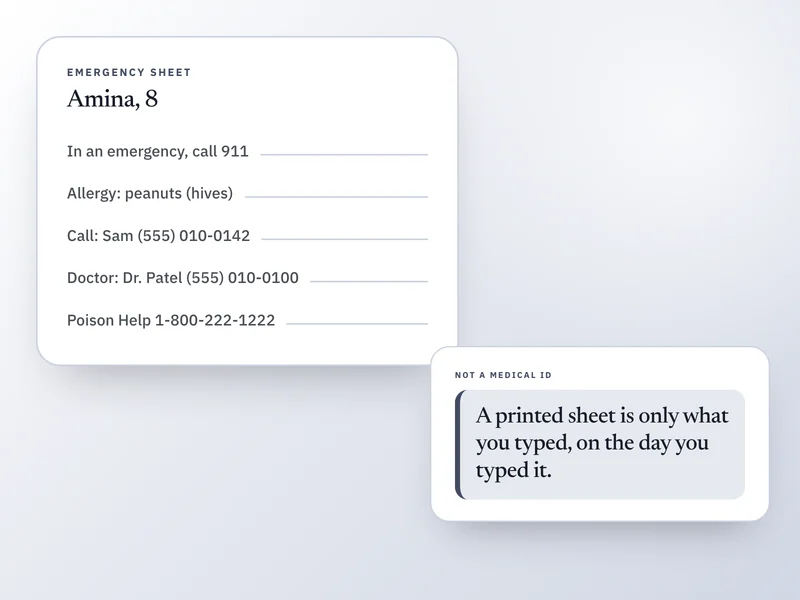 If this is where you areEmergency contact information sheet: what to includeOnce you know what to share, this shows how to set out the emergency page that everyone can see.
- Babysitter information sheet: what to put on it
For the actual sitter or grandparent sheet, this lists what goes on it and how to order it.
- Camp and school health forms: what to have ready
Schools and camps ask for a fixed set of details, and this lists what to have ready.
- What to put in a family medical binder
To keep the full set of private details in one place, start with the family medical binder.