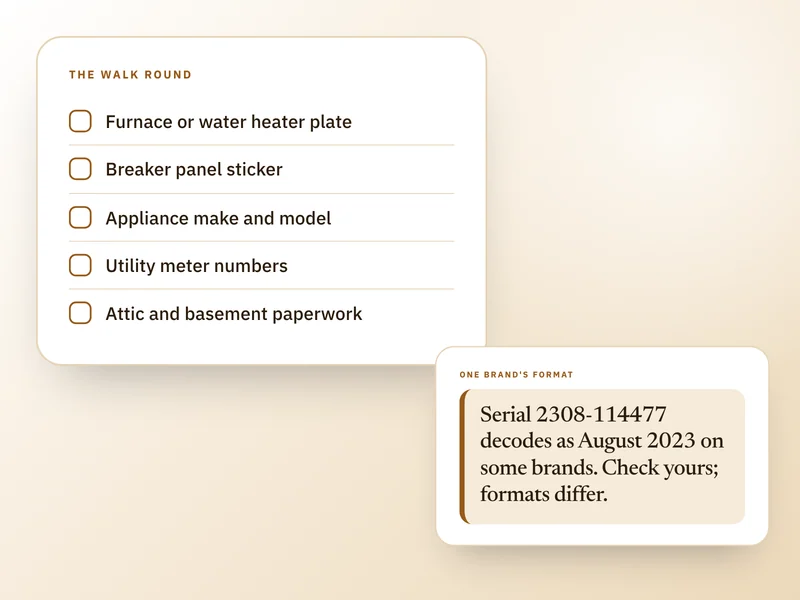
Most of what an inherited or unrecorded house needs to tell you is already written on it. An afternoon with a flashlight and your phone's camera, checking data plates, service stickers and any paperwork still in a drawer, recovers the age and condition of nearly everything, even with no manuals and no history from the last owner.
This is for the maintenance side only: dating what you have, and knowing what to check first. If you inherited this house because someone died, we're sorry, and this page has nothing to say about probate or how title passes, which are handled by the state the property sits in and are worth a local probate attorney's time, not a maintenance guide.
Example: reading an age out of a serial number
Say the sticker on the water heater reads Serial: 2308-114477. On some brands, not all, the first two digits are the year and the next two are the month, which would make this unit built in August 2023. That's one data point from one numbering scheme, not a certainty, so treat it as a starting guess until you confirm it against that brand's own page.
A fifteen year old water heater and a two year old one are different planning problems, regardless of whether either is misbehaving today. That's the one thing a manufacture date tells you that nothing else does.
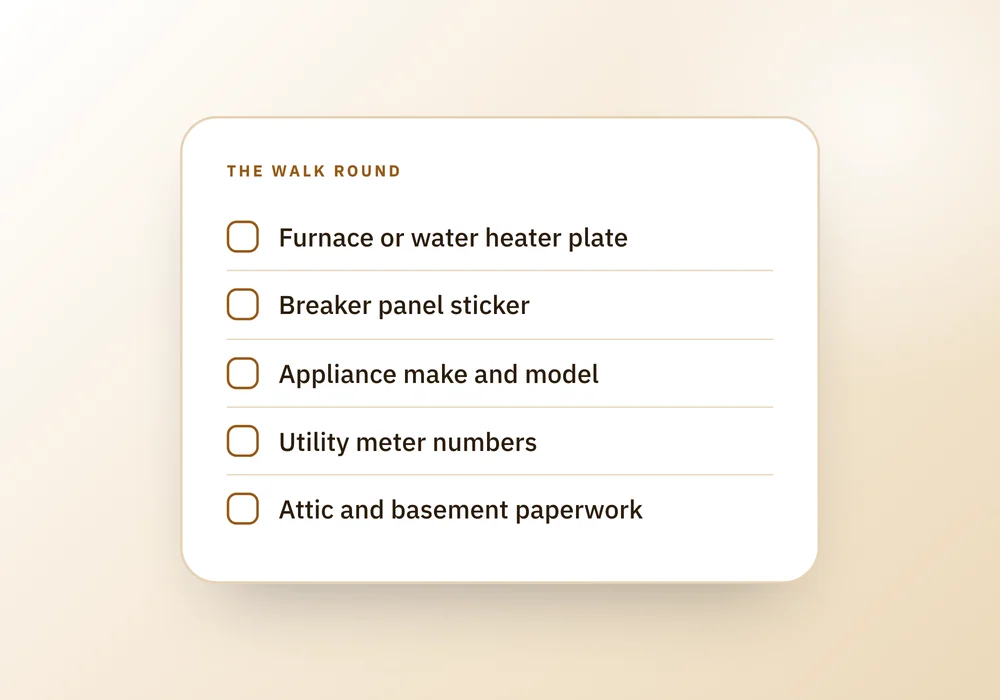
The walk round
Photograph every plate and label you find instead of copying numbers by hand. Bad light and small print turn handwriting into guesswork.
6 things to do
Ticks are for this visit only. Nothing here is saved anywhere.
Typical service lives
General trade guidance, not a prediction for your house and not something Home Base tracks. Climate, use and upkeep change these a lot.
Furnace (gas)
- Typical life
- Often 15 to 20 years
- What to do if yours is near it
- Get it serviced and ask directly about remaining life
Water heater, tank
- Typical life
- Roughly 8 to 12 years
- What to do if yours is near it
- Budget for replacement rather than waiting for a failure
Water heater, tankless
- Typical life
- Often 15 to 20 years
- What to do if yours is near it
- Descale on schedule and ask about the heat exchanger
Central air conditioning
- Typical life
- Often around 15 years
- What to do if yours is near it
- Service before summer, ask about the refrigerant type
Asphalt shingle roof
- Typical life
- 15 to 30 years, depending on the product
- What to do if yours is near it
- Get an inspection rather than guessing from the ground
Main electrical panel
- Typical life
- Often 30 years or more
- What to do if yours is near it
- Have it inspected, particularly if it looks original
| System | Typical life | What to do if yours is near it |
|---|---|---|
| Furnace (gas) | Often 15 to 20 years | Get it serviced and ask directly about remaining life |
| Water heater, tank | Roughly 8 to 12 years | Budget for replacement rather than waiting for a failure |
| Water heater, tankless | Often 15 to 20 years | Descale on schedule and ask about the heat exchanger |
| Central air conditioning | Often around 15 years | Service before summer, ask about the refrigerant type |
| Asphalt shingle roof | 15 to 30 years, depending on the product | Get an inspection rather than guessing from the ground |
| Main electrical panel | Often 30 years or more | Have it inspected, particularly if it looks original |
Who should you call for a first inspection?
If the house is truly undocumented, one visit from a licensed home inspector, or a heating and cooling technician if you only care about that one system, tells you more in a couple of hours than weeks of guessing, and it produces something you can keep: a dated, written report.
The value isn't only the findings. It's that you now have a real starting point, which is what every future service interval gets measured from.
Treat unknowns as due
Where you truly can't find out when something was last done, assume it's due. For most jobs on a home maintenance list, checking something that didn't need it costs an hour, and skipping something that did costs a great deal more.
Once you've done it, you have a real date, and the guessing stops for good. How often things in your house actually need servicing has the intervals to work from next.
What the walk round won't tell you
A walk round finds what's visible. It won't tell you about wiring behind a wall, a slow leak under a slab, or whether a permit was ever pulled for work someone did years ago. If anything you find looks like older wiring, an unfamiliar panel brand, or metal pipe where you expected plastic, that's a reason to call an electrician or plumber, not a reason to keep guessing on your own.
And if you're here because of a death in the family, the maintenance list can wait. There's no deadline on a furnace filter that applies before you're ready to deal with any of this.
Questions people ask
How do I find out how old my furnace or water heater is?
Check the data plate for a manufacture date first; many list it outright. If not, the serial number often encodes it, though the format differs by brand, so search that brand's support page for how to read it. A purchase or install date written anywhere in the house also works as a rough substitute.
What should I check first in a house with no records?
Start with whatever would be worst to have fail without warning: the water heater, the furnace or heat pump, and the breaker panel. Photograph their plates, note the age if you can find it, and book one inspection if the house is completely undocumented. Everything else can follow at a slower pace.
Do I need a home inspection if I already live there?
Not always, but it's worth it for a house you have no history on. A licensed inspector will look at systems you can't easily assess yourself, wiring, structure, roofing, and give you a dated written report that becomes your new starting point for every future maintenance interval.
Is probate the same in every state?
No. Probate and how title passes after a death are set by the state the property is in, and the process, timeline and paperwork differ from state to state. This guide only covers home maintenance; for the estate itself, a probate attorney licensed in that state, or the local court handling probate for the county where the house sits, is the right place to start.
Can Home Base tell me how old my appliances are?
No. Home Base has no lifespan or age feature; it works from whatever dates you enter and tells you what's due based on those, not on a predicted replacement year. The typical-life table above is this guide's own general trade guidance, not something the app calculates or tracks.
What Home Base does with it
Home Base is built to be filled in from exactly this kind of walk round. Add each thing you find with just a name, and it only asks for the fields that make sense for that category, brand, model, install date, warranty, what to buy, so a water heater and a breaker panel don't get the same form. It works from whatever you know, not a complete history, and once a single date exists for something, it takes over the job of saying what's due next. See Home Base.
Sources and how we checked
- Menlo Park Fire Protection District: Nominal Life Expectancy for Building Components: General facilities-planning figures used for the furnace, roof and electrical panel typical-life rows.Checked 26 September 2026.
- Today's Homeowner: How Long Does a Water Heater Last?: Tank vs tankless typical lifespans, and the year-month serial number convention used in the worked example.Checked 26 September 2026.
Where to go next
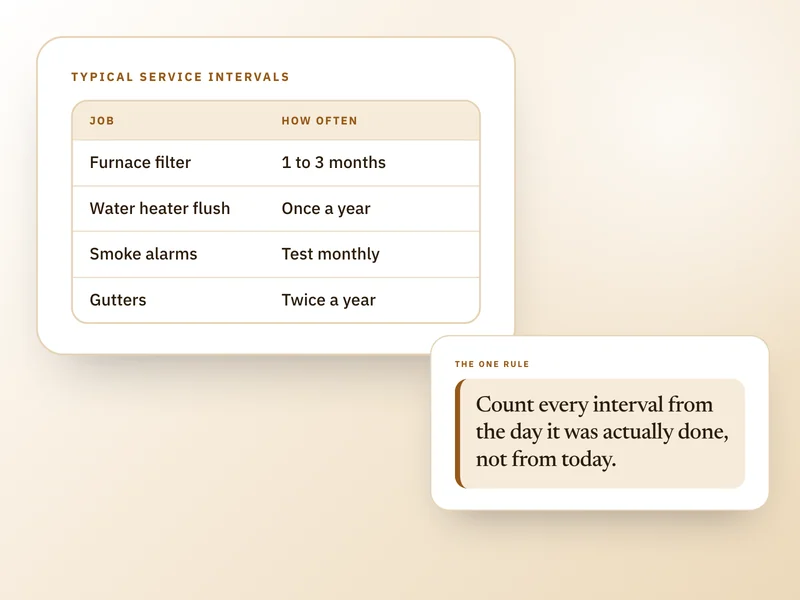 If this is where you areHome maintenance schedule: how often to service each systemWith no service history to go on, a schedule of typical intervals tells you which systems to look at first.
- New house checklist: what to do in the first week
Handing over the keys is the same moment as a new purchase, so this checklist covers the first week.
- What to write down when you buy an appliance
Start writing things down now with this one-page appliance record so the next owner is not guessing.
- Home maintenance jobs that cost the most to skip
To decide where the first repair money goes, this ranks the eight jobs that cost most when skipped.