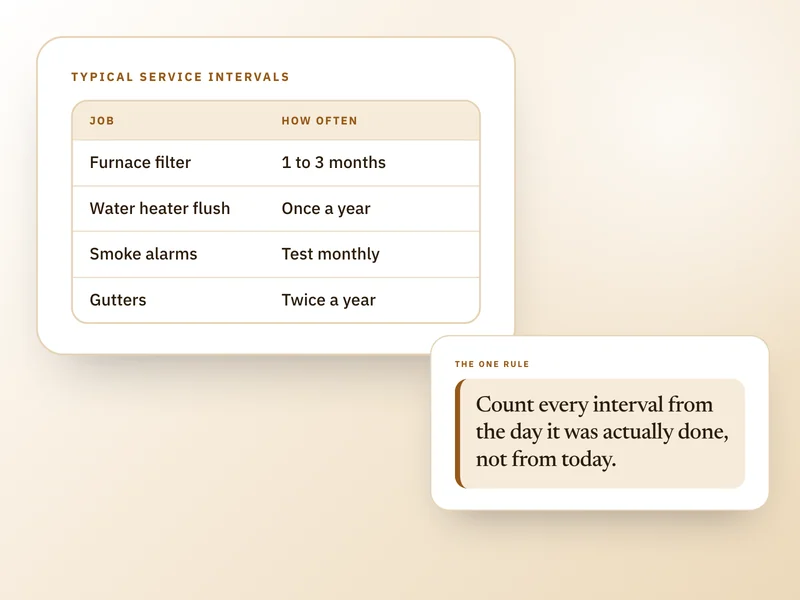
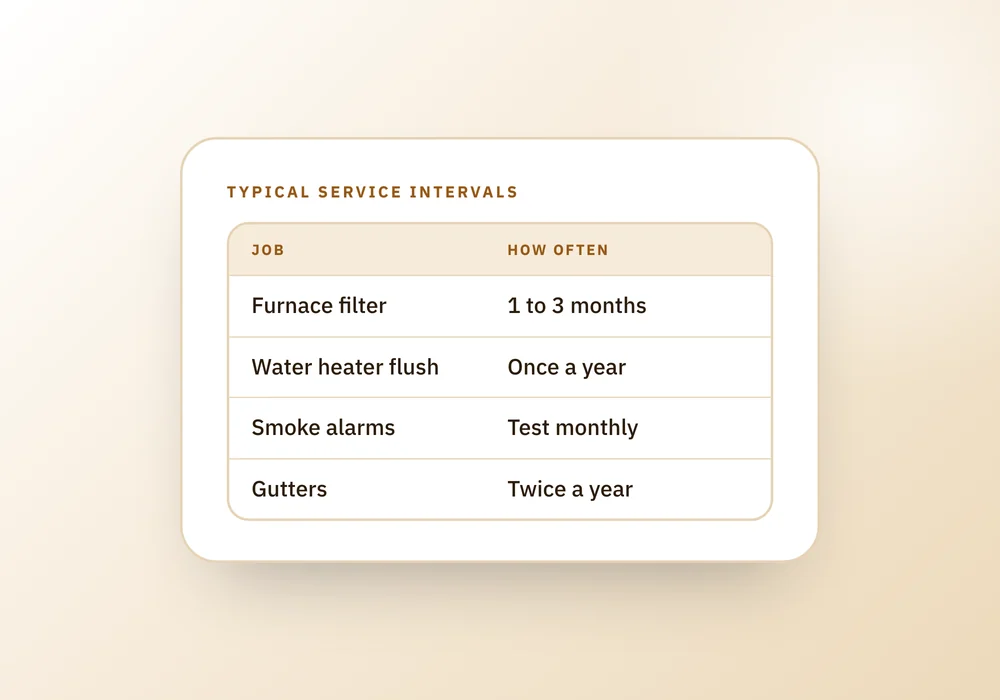
Furnace and AC filters want attention every one to three months. A water heater wants a flush once a year and an anode rod check on the same schedule. Smoke alarms get tested monthly and replaced at 10 years. A handful of outdoor jobs run on a season instead of a date.
This is a reference table for a typical U.S. home, not your owner's manual, which always wins when the two disagree. It also can't tell you the condition of a system no one has looked at in years: treat anything unknown as already due, not as still within its interval.
Example: a house bought three years ago
Say you moved in three years ago. The furnace filter has never been changed, because no one mentioned it needed to be. The water heater has never been flushed. The smoke alarms are original to a house built in 2013, which puts them a year past the 10 year mark printed on the back of the unit.
None of that is unusual, and none of it is expensive to fix once you know it's due. That's what the rest of this page is for: a plain answer for each system, and what changes if you don't know the last time it was done.
Heating, cooling and water
The systems where a missed service tends to show up in the coldest or hottest week of the year.
Replace the furnace or AC filter
- Interval
- Every 1 to 3 months
- Why this interval
- A dirty filter restricts airflow, strains the blower, and raises the energy bill before it fails outright
Book a heating tune-up
- Interval
- Annually, before the heating season
- Why this interval
- Catches an unsafe burner or a cracked heat exchanger before the coldest week finds it
Book a cooling tune-up
- Interval
- Annually, before summer
- Why this interval
- A failure in August takes longer and costs more to fix than one caught in April
Flush the water heater tank
- Interval
- Annually
- Why this interval
- Sediment settles on the tank floor and insulates the burner or element from the water, so it works harder for the same result
Check the water heater anode rod
- Interval
- Once a year; most need replacing every 3 to 5 years
- Why this interval
- The rod corrodes on purpose so the tank doesn't. Once it's gone, the tank corrodes next
Clean the furnace condensate drain line
- Interval
- Annually
- Why this interval
- A blocked drain line is a common, avoidable cause of water damage near the furnace
| Job | Interval | Why this interval |
|---|---|---|
| Replace the furnace or AC filter | Every 1 to 3 months | A dirty filter restricts airflow, strains the blower, and raises the energy bill before it fails outright |
| Book a heating tune-up | Annually, before the heating season | Catches an unsafe burner or a cracked heat exchanger before the coldest week finds it |
| Book a cooling tune-up | Annually, before summer | A failure in August takes longer and costs more to fix than one caught in April |
| Flush the water heater tank | Annually | Sediment settles on the tank floor and insulates the burner or element from the water, so it works harder for the same result |
| Check the water heater anode rod | Once a year; most need replacing every 3 to 5 years | The rod corrodes on purpose so the tank doesn't. Once it's gone, the tank corrodes next |
| Clean the furnace condensate drain line | Annually | A blocked drain line is a common, avoidable cause of water damage near the furnace |
The furnace filter is the one job on this table people get wrong most often, mostly because the size printed on the frame is easy to lose track of. There's a full page on reading it and writing it down once: how often to change a furnace filter.
Kitchen and laundry appliances
Smaller jobs, easy to forget, real consequences when they're skipped.
Clean the refrigerator condenser coils
- Interval
- Every 6 months
- Why this interval
- Dust-caked coils make the compressor run longer for the same amount of cooling
Clean the dryer vent
- Interval
- At least once a year
- Why this interval
- Lint restricts airflow and is a documented cause of house fires
Replace the washing machine's supply hoses
- Interval
- Every 3 to 5 years, sooner if cracked or bulging
- Why this interval
- A failed hose can empty hundreds of gallons into a laundry room in minutes
Degrease the range hood filter
- Interval
- Monthly
- Why this interval
- A greasy filter is a fire risk and the reason the hood stops pulling smoke
| Job | Interval | Why this interval |
|---|---|---|
| Clean the refrigerator condenser coils | Every 6 months | Dust-caked coils make the compressor run longer for the same amount of cooling |
| Clean the dryer vent | At least once a year | Lint restricts airflow and is a documented cause of house fires |
| Replace the washing machine's supply hoses | Every 3 to 5 years, sooner if cracked or bulging | A failed hose can empty hundreds of gallons into a laundry room in minutes |
| Degrease the range hood filter | Monthly | A greasy filter is a fire risk and the reason the hood stops pulling smoke |
Structure, safety and exterior
Cheap to do, expensive to skip. A lot of water and fire damage starts with something on this list.
8 of 8 rows shown
Clear the gutters
- Interval
- Twice a year, spring and fall
- Why this interval
- A clogged gutter sends water down the siding instead of away from the foundation
Inspect the roof and flashing
- Interval
- Annually
- Why this interval
- Roof leaks usually start at a joint, not in the middle of a slope
Reseal grout and caulk
- Interval
- Every 1 to 2 years
- Why this interval
- Failed sealant lets water behind tile or trim, where it's invisible for months
Test smoke and CO alarms
- Interval
- Monthly
- Why this interval
- The one job here where the cost of skipping isn't measured in dollars
Replace smoke alarm units
- Interval
- Every 10 years from the manufacture date
- Why this interval
- Sensors lose sensitivity with age even when the battery still tests fine
Test GFCI outlets
- Interval
- Monthly
- Why this interval
- A GFCI that's stopped tripping still powers the outlet, so nothing looks wrong
Test the garage door's auto-reverse
- Interval
- Every 6 months
- Why this interval
- A door that doesn't reverse on contact is a real hazard, not a maintenance nicety
Test the sump pump
- Interval
- Every 6 months
- Why this interval
- An untested pump is one you find out about during the storm
| Job | Interval | Why this interval |
|---|---|---|
| Clear the gutters | Twice a year, spring and fall | A clogged gutter sends water down the siding instead of away from the foundation |
| Inspect the roof and flashing | Annually | Roof leaks usually start at a joint, not in the middle of a slope |
| Reseal grout and caulk | Every 1 to 2 years | Failed sealant lets water behind tile or trim, where it's invisible for months |
| Test smoke and CO alarms | Monthly | The one job here where the cost of skipping isn't measured in dollars |
| Replace smoke alarm units | Every 10 years from the manufacture date | Sensors lose sensitivity with age even when the battery still tests fine |
| Test GFCI outlets | Monthly | A GFCI that's stopped tripping still powers the outlet, so nothing looks wrong |
| Test the garage door's auto-reverse | Every 6 months | A door that doesn't reverse on contact is a real hazard, not a maintenance nicety |
| Test the sump pump | Every 6 months | An untested pump is one you find out about during the storm |
Jobs that run on a season, not a date
These don't follow a rolling interval. For the full month-by-month version, see home maintenance checklist by month.
5 things to do
Ticks are for this visit only. Nothing here is saved anywhere.
Start counting from the last time it was actually done
A common mistake is to start every interval from the day you happen to write the list, which schedules a furnace tune-up twelve months from an arbitrary Tuesday instead of twelve months from the last real service. If you know roughly when something was last done, count from that date.
If you truly don't know, treat it as due. For nearly everything on this page, an unnecessary check costs an hour and a missed one costs a great deal more. There's more on which of these bite hardest, in order, in the home maintenance you skip that costs the most.
When this table won't match your house
Your manual always wins over this page. A specific model can call for something different, and a tankless water heater is descaled on its own schedule rather than flushed like a tank.
An older system that's never been serviced doesn't get a pass because the interval hasn't technically arrived yet. If a 12-year-old water heater has never been flushed, or the furnace filter is the one that came with the house, treat the job as overdue starting now, not on a schedule that assumes it was kept up.
Climate changes some of these too. A furnace in a mild climate runs less and can sometimes stretch its tune-up interval; an AC in a hot climate works harder and shouldn't. These are typical U.S. ranges, not a substitute for what a technician sees in your specific system.
Questions about which jobs matter most
What is the most important home maintenance task?
There's no single answer, because the jobs on this page rank close together in what they cost to skip. If you can only do one this weekend, start with the furnace or the water heater: both tend to fail in the season you need them most, and both take under an hour to check or book.
How often should gutters be cleaned?
Twice a year for most houses: once in spring after winter debris settles, and once in fall once the leaves are down. Clean them more often with overhanging trees, since needles and small leaves clog a downspout faster than large leaves do.
How often should you change a furnace filter?
Check it monthly and change it at least every three months, per ENERGY STAR guidance. Shorten that to once a month with pets, allergies, or recent construction dust in the house, since airflow through a clogged filter drops well before it looks obviously dirty.
How often should a water heater be flushed?
Once a year for most tank water heaters, according to manufacturer guidance from brands including A.O. Smith. Flushing removes sediment that settles on the tank floor, which insulates the heating element from the water and makes it work harder for the same result over time.
How often do smoke detectors need to be replaced?
Every 10 years from the manufacture date, printed on the back or side of the unit, according to the U.S. Fire Administration. Test the alarm monthly in the meantime; a working battery doesn't mean the sensor inside is still reliable after a decade.
What Home Base does with this table
Home Base already holds an interval for each of its 148 built-in care jobs, ranks what to look at first by what happens if you skip it, and works out the next due date from when you actually last recorded the job rather than from an arbitrary start date. Record the brand and model on an item once, and every row above turns into a fact instead of a guess.
Once a job is done, a maintenance log is where the date goes so the next one isn't a guess either. See how the intervals work in Home Base.
Sources and how we checked
- ENERGY STAR: Heat and Cool Efficiently, Maintenance Checklist: Inspect the filter monthly, change it at least every 3 months; schedule an annual pre-season tune-up.Checked 26 September 2026.
- A.O. Smith: Water Heater Maintenance Guide: Flush most tank water heaters annually; inspect the anode rod once a year.Checked 26 September 2026.
- U.S. Fire Administration: Smoke Alarms: Test smoke alarms monthly; replace the unit 10 years from its manufacture date.Checked 26 September 2026.
- CPSC: Overheated Clothes Dryers Can Cause Fires: Clean the dryer vent, exhaust duct and lint screen periodically; blocked lint is a documented fire risk.Checked 26 September 2026.
- South Carolina Farm Bureau Insurance: Washing Machine Hose Inspection and Replacement: Replace washing machine supply hoses every 3 to 5 years; deterioration can start from the inside out.Checked 26 September 2026.
Where to go next
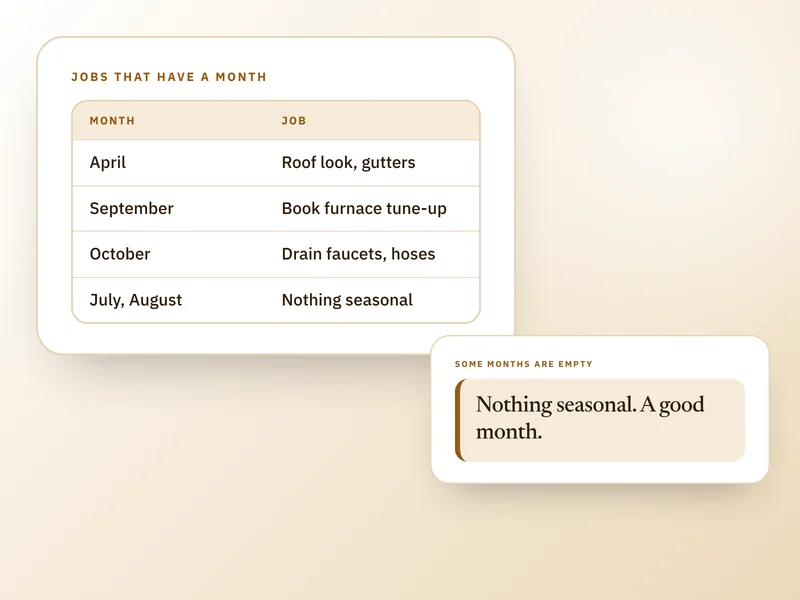 If this is where you areHome maintenance checklist by month (short version)After the intervals, this turns them into a checklist of jobs that belong to a season rather than a date.
- Home maintenance jobs that cost the most to skip
If you only have time for a few jobs, this ranks the eight that cost the most when skipped.
- How often to change a furnace filter (and the size to note)
Filters have the shortest interval on the schedule, so this covers changing them and noting the size.
- Home maintenance log template: what to write each time
Once a job is done, this shows what to write in the log so the next due date is easy to find.