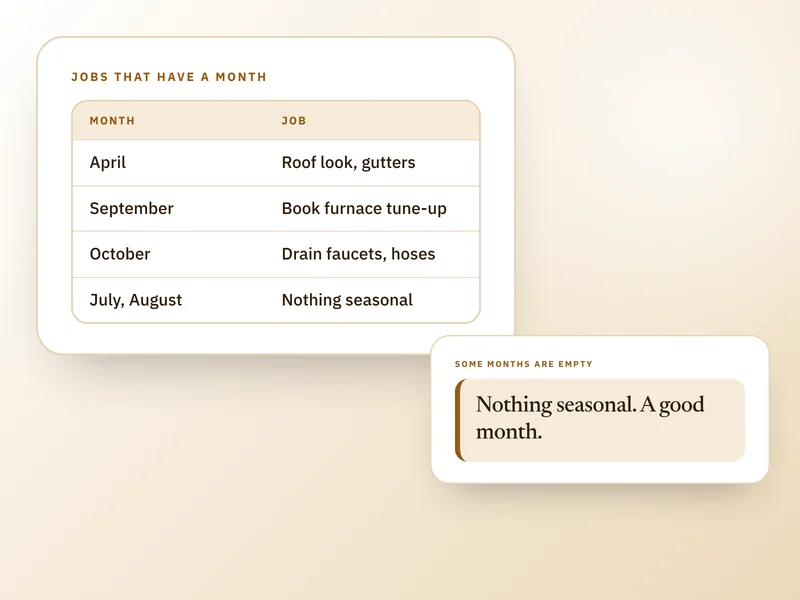
Put each deadline job in the month it belongs to. Drain outdoor faucets and irrigation before the first hard freeze, usually October or November in cold states. Book furnace service in September and air conditioning service in April. Clear gutters after the leaves fall and again in spring. Everything else runs on an interval, not a month.
This is for a house in the United States, northern hemisphere. Freeze dates and storm seasons shift with your climate, and your appliance manuals win over any list, this one included.
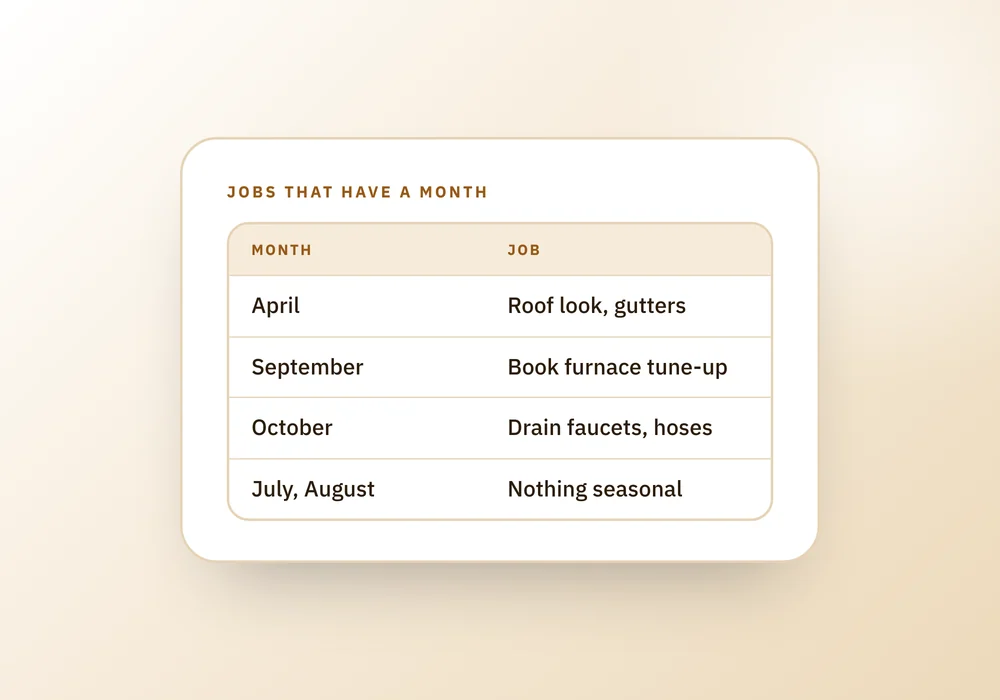
The year, month by month
Only jobs that have a season. Some months have nothing on them, and that is correct.
January
Nothing has to happen this month. Keep the monthly alarm test and the filter check, and stop there.
February
Look for tree limbs over the roof or near power lines. Book any pruning now, before spring growth.
March
Walk the outside once the snow is gone. Check that downspouts drain away from the house and that the soil hasn't sunk toward the foundation.
April
Look at the roof from the ground for lifted or missing shingles. Clear the gutters. Book air conditioning service. Switch ceiling fans to summer direction and dust the blades.
May
Have the AC serviced if you haven't. Reconnect hoses and turn outdoor water back on, then look for drips at the faucet.
June
A light month. Touch up exterior paint or caulk while the weather is dry.
July and August
Nothing seasonal. A good month.
September
Book the furnace tune-up now, before the first cold week. Seal gaps where mice can get in. Look for drafts around doors and windows.
October
The busy one. Disconnect hoses and drain outdoor faucets, blow out irrigation lines, bleed radiators if you have them, swap the humidifier pad, service the snow blower, and take window air conditioners out.
November
Clear the gutters once the leaves are down. Finish any freeze job you skipped in October.
December
Nothing seasonal. If a hard freeze is forecast and the outdoor faucets are still connected, do it today.
An example: one October weekend
Say you live somewhere the first hard freeze usually lands in early November, and it's the first Saturday of October. Two hours covers the freeze jobs. Nothing here is urgent yet, which is the point of doing it now.
The order we'd do them in
- Unscrew every garden hose, drain it and coil it in the garage. A hose left on a faucet can hold water against the pipe.
- Open the outdoor faucets to drain them. If a faucet has its own shutoff valve inside the house, close that first.
- Blow out the irrigation lines, or book the company that does it. Water left in the lines can split them.
- Bleed the radiators and swap the humidifier pad if you have either.
- Take window air conditioners out and store them.
- Write the date next to each job. Next October you'll know it was done, not just planned.
Jobs that look seasonal and aren't
These go on an interval. Tie them to the date you last did them, not to a month.
Test smoke and CO alarms
- How often
- Every month
- Why not a month
- A monthly test has no season
Furnace and AC filter
- How often
- Check monthly, change at least every 3 months
- Why not a month
- Depends on the filter and the house
Dryer lint filter
- How often
- Before and after each load
- Why not a month
- Use, not the calendar
Dryer vent
- How often
- Once a year is our default
- Why not a month
- Length of run and use decide it
Water heater flush
- How often
- Once a year
- Why not a month
- Count from the last flush
Replace smoke alarm units
- How often
- 10 years from the manufacture date
- Why not a month
- Date printed on the alarm
| Job | How often | Why not a month |
|---|---|---|
| Test smoke and CO alarms | Every month | A monthly test has no season |
| Furnace and AC filter | Check monthly, change at least every 3 months | Depends on the filter and the house |
| Dryer lint filter | Before and after each load | Use, not the calendar |
| Dryer vent | Once a year is our default | Length of run and use decide it |
| Water heater flush | Once a year | Count from the last flush |
| Replace smoke alarm units | 10 years from the manufacture date | Date printed on the alarm |
The intervals for the rest of the house are in how often things need servicing. The furnace filter has its own page, because the size and the schedule are where most people guess.
Where a month-based list goes wrong
It goes wrong first on climate. October is the freeze month in Minnesota and an ordinary month in Phoenix. Set your dates from your own first-frost date, and treat the months above as the default for the northern states.
It goes wrong second on length. Forty-item lists get abandoned around item twelve, so we'd keep only jobs with a real failure attached: a burst pipe, a leak behind a wall, a fire, a dead furnace in the first cold week. Reorganizing the garage is fine, but it isn't maintenance.
And gutters depend on the trees, not the calendar. Clearing them in September, before the leaves drop, achieves very little. Wait for the leaves.
For the freeze deadline in detail, see the winterize checklist. For the whole of autumn in order, see the fall checklist.
Questions people ask
What home maintenance should be done every month?
Test the smoke and CO alarms, since fire safety authorities say monthly. Check the furnace or AC filter and change it if it looks dirty. Clean the dryer lint filter every load. That's the whole monthly list. Everything else runs on a season or a longer interval.
What home maintenance should be done in the fall?
Book the furnace tune-up in September, drain outdoor faucets and irrigation in October, and clear gutters in November once the leaves are down. Also disconnect hoses and take window air conditioners out. Of the year's jobs, these have the strictest deadlines because a freeze doesn't wait for you.
What should you do to your house before winter?
Disconnect and drain garden hoses, drain outdoor faucets, blow out irrigation lines and get the heating serviced. Add weather stripping where you feel drafts. Federal emergency guidance names hoses, outdoor faucets and weather stripping as the basics. Do it before the first hard freeze, not after.
How often should you do home maintenance?
Some jobs are monthly, some yearly, some every few years, and a handful belong to a month. Keep two lists: a calendar for the seasonal jobs and a last-done date for the interval ones. Mixing them is how a water heater ends up flushed in a month when it was done the November before.
Where Home Base fits
This list is the same for every house, and your house isn't. Home Base keeps the months for you: its Seasons page shows spring, summer, fall and winter, each with the jobs that belong to those months for the things you told it you have. A house with no irrigation never sees the irrigation line. It reads from the same care jobs as the main screen, so the two can't disagree.
It assumes the northern hemisphere and has no region setting, so a warm-climate house should read the dates as a guide. Reminders are off until you turn them on. And you still type in what you have, since it doesn't scan or detect anything. If you want a place to write the dates down first, the home log works on paper.
Sources and how we checked
- ENERGY STAR: Heat and cool efficiently: Check the filter monthly, change at least every 3 months; yearly heating and cooling tune-up.Checked 26 September 2026.
- USFA: Smoke alarms: Test alarms monthly; replace alarms 10 years from the manufacture date.Checked 26 September 2026.
- Ready.gov: Winter weather: Disconnect hoses, drain outdoor faucets, add weather stripping before winter.Checked 26 September 2026.
- USFA: Clothes dryer fire safety: Clean the lint filter before and after each cycle; check the vent behind the dryer.Checked 26 September 2026.
- A. O. Smith: Water heater maintenance guide: Flush a tank water heater at least once a year.Checked 26 September 2026.
Where to go next
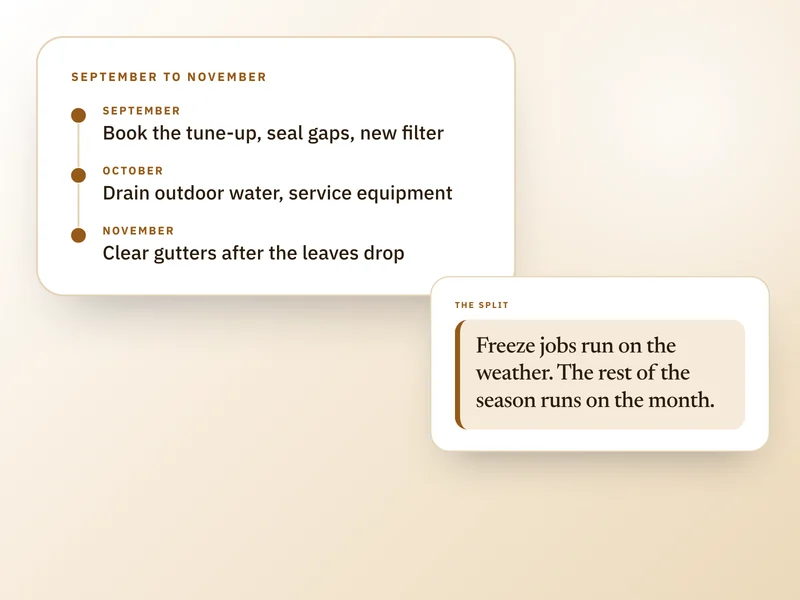 If this is where you areFall home maintenance checklist by monthAutumn has the most jobs of any season, and this lays out September to November in order.
- Home maintenance schedule: how often to service each system
For jobs that run on an interval rather than a season, this gives how often each system needs service.
- Winterize your house: jobs to finish before the first freeze
Freeze jobs have a hard deadline, and this covers what to finish before the first hard frost.
- Home maintenance log template: what to write each time
Checking jobs off is only half of it, so this shows the four fields to write each time.