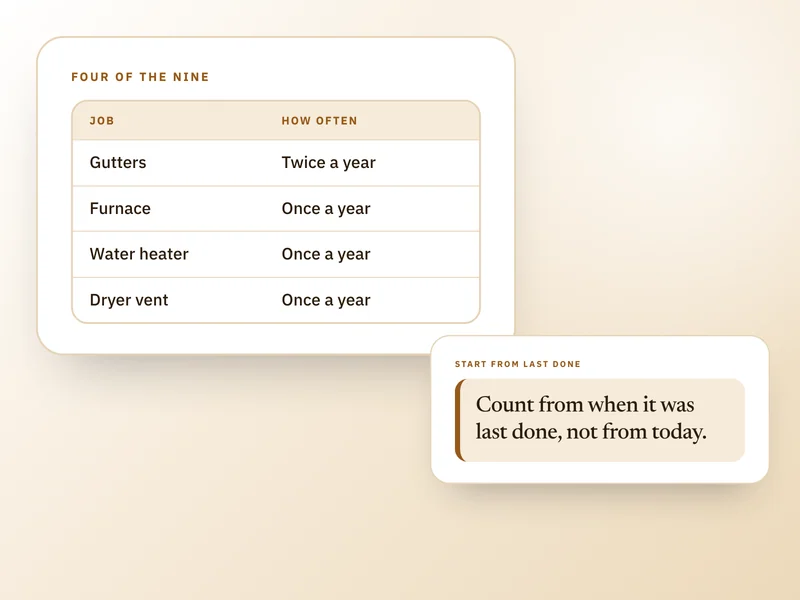
Nine home maintenance jobs turn expensive fast when you let them slide: the gutters, the furnace, the water heater, the HVAC filter, the roof, the smoke and CO alarms, the dryer vent, the washing machine hoses, and the outdoor faucets before a freeze. Each has a real interval, and pushing it past that interval is what turns a cheap job into a repair.
This is written for a house in the United States, and the intervals below are typical rather than a promise about your own systems. It cannot tell you the condition of your roof or your furnace today, only what tends to happen when a job like this runs long.
An example: what a full gutter actually costs
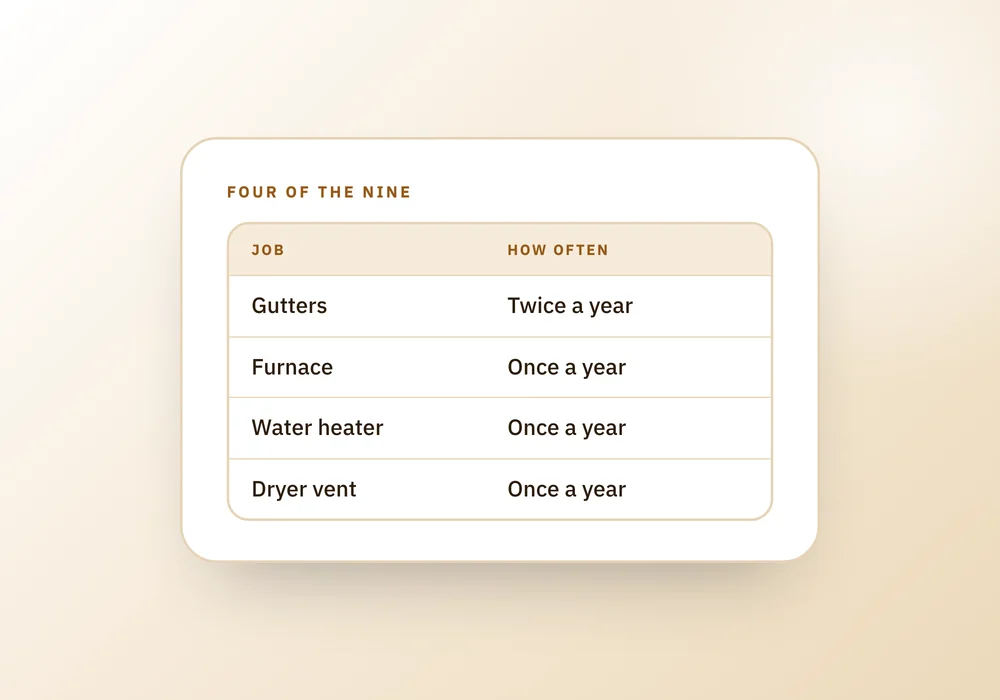
Say the gutters filled with leaves last October and nobody cleared them. Water backs up at the roof edge instead of running to the downspout, so it soaks the fascia board behind the gutter every time it rains. Wood holds that moisture longer than it dries, so it starts to rot from the inside, where you cannot see it from the ground. By the time paint is peeling or the gutter itself sags, the job is no longer clearing the gutters. It is replacing fascia, and sometimes the sheathing behind it. The labor is the same crew either way. Only the price changes.
The jobs where skipping costs the most
Sourced where a manufacturer, fire-safety or research body publishes a number; the rest is common trade practice. Your own manual wins over this table.
9 of 9 rows shown
Clear the gutters
- How often
- Twice a year, spring and fall
- What skipping it turns into
- Water pools at the roof edge, then soaks the fascia, then rots wood you cannot see from the ground
Service the furnace or heating system
- How often
- Once a year, before the cold months
- What skipping it turns into
- A breakdown in the coldest week, when technicians are booked out and parts are slow to arrive
Flush the water heater
- How often
- Once a year
- What skipping it turns into
- Sediment settles on the tank floor, which lowers efficiency and shortens the tank's life
Replace the HVAC filter
- How often
- Every 1 to 3 months
- What skipping it turns into
- A clogged filter strains the blower motor and raises the bill before it fails outright
Inspect the roof and flashing
- How often
- Once a year
- What skipping it turns into
- A small gap at a flashing joint becomes a leak, then wet insulation, then a stained ceiling
Test smoke and CO alarms; replace the units
- How often
- Test monthly, replace at 10 years
- What skipping it turns into
- The one job here where the cost of skipping is not measured in dollars
Clean the dryer vent
- How often
- Once a year, our default
- What skipping it turns into
- Lint buildup restricts airflow and is a documented cause of house fires
Replace the washing machine's rubber supply hoses
- How often
- By 10 years, sooner if cracked or bulging
- What skipping it turns into
- A burst hose floods a laundry room while nobody is home to catch it
Shut off and drain outdoor faucets
- How often
- Once, before the first hard freeze
- What skipping it turns into
- Water trapped in the line freezes, expands, and splits the pipe inside the wall
| Job | How often | What skipping it turns into |
|---|---|---|
| Clear the gutters | Twice a year, spring and fall | Water pools at the roof edge, then soaks the fascia, then rots wood you cannot see from the ground |
| Service the furnace or heating system | Once a year, before the cold months | A breakdown in the coldest week, when technicians are booked out and parts are slow to arrive |
| Flush the water heater | Once a year | Sediment settles on the tank floor, which lowers efficiency and shortens the tank's life |
| Replace the HVAC filter | Every 1 to 3 months | A clogged filter strains the blower motor and raises the bill before it fails outright |
| Inspect the roof and flashing | Once a year | A small gap at a flashing joint becomes a leak, then wet insulation, then a stained ceiling |
| Test smoke and CO alarms; replace the units | Test monthly, replace at 10 years | The one job here where the cost of skipping is not measured in dollars |
| Clean the dryer vent | Once a year, our default | Lint buildup restricts airflow and is a documented cause of house fires |
| Replace the washing machine's rubber supply hoses | By 10 years, sooner if cracked or bulging | A burst hose floods a laundry room while nobody is home to catch it |
| Shut off and drain outdoor faucets | Once, before the first hard freeze | Water trapped in the line freezes, expands, and splits the pipe inside the wall |
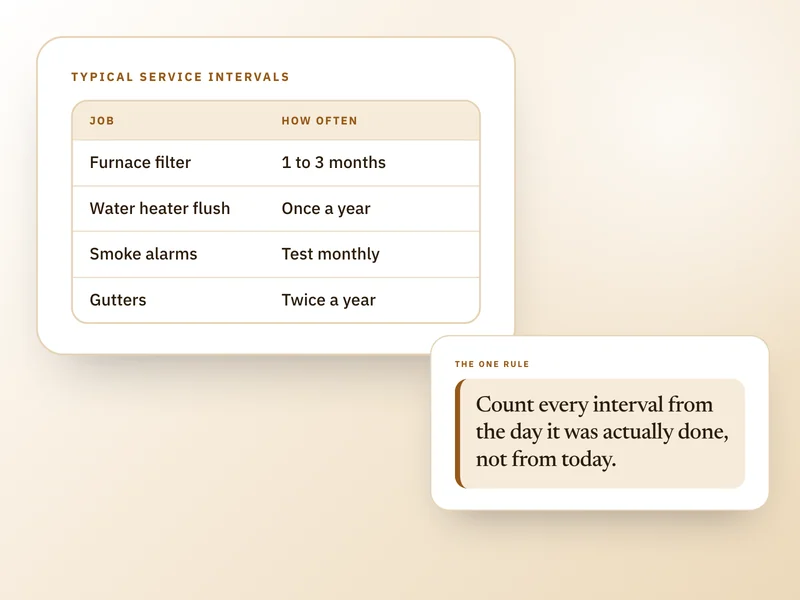
Start counting from the last time it was done, not from today
A common mistake is to start every interval from the day you happen to write the list, which schedules a furnace service twelve months from an arbitrary Tuesday rather than twelve months from the last real service. If you know roughly when something was last done, count from that date. If you truly have no idea, treat it as due, because for nearly everything on this list an unnecessary check costs an hour, and a missed one costs a great deal more.
The freeze job on this list does not follow a rolling interval at all. Draining outdoor faucets belongs to the week before the first hard freeze, not exactly a year after the last time you did it. Setting every reminder to a fixed number of days is how a list ends up telling you to winterize a house in July.
Questions about which jobs matter most
What is the most important home maintenance task?
There is no single answer, because the nine jobs above rank close together in what they cost to skip. If you can only do one this weekend, start with the furnace or the water heater: both tend to fail in the season you need them most, and both take under an hour to check or book.
How often should gutters be cleaned?
Twice a year for most houses: once in spring after winter debris, and once in fall once the leaves are down. Clean them more often with overhanging trees, since needles and small leaves clog a downspout faster than large leaves do.
How do I know if my furnace filter needs changing?
Hold it up to a light. If you cannot see light through it, it is overdue. As a default, check it monthly and replace it every one to three months, sooner with pets, allergies, or recent construction dust in the house.
What happens if you never flush a water heater?
Sediment settles on the bottom of the tank and acts as insulation between the burner or element and the water, so the unit works harder for the same result. Over years, that layer also corrodes the tank from the inside, which is one of the more common reasons a water heater fails early.
What Home Base does with this list
Home Base already holds an interval for each of its 148 built-in care jobs, ranks what to look at first by what happens if you skip it, and works out the next due date from when you last recorded the job rather than from an arbitrary start date. Record the make, model and last service on an item once, and every job above stays a fact instead of a guess. See it in Home Base.
Sources and how we checked
- ENERGY STAR: Maintenance checklist for heating and cooling: Check filters monthly, change at least every 3 months; annual pre-season tune-up for heating and cooling.Checked 26 September 2026.
- Hotwater.com (A. O. Smith): Water heater maintenance guide: Flush a tank water heater at least once a year.Checked 26 September 2026.
- USFA: Smoke alarms: Test alarms monthly; replace the entire unit 10 years from the manufacture date.Checked 26 September 2026.
- USFA: Clothes dryer fire safety: Lint buildup and a blocked vent are named fire causes; supports the dryer vent row (interval itself is our default, not government-sourced).Checked 26 September 2026.
- IBHS: Winter Weather Ready guide: Change washing machine supply hoses connected to the plumbing supply once they are more than 10 years old.Checked 26 September 2026.
- Ready.gov: Winter weather: Disconnect hoses and drain outdoor faucets before winter weather.Checked 26 September 2026.
Where to go next
 If this is where you areHome maintenance schedule: how often to service each systemOnce you know which eight jobs matter most, this gives the service interval for every system in the house.
- Home maintenance checklist by month (short version)
To place those jobs on the calendar, this sorts them by the season each one belongs to.
- How often to change a furnace filter (and the size to note)
The filter is the cheapest job on your list, and this says how often to change it and what size to buy.
- Fall home maintenance checklist by month
Gutters and heating come first in fall, and this puts them in order across September to November.