You have the keys, and for about two weeks every fact about this house is either in front of you or one phone call away: meter readings, where the main shutoffs are, who serviced the furnace last, what the previous owner would tell you if you asked.
Capture it now. This page won't tell you what to fix or what it's worth, only what to write down before it disappears, and most of it does disappear within a month or two.
Example: the real window
Say you close on a Friday and move in over the weekend. By Monday, the shutoffs are found, the meters are photographed, and the smoke alarms are tested. By the following weekend, the inspection report is marked up with a date beside each item, and the previous owner, who's been quick to answer texts so far, has gone quiet.
That's the real window: about a week of easy access, then a slow decline toward zero. None of it is hard. Most of it takes minutes.
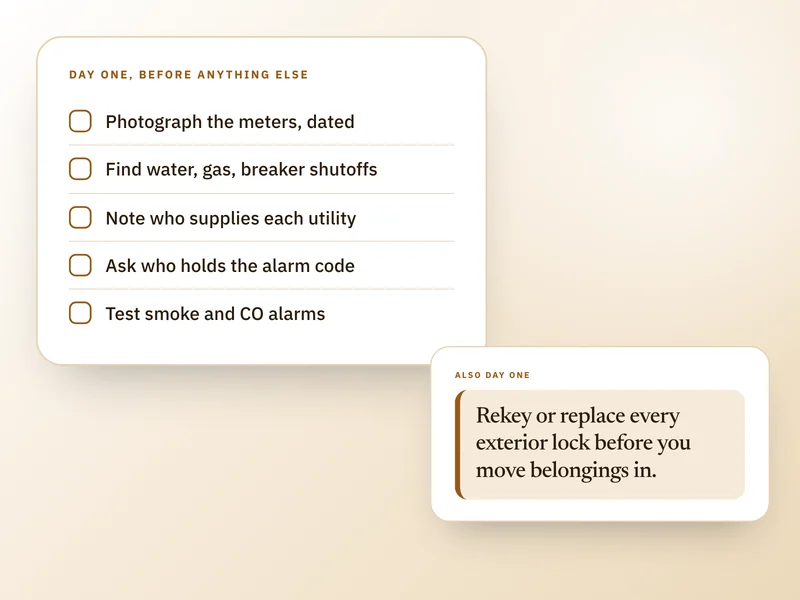
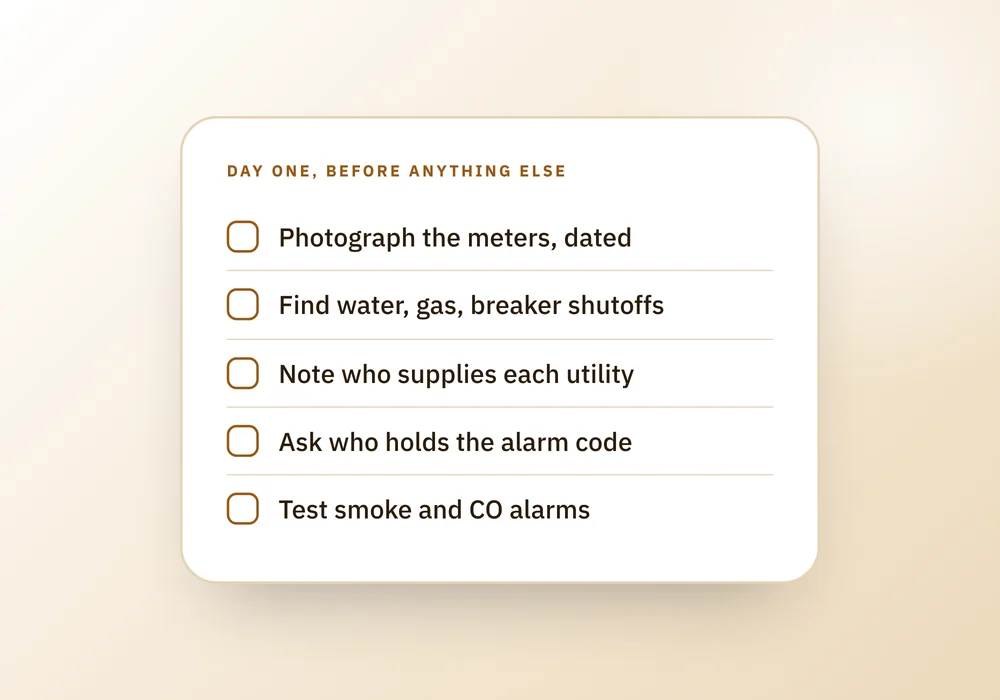
Day one, before anything else
These are time sensitive in a way the rest of the list isn't.
5 things to do
Ticks are for this visit only. Nothing here is saved anywhere.
The main shutoff deserves its own page, since finding it isn't always obvious and a stuck valve is its own small project: where is your main water shutoff.
Week one, while it's still easy to ask
5 things to do
Ticks are for this visit only. Nothing here is saved anywhere.
Once the model plates are photographed, what to write down when you buy an appliance covers which fields are worth keeping for each one, and which are optional.
Locks, codes, and the thing most lists skip
Changing the locks is the item first-week checklists leave out most often. You have no way to know how many keys exist from before you owned the place, so rekey or replace every exterior lock before you move belongings in, not after: the front door, the back door, any gate, and the garage keypad code.
Write the new code or key location down on your own record once it's changed, so it isn't only in your head.
The rest of day-one admin
Forward mail through the postal service, put the utilities in your name from the day you close so there's no service gap, and update your address with your bank, employer and insurer. None of this is specific to a house, but it's exactly the kind of task that gets lost in a move.
If the house will sit empty for a stretch between closing and moving in, check your policy's vacancy clause. Most homeowners policies limit or exclude coverage for vandalism, theft and water damage once a property has been vacant for 30 to 60 consecutive days, which is exactly the situation a slow move-in can create.
Read the inspection report again, as a to-do list
The inspection report was read once, as a buying decision. Read it again now as a maintenance plan, because it's the only document that has systematically gone through the house, and it usually names things that are fine today and won't be in three years.
Pull out anything with a timeframe attached and give it an actual date. That's a maintenance schedule somebody else already did the legwork on.
If you're moving in as the weather turns
A house bought in September or October comes with extra jobs the list above doesn't cover: draining outdoor faucets, servicing the heating system before you need it, and sealing obvious gaps before the cold. Fall home maintenance checklist and winterize your house cover those in order. A spring or summer move skips this section entirely.
When the window has already closed
If you're reading this six months in, most of it is still doable, just harder. The previous owner is less likely to answer, small facts like a filter size are already forgotten, and an unlabeled shutoff takes longer to trace without someone pointing at it.
Start with the highest-value items: the main shutoff, the breaker panel, and the smoke alarm dates, since those matter most in an actual emergency and are worth finding even late. If there's truly no paperwork at all, bought or inherited a house with no records covers how to work out what you have from what's left.
Questions about the first week
What should I do first when I buy a house?
Find the main water shutoff, the breaker panel and the gas shutoff before anything else, and test the smoke and carbon monoxide alarms. Those are the things you'd want fastest in an actual emergency, and the first week is the easiest time to find them, while the previous owner and the inspection report are still one call away.
Should I change the locks when I buy a house?
Yes. You have no way to know how many keys exist from before you owned the property, so rekey or replace every exterior lock, including the garage keypad, before you move belongings in. It's inexpensive relative to the risk, and a locksmith can usually do a full house in under two hours.
Do I need to test the smoke detectors in a new house?
Yes, on day one, regardless of how new the house looks. Press the test button on each alarm and check the manufacture date on the back or side. Per the U.S. Fire Administration, a unit more than 10 years old needs replacing outright, since a working battery doesn't mean the sensor inside is still reliable.
What documents should I keep after closing?
The inspection report, the closing disclosure, and any warranties or manuals the previous owner left behind are worth keeping permanently, not just filing away. The inspection report is worth a second read in week one, since it's the only systematic look anyone has taken at the house's condition.
What Home Base does with this list
Home Base is built for exactly this kind of capture. Tap what you have during setup, and it asks for the fields that make sense per category, brand and model for a furnace, lease dates for a rental, rather than one form for everything. You can also paste in notes or import a spreadsheet instead of typing each item by hand.
See it in Home Base.
Sources and how we checked
- Insurance Information Institute (Triple-I): When No One's Home, Understanding the Role of Vacancy Insurance: Most homeowners policies limit or exclude coverage after 30 to 60 consecutive days of vacancy.Checked 26 September 2026.
- U.S. Fire Administration: Smoke Alarms: Test monthly; replace the unit 10 years from its manufacture date, printed on the alarm.Checked 26 September 2026.
Where to go next
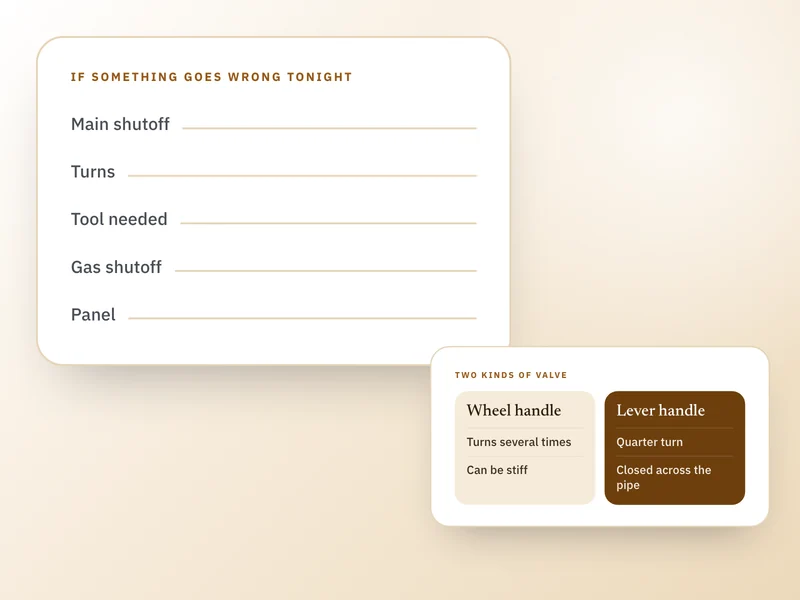 If this is where you areWhere is your main water shutoff? Find it before you need itOf everything to find in week one, the main water shutoff matters most in an emergency, and this shows how to locate it.
- What to write down when you buy an appliance
Each appliance label you photograph needs a home, and this is the one-page record to copy it into.
- Inherited a house with no records? Where to start
If the sellers left no records at all, this covers dating what you have and checking it first.
- Moving into a rental: what to document on day one
Renting rather than buying, you need a different day-one list, and this covers deposit photos and lease dates.