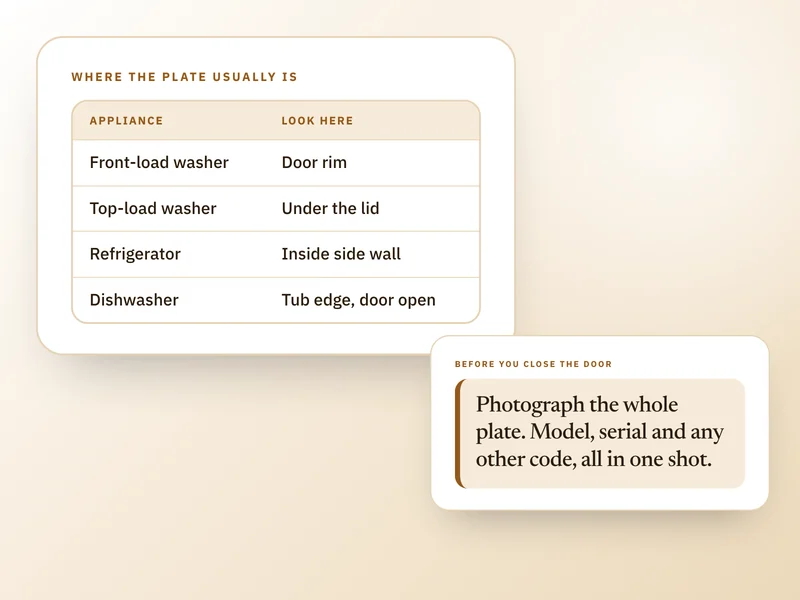
The model number is printed on a rating plate or sticker, and it is almost never on the front. Look on the door rim of a washer or dryer, on the inside wall of a refrigerator, on the frame behind an oven door, and on the outside of a water heater tank.
This is for common US household appliances. Your manual overrules any general guide, and this page cannot decode every brand's serial number.
What a plate actually says (an example)
Say you have the dryer door open and you are looking at a plate on the rim. It carries several codes, and only one is the model number. The example below uses made-up values, but the layout is typical.
MODEL
- Example
- ABC1234XYZ
- What it is for
- Which product this is. What a parts store or repair service asks for first.
SERIAL
- Example
- VF1234567
- What it is for
- Your one unit. Used for warranty and recalls, and often carries the build date.
VOLTS / WATTS
- Example
- 240V, 5400W
- What it is for
- Electrical rating. Useful to an electrician, rarely to you.
Barcode or QR code
- Example
- (square pattern)
- What it is for
- On some newer tags, scanning it opens the maker's page for that product.
| Line on the plate | Example | What it is for |
|---|---|---|
| MODEL | ABC1234XYZ | Which product this is. What a parts store or repair service asks for first. |
| SERIAL | VF1234567 | Your one unit. Used for warranty and recalls, and often carries the build date. |
| VOLTS / WATTS | 240V, 5400W | Electrical rating. Useful to an electrician, rarely to you. |
| Barcode or QR code | (square pattern) | On some newer tags, scanning it opens the maker's page for that product. |
One brand tip from GE Appliances' own locator page: GE and GE Profile model numbers always begin and end with a letter. If the string you copied starts with a digit, you probably grabbed the serial or a part number.
Where to look, by appliance
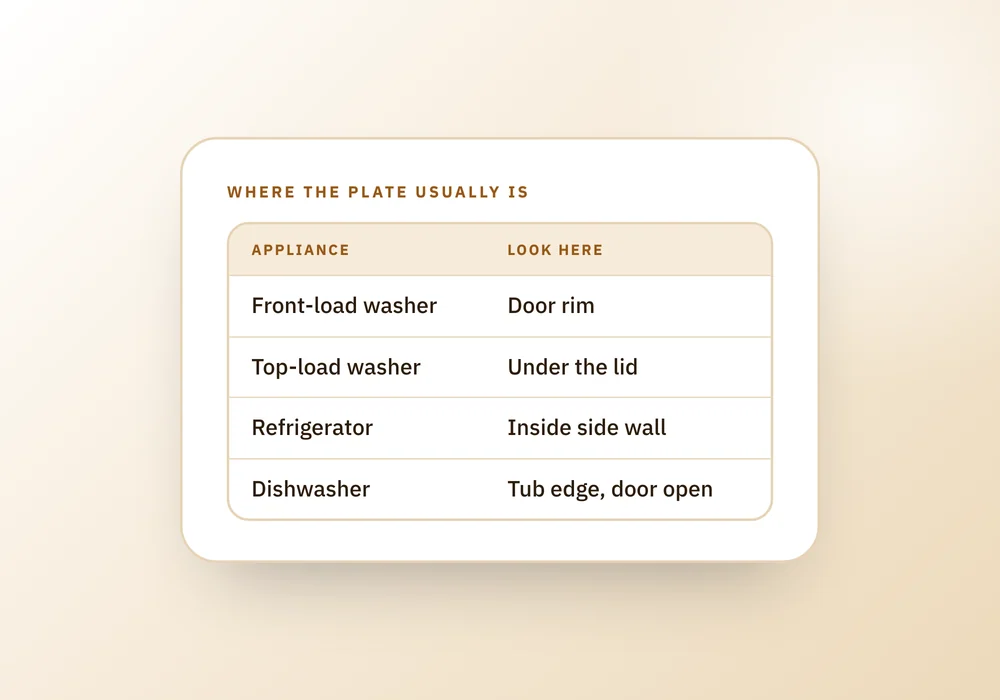
These are the usual spots, taken from two large makers' support pages and general practice. Brands differ, so treat the last column as a place to start.
11 of 11 rows shown
Front-load washer
- Where the plate usually is
- Inside the door, on the rim of the opening
- Watch for
- Open the door fully
Top-load washer
- Where the plate usually is
- Under the lid, on the tub rim
- Watch for
- Lift the lid all the way
Dryer
- Where the plate usually is
- Inside the door, on the rim
- Watch for
- Sometimes behind the lint filter housing
Refrigerator
- Where the plate usually is
- Inside, on a side wall, often the left in a top-freezer
- Watch for
- Side-by-side models often use the right wall
Dishwasher
- Where the plate usually is
- On the tub frame or edge, visible with the door open
- Watch for
- Left side is common
Range or oven
- Where the plate usually is
- On the frame behind the oven door, or under the drawer
- Watch for
- Some sit under the control panel
Built-in microwave
- Where the plate usually is
- Underneath the control panel
- Watch for
- Over-the-range units may show it inside the door frame
Range hood
- Where the plate usually is
- Behind a filter, on the rear wall
- Watch for
- Lift out the filter first
Water heater
- Where the plate usually is
- A rating label on the outside of the tank, usually near the top
- Watch for
- Do not open any panel
Furnace
- Where the plate usually is
- On a label inside the front panel or blower door
- Watch for
- Power switch off before opening
Central air
- Where the plate usually is
- A plate on the outdoor unit, often on a side panel
- Watch for
- May face the wall
| Appliance | Where the plate usually is | Watch for |
|---|---|---|
| Front-load washer | Inside the door, on the rim of the opening | Open the door fully |
| Top-load washer | Under the lid, on the tub rim | Lift the lid all the way |
| Dryer | Inside the door, on the rim | Sometimes behind the lint filter housing |
| Refrigerator | Inside, on a side wall, often the left in a top-freezer | Side-by-side models often use the right wall |
| Dishwasher | On the tub frame or edge, visible with the door open | Left side is common |
| Range or oven | On the frame behind the oven door, or under the drawer | Some sit under the control panel |
| Built-in microwave | Underneath the control panel | Over-the-range units may show it inside the door frame |
| Range hood | Behind a filter, on the rear wall | Lift out the filter first |
| Water heater | A rating label on the outside of the tank, usually near the top | Do not open any panel |
| Furnace | On a label inside the front panel or blower door | Power switch off before opening |
| Central air | A plate on the outdoor unit, often on a side panel | May face the wall |
Find it and save it, step by step
- Do it while the appliance works and you can reach it. Not on the morning it fails and the technician is at the door.
- Open the door, lid or drawer where the plate should be. Use a flashlight, because plates sit in shadow. For a furnace, turn its power switch off first, and if the plate is not on the front panel, stop and check the manual instead of removing more covers.
- Photograph the whole plate, then a close shot of each code. Do not choose which code to keep. Keep them all.
- Type the model and serial into whatever you keep records in, and put the location of the plate beside them, such as "inside left wall, above the crisper".
- Note the year you bought it and where. Then check the warranty, which is covered in appliance warranties: what to track.
Reading the age out of a serial number
Many makers encode the build date in the serial number, but the format changes by brand and even by decade, so we will not give one rule. Check the manufacturer's support page for that brand, or the manual. Some plates also print a date of manufacture outright. Knowing an appliance is twelve years old changes whether a repair is worth it, and how often things in your house need servicing has typical service intervals to help judge that.
When the label is gone or unreadable
Worn, painted over, hidden behind cabinetry or peeled off. These usually work, in roughly this order.
- The original receipt or order confirmation email. Search your inbox for the brand.
- The manual or the box, if either survived. The model is usually on the cover or the box end.
- A past repair invoice. Technicians almost always write the model on it.
- The retailer's account or the maker's registration, if you registered the product.
- Photos of the appliance sent to the maker's support line, who can sometimes identify it by look and features.
- If you just moved in and nothing is left, what to do when you inherit a house with no records covers dating and identifying what is there.
What can go wrong
You copy the serial number when the parts store wants the model. You read a letter O as a zero, or a 1 as an I. Zoom in on the photo before you type. A few plates carry two similar codes, such as a model and a product or type number, so photograph them all and let the person on the phone pick.
The physical risks are small but real. Do not drag a refrigerator or range out alone. Do not pull covers off a gas appliance or a water heater to find a label. If the plate is not visible without opening something, the manual or a technician is the safer route.
Questions people ask
Where is the model number on a refrigerator?
Usually inside, on a side wall of the fresh food compartment, often the left wall in a top-freezer and the right wall in a side-by-side. Some models put it on the ceiling of the freezer section or behind the lower grille. Check the manual for the exact spot, because it changes by brand.
Is the model number the same as the serial number?
No. The model number identifies the product design and is what you use to order parts. The serial number identifies your specific unit and is what warranty and recall checks use. Both are usually on the same plate, so photograph the whole plate and write both down.
What if the model number sticker is worn off?
Try your receipt or order email, the manual, or a past repair invoice, since technicians usually write the model down. The maker's support team can sometimes identify the appliance from photos. Some newer tags also carry a QR code that opens the product page.
How can I tell how old an appliance is?
Look for a manufacture date on the plate, or decode the serial number. Many brands put the build date in the serial, but the format differs by brand, so use that brand's support page or manual. Purchase receipts and install dates also work as a rough age.
Where is the model number on a water heater?
On a rating label on the outside of the tank, usually near the top or on the side facing the room. It often lists the model, serial, capacity and the maker's date code. You should not need to open any panel to read it.
What Home Base does with the number
In Home Base, each thing in the house has Brand and Model fields, a Location, a What to buy field (say, the filter or the anode rod), and a Notes field where the serial number can go. There is no separate serial field, so Notes is where it lives. Tap Print card and it makes a one-page PDF of what you entered, so the hardware store or the technician gets a number instead of a guess. Home Base keeps only what you type. It does not scan labels. See Home Base.
Sources and how we checked
- Whirlpool Product Help: Where is my Model and Serial Number Located?: Plate locations for washers, dryers, dishwashers, refrigerators, ranges, microwaves and hoods.Checked 26 September 2026.
- GE Appliances Model and Serial Number Locator: GE and GE Profile model numbers begin and end with a letter; locator by product type.Checked 26 September 2026.
Where to go next
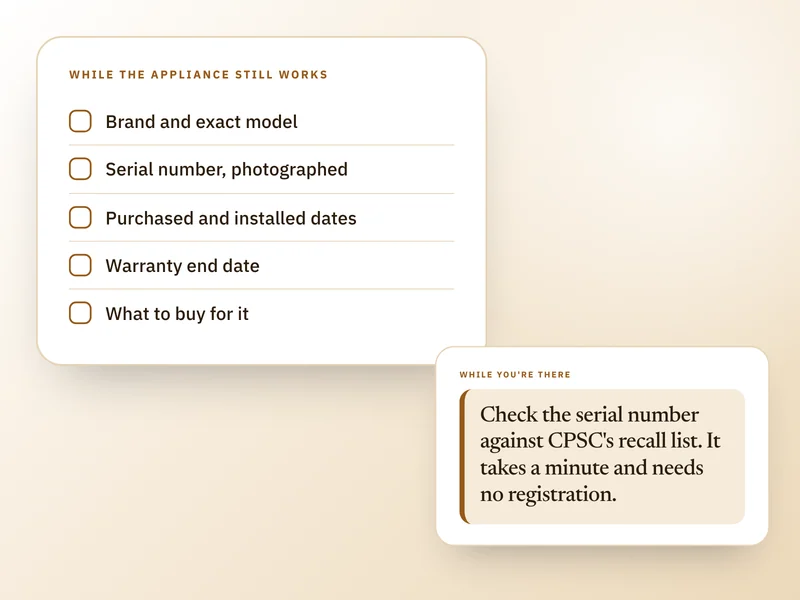 If this is where you areWhat to write down when you buy an applianceOnce you have the model number, this lists what else to write down beside it while the machine is in front of you.
- How to keep track of appliance warranties
A model number is what a warranty claim asks for first, and this explains how to track the expiry.
- How often to change a furnace filter (and the size to note)
Another number worth writing down is the furnace filter size, and this explains how to read it.
- Inherited a house with no records? Where to start
When an old house has no manuals, this covers dating each appliance and knowing its typical life.