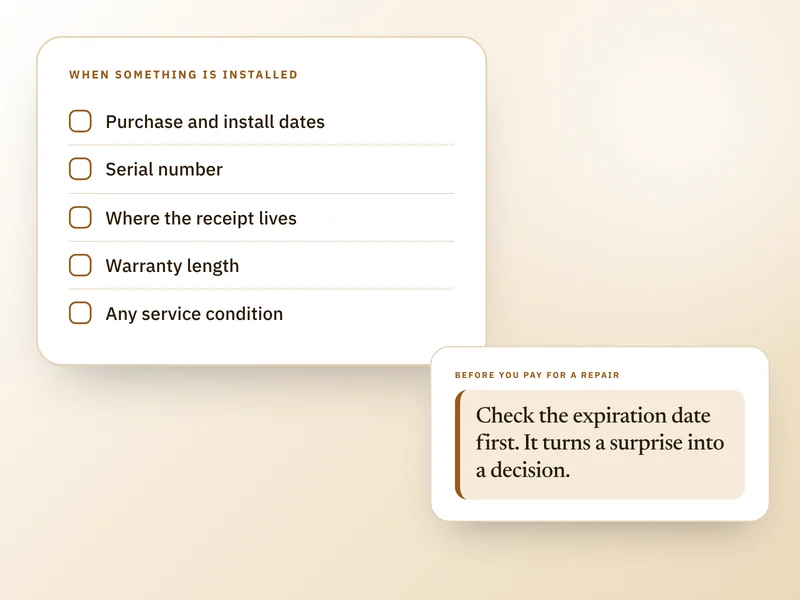
Most appliance warranty claims fail on paperwork, not because a manufacturer refuses a valid one: no proof of purchase, no serial number, a missed service the warranty required, or a claim filed after the term ran out. Record five things when something is installed, and check the expiration date before you agree to pay for a repair.
This is for the manufacturer's warranty that comes with a new appliance in the US, not a paid whole-house home warranty plan, which is a separate kind of contract with its own rules. It can't tell you whether a specific manufacturer will honor your claim, and it isn't legal advice.
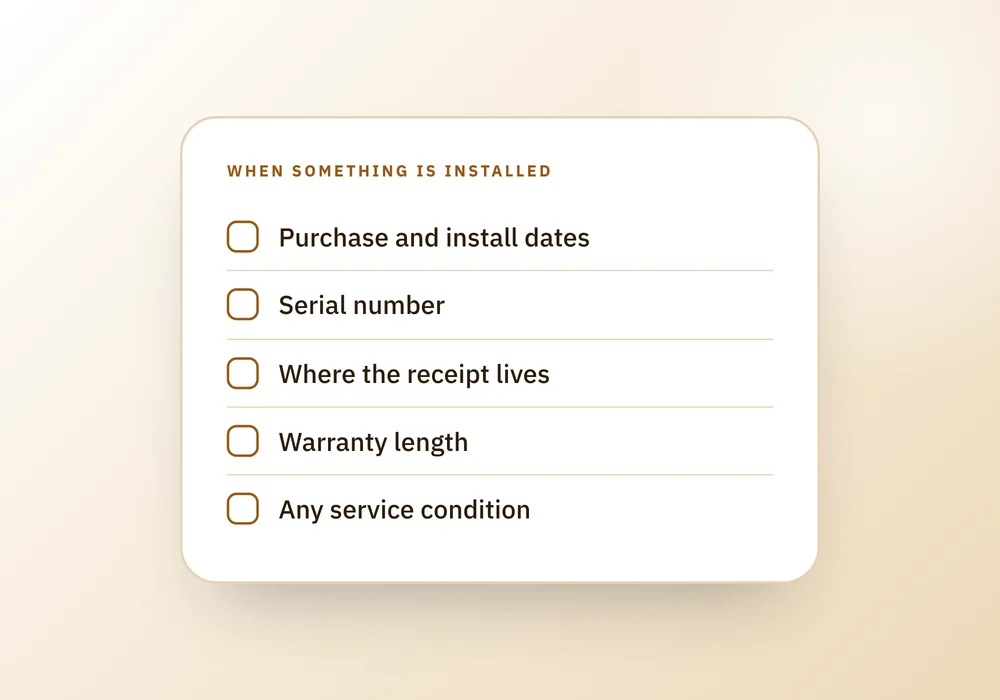
Example: a filled warranty record
A made-up record, not a real one, for a single water heater.
Item
- What you'd write
- Water heater, 50 gallon gas
Purchased / installed
- What you'd write
- 3/14/2024, installed 3/18/2024
Serial number
- What you'd write
- Photographed the plate, number is RH4482201
Warranty length
- What you'd write
- 6 years on the tank, 1 year on parts and labor
Condition attached
- What you'd write
- None found in the manual
Proof of purchase
- What you'd write
- Home Depot receipt, forwarded to an email folder
| Field | What you'd write |
|---|---|
| Item | Water heater, 50 gallon gas |
| Purchased / installed | 3/14/2024, installed 3/18/2024 |
| Serial number | Photographed the plate, number is RH4482201 |
| Warranty length | 6 years on the tank, 1 year on parts and labor |
| Condition attached | None found in the manual |
| Proof of purchase | Home Depot receipt, forwarded to an email folder |
What to record when something is installed
5 things to do
Ticks are for this visit only. Nothing here is saved anywhere.
Two different things people mix up
- Free with the purchase
- Covers defects in that one item
- Ends on a fixed date, no renewal
- A separate paid service contract
- Covers many systems, with a fee per visit
- Renews yearly, like insurance
Manufacturer's warranty
- Free with the purchase
- Covers defects in that one item
- Ends on a fixed date, no renewal
Home warranty plan
- A separate paid service contract
- Covers many systems, with a fee per visit
- Renews yearly, like insurance
The service condition that catches people
Many furnace, heat pump and water heater warranties require a documented annual service, sometimes called an inspection or maintenance visit in the fine print. Skip one, and the manufacturer can void the rest of the warranty term, which most people discover only when they try to use it.
The requirement is easy to miss because it usually sits in a single paragraph on page four, not on the front of the card. Knowing it exists, and keeping the service dates written down, is the whole fix.
Registering can be worth two minutes
Registration sometimes stretches a warranty by a few months, and it's a form a lot of people skip because it looks like marketing. It's also one way a manufacturer reaches you directly if there's a recall.
If you'd rather not register anything, you can check for recalls yourself and subscribe to recall emails at the U.S. Consumer Product Safety Commission's site, which covers recalled appliances whether or not you ever registered yours.
Check the expiration date before you pay
This is the step everyone means to do and skips under pressure. Something breaks, you want it fixed today, and the expiration date only gets checked after the invoice is already in your hand.
Knowing the date in advance turns a bad surprise into an ordinary decision: fix it yourself, call the manufacturer, or pay for the repair with your eyes open.
If you do need to make a claim
- Contact the seller first. Many warranty problems get resolved there before the manufacturer is even involved.
- If that doesn't work, contact the manufacturer directly. The warranty document lists an address or a claims line.
- Have the serial number, the purchase date and the proof of purchase ready before you call.
- Ask what documentation they need, and get the outcome in writing, with a claim or reference number.
- If a call goes nowhere, write to the manufacturer instead, keep a copy, and consider certified mail with a return receipt, so there's a record the letter arrived.
Think before buying an extended warranty
We'd read what an extended warranty actually covers before agreeing to one at checkout, because it's sold at a profit and often duplicates coverage the standard warranty, or your credit card, already gives you.
It can be worth the cost where a single failure would be expensive relative to the item's price. That's a judgment worth making with the expiration dates in front of you, not at the counter.
Questions people ask
Do I need my receipt to make a warranty claim?
Usually, yes. The receipt is what proves the purchase date and that you're the original owner, and most manufacturers ask for it first. Save a copy separately from the paper one, since a printed receipt fades and a photo or forwarded email survives better than most people expect.
What voids an appliance warranty?
The common reasons are a missed required service, using unauthorized parts or repair services when the manufacturer supplied free ones, damage from misuse, and a claim filed after the term ends. Read the specific conditions in your warranty document rather than assuming; they vary by brand and by appliance.
Is an extended warranty worth it?
It depends on what it actually covers and what a single repair would cost. For an expensive appliance where a major failure is plausible, it can be worth it. For something cheap to replace, or already covered by a credit card's purchase protection, it's often paying twice for the same risk.
What's the difference between a manufacturer's warranty and a home warranty plan?
A manufacturer's warranty comes free with a purchase and covers defects in that one item for a fixed term. A home warranty plan is a separate paid service contract, usually renewed yearly, that covers many systems and appliances at once, typically with a fee charged per visit.
How do I find out if my appliance was recalled?
Check the U.S. Consumer Product Safety Commission's recall listings by brand or product type, or subscribe to their recall emails so new ones reach you directly. You don't need to have registered the product for this to work; the listings are public and searchable by anyone.
What Home Base does with it
Home Base records the purchase date, install date and warranty expiration for anything you add, with a Notes field where the serial number can go, since there's no separate field for it. A warranty shows up in the "Coming up" list 30 days before it ends, worded plainly, like "Warranty ends in 3 weeks." A push reminder for that only goes out if you turn on the "Warranties expiring soon" setting, which is off by default. See Home Base.
Sources and how we checked
- FTC Consumer Advice: Warranties: Save the receipt with the warranty; contact the seller first, then the manufacturer in writing if unresolved.Checked 26 September 2026.
- U.S. Consumer Product Safety Commission: Recalls: Public recall listings and email subscription, independent of manufacturer product registration.Checked 26 September 2026.
Where to go next
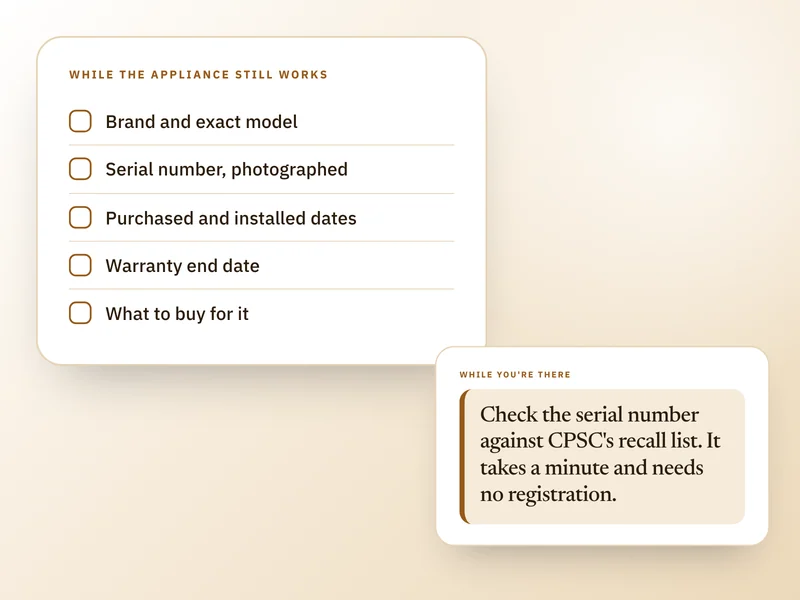 If this is where you areWhat to write down when you buy an applianceWarranty dates only help if you wrote them down at purchase, and this lists the facts to record.
- How to find the model number on any appliance
Warranty claims need the model number, and this shows where to find it on each type of appliance.
- What to keep after a home repair, besides the invoice
When a repair is under way, this covers what to keep from the visit alongside the warranty paperwork.
- How to make a home binder: what goes in and what stays out
Warranty papers belong with your other home records, and this shows how to sort them into a binder.