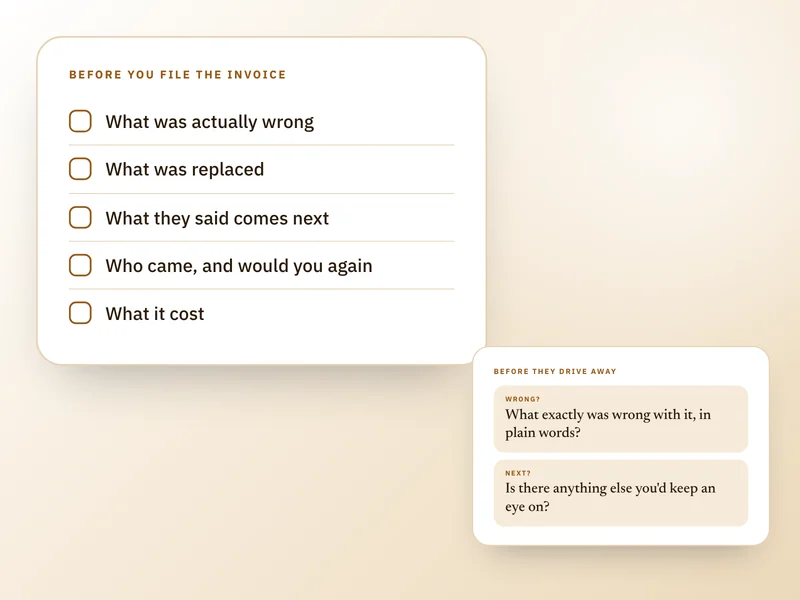
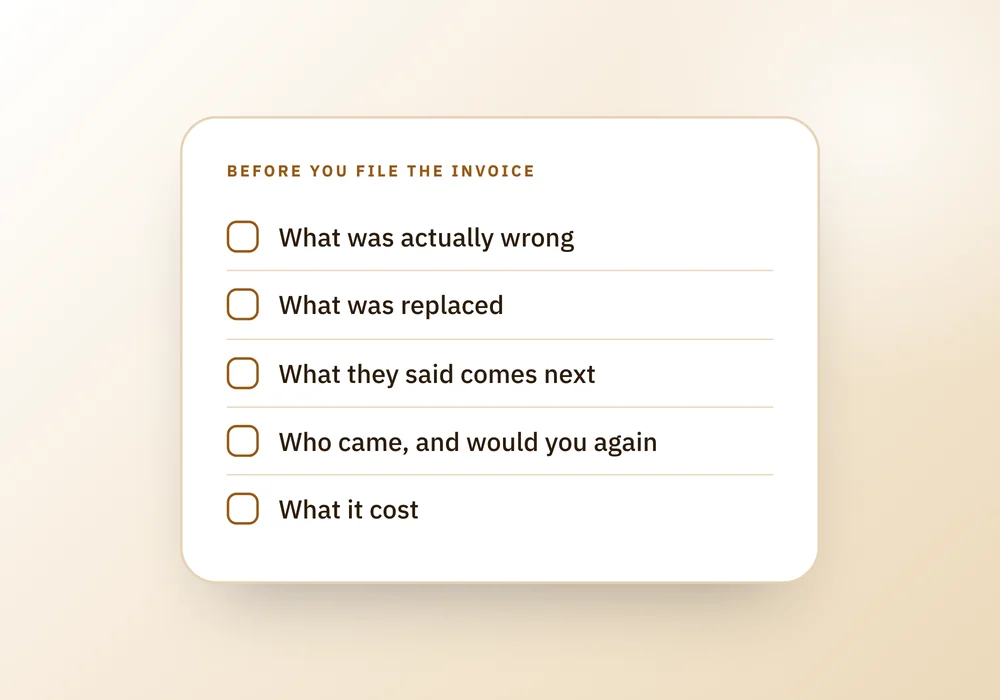
The invoice tells you what you paid. It rarely says what was actually wrong, what part got replaced, or what the technician said might need doing next. Write those three things down the same day, while you still remember them exactly, not five months later when the same problem shows up again.
This is for any US homeowner or renter who just had someone out to fix something, a plumber, an HVAC technician, an appliance repair service. It can't tell you whether the price you were quoted was fair, and it isn't a substitute for a written estimate.
Example: a filled repair note
A made-up visit, not a real one, showing what five minutes of writing looks like.
Symptom, in your words
- What you'd write
- Water heater making a popping sound, no hot water by evening
What they said was wrong
- What you'd write
- Sediment built up around the heating element, tank was overheating locally
What was replaced
- What you'd write
- Lower heating element and thermostat
What they said comes next
- What you'd write
- Anode rod is original, worth checking within the next year
Who came, and the cost
- What you'd write
- Ace Plumbing, $340, would use again
| What to capture | What you'd write |
|---|---|
| Symptom, in your words | Water heater making a popping sound, no hot water by evening |
| What they said was wrong | Sediment built up around the heating element, tank was overheating locally |
| What was replaced | Lower heating element and thermostat |
| What they said comes next | Anode rod is original, worth checking within the next year |
| Who came, and the cost | Ace Plumbing, $340, would use again |
Write these down the same day
6 things to do
Ticks are for this visit only. Nothing here is saved anywhere.
Questions to ask before the technician leaves
Four short questions, asked while the van is still in the driveway.
Pick the one you are facing
“What exactly was wrong with it, in plain words?”
“What's the part number, in case I need it again?”
“Is there anything else you'd keep an eye on?”
“Can you write that diagnosis on the invoice for me?”
Why the diagnosis outlasts the invoice
A repair invoice proves you paid. It almost never explains what actually failed. When the same appliance acts up again in a year or two, the diagnosis a technician gave you the first time is what makes the second visit faster, and it sometimes stops the visit from being needed at all, because you recognize the symptom before it gets worse.
It also protects you in a different way. A technician telling you a part was replaced eighteen months ago is a very different conversation from one where no one involved can remember.
What tends to go wrong
Technicians are often out the door before you've thought to ask anything. If that happens, call the company the same day and ask what they have on file. Most keep their own service notes and will read them back to you over the phone. If the repair might be covered by a manufacturer's warranty, check the terms before you pay, since some warranties are void once an outside repair happens. Appliance warranties: what to track covers what to check first.
There's also a tax wrinkle worth knowing. A repair that just fixes something broken, like a new water heater after the old one failed, is not what the IRS calls an improvement, and it does not add to your home's cost basis when you sell (Publication 523 draws that line). If a small repair turns into a larger renovation, replacing a wall along with the leak behind it, keep that folder separate from ordinary repair notes.
Questions people ask
Do I need to keep the invoice from a home repair?
Keep it if any part of the job might be covered by a manufacturer's warranty, if you're tracking what the house has cost you, or if the repair was large enough to matter for your home's cost basis when you sell. For a small routine fix, the diagnosis and the part number are usually more useful later than the invoice itself.
How long should I keep home repair records?
As long as you own the item or the house, in practice. A repair record for an appliance is useful until you replace it. A record tied to the house, like a roof or a furnace, is worth keeping for as long as you live there, and worth handing to a buyer when you sell.
What if the technician doesn't explain what was wrong?
Ask directly before they leave, using plain words: what was actually wrong, and what should I watch for. If they've already gone, call the company that afternoon and ask what's on their service ticket. Most companies keep a written note of the visit even if no one told you what it said.
Does a home repair affect my taxes?
An ordinary repair, one that just restores something to working order, generally does not change your home's cost basis for tax purposes. A larger renovation that includes repair work as part of it can count as an improvement instead. This isn't tax advice; a tax professional can tell you which side of that line your project falls on.
Should I photograph a repair before and after?
It's worth thirty seconds if the work is visible, like a wall opened up or a fixture replaced. A photo with a timestamp backs up the invoice if a dispute ever comes up, and it's the easiest record to lose track of later if you don't save it somewhere you'll look again.
What Home Base does with it
In Home Base, resolving a reported problem (the "It's sorted" toggle) asks when it was fixed, who did it or is coming, what it cost, and a line for anything worth remembering, the same kind of note as "anode rod is due next time." That gets written to the item's History, dated automatically. The next time you report a problem in the same category, water and plumbing, heating, and so on, Home Base suggests the last provider you used for that kind of work, drawn only from your own past entries, never a directory. It does not store the invoice itself, only what you type. See Home Base.
Sources and how we checked
- IRS Publication 523, Selling Your Home: Distinguishes repairs from improvements; only improvements add to a home's cost basis.Checked 26 September 2026.
- FTC Consumer Advice: How To Avoid a Home Improvement Scam: Get verbal promises in writing and keep notes and copies of documents for your files.Checked 26 September 2026.
Where to go next
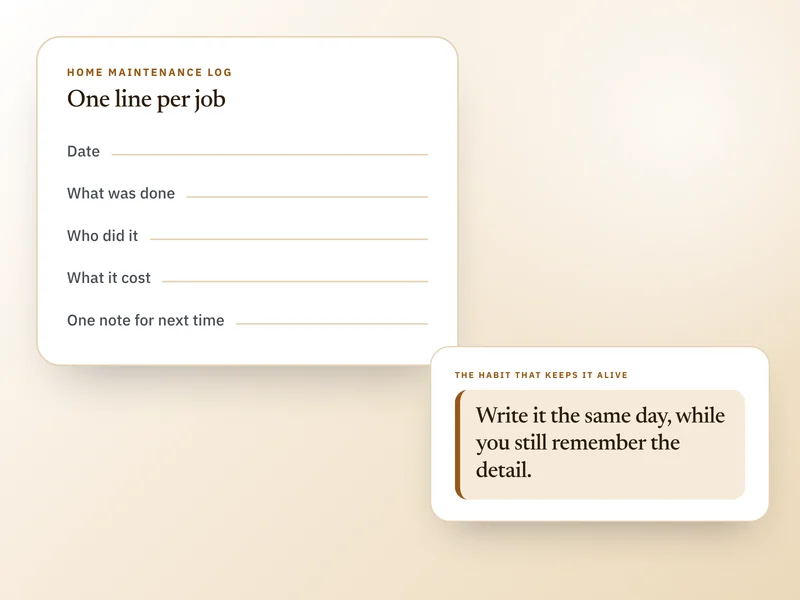 If this is where you areHome maintenance log template: what to write each timeRepair notes are more useful in one running place, and this sets up a home log to hold them.
- How to keep track of appliance warranties
A repair may be covered, so this shows when to check the warranty before you pay the bill.
- What to write down when you buy an appliance
The model and purchase date on your appliance record make the technician's diagnosis easier to use later.
- Home maintenance jobs that cost the most to skip
To avoid repairs in the first place, this ranks the eight maintenance jobs that cost most when skipped.