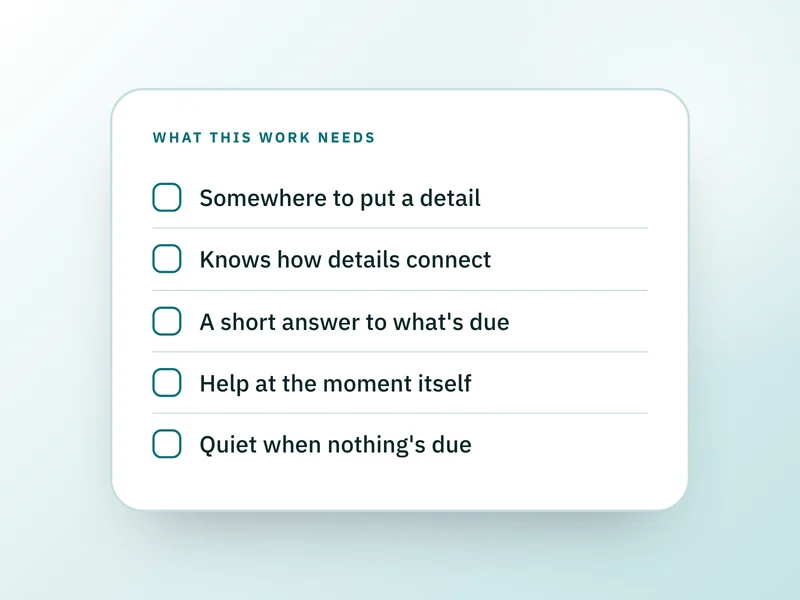
Life admin is the unpaid, unscheduled work of keeping an adult life running: renewing things, chasing things, and remembering that a boiler needs servicing or a pension exists from a job you left years ago. It has no fixed hours, no manager and no finish line, which is most of why it goes undone until something breaks.
This is for anyone trying to name what keeps slipping, whether you carry it alone or split it with a household that has never actually agreed who does what. It won't tell you how to divide the load with a partner or which task to start with today; it names the category so you can see the shape of it first.
One move, as an example
Say you move house in March. The obvious task is telling the post office. Less obvious: the bank mails your new card to the old address, the car insurance renewal quote still has the old postcode on it, a dentist reminder never arrives, and a parcel you were waiting on gets sent back to the sender. None of that sat on a list called change of address. It surfaced over about six weeks, one call at a time, each thread caught only because someone happened to notice it before it became a fee or a missed appointment.
Three traits that set it apart from a normal task list
- It's invisible when it goes right. Nothing marks the insurance that renewed on time or the appointment that got moved before it clashed with anything, so there's no signal, only the absence of a problem, and the same silence when nothing got done at all.
- It's connected rather than standalone. A flight moves and three separate bookings are suddenly wrong. An address changes and a dozen organizations need telling, each a different way. A death turns out to have kept dozens of small facts in one person's head, and nowhere else.
- It lands hardest exactly when capacity is lowest: a new baby, a bereavement, an illness, a move. The volume of this work doesn't wait for a good week to show up.
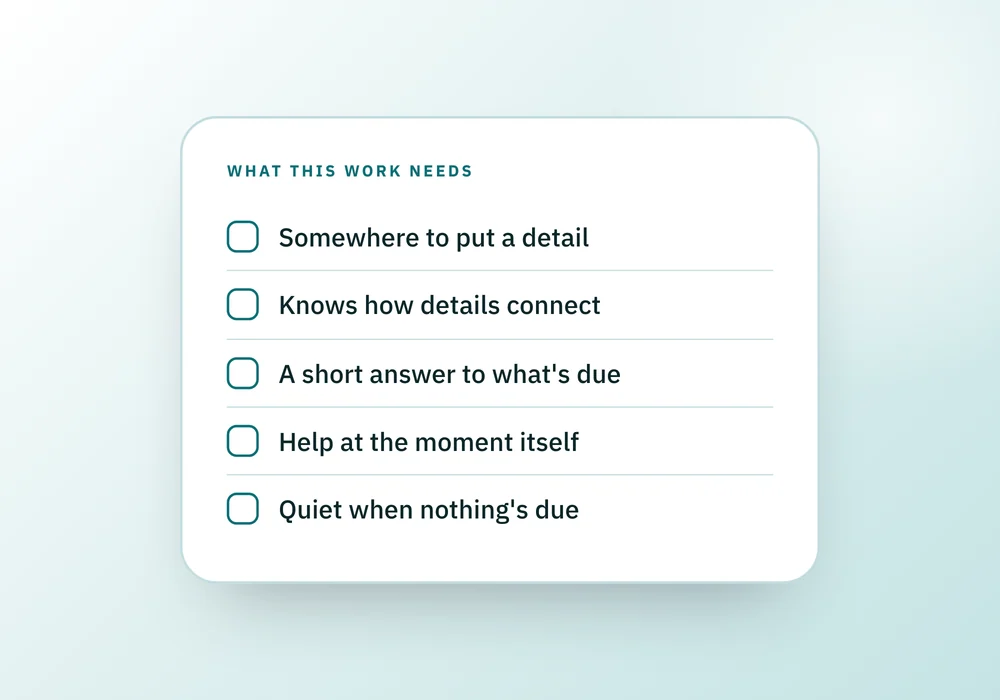
What this work actually needs
Check off anything you already have somewhere for this.
5 things to do
Ticks are for this visit only. Nothing here is saved anywhere.
Who ends up carrying it
In many households, one person tracks most of this without it ever being discussed or assigned. A 2019 study of cognitive labor in different-gender couples found that women did more of the anticipating and monitoring work, the parts that happen before anything visible gets done, even among couples who described their split as even. Calling that being naturally organized turns a workload into a compliment; naming it as work is the first step toward splitting it on purpose instead of by default.
Why remembering harder doesn't fix it
Once this pile is visible, the instinct is to remember better or write longer lists. That rarely holds, because the problem was never memory: most of this has already been remembered for weeks. What's missing is something that tracks how one fact connects to the next and flags it when that connection breaks. Where calendars and to-do lists fall short of that is covered in why productivity tools fail at life admin.
Questions people ask
Is life admin a real term or just internet slang?
It's a real, if informal, term. Columbia law professor Elizabeth Emens used it as the title of a book on the office-type work of running a household, from broken technology to funerals, and it has since been picked up as shorthand for exactly that category of unpaid, unscheduled work.
Why does life admin feel harder for some people in a household than others?
Partly because it's split unevenly to start with. A 2019 study of cognitive household labor found that women did more of the anticipating and monitoring stages, the work of noticing something is needed and tracking it until it's resolved, even in couples who believed their split was fair.
How much time does life admin actually take?
There's no reliable population figure for this, and the numbers that circulate online vary too widely to trust. What is measurable is that the planning happens in your head and your devices rather than on a timesheet, which is part of why it's easy to underestimate.
Is life admin the same thing as the mental load?
They overlap heavily. Mental load usually refers to the planning and remembering behind household and childcare tasks specifically. Life admin is the wider category, one that also covers renewals, paperwork, appointments and the calls that follow a life event. What applies to one mostly applies to the other.
Can any of this actually be handled by software instead of a person?
Some of it. A renewal date, a service interval or a document's expiry can be tracked and surfaced without you holding it in your head. The parts that need a decision, a phone call or a signature still need you; software can hand you the moment to decide, not make the decision for you.
Where the Companion Series fits
The Companion Series is nine Companions across six life areas, each holding the facts for one kind of admin instead of all of it in a single, generic pile. See the Companion Series.
Sources and how we checked
- Elizabeth Emens: The Invisible Labor of Life Admin (Psychology Today): Origin and definition of the term life admin, the author's academic role, and why the work stays unseen.Checked 26 September 2026.
- Allison Daminger: The Cognitive Dimension of Household Labor (American Sociological Review, 2019): 2019 study finding cognitive household labor, especially anticipating and monitoring, is gendered even in couples who see their split as even.Checked 26 September 2026.
Where to go next
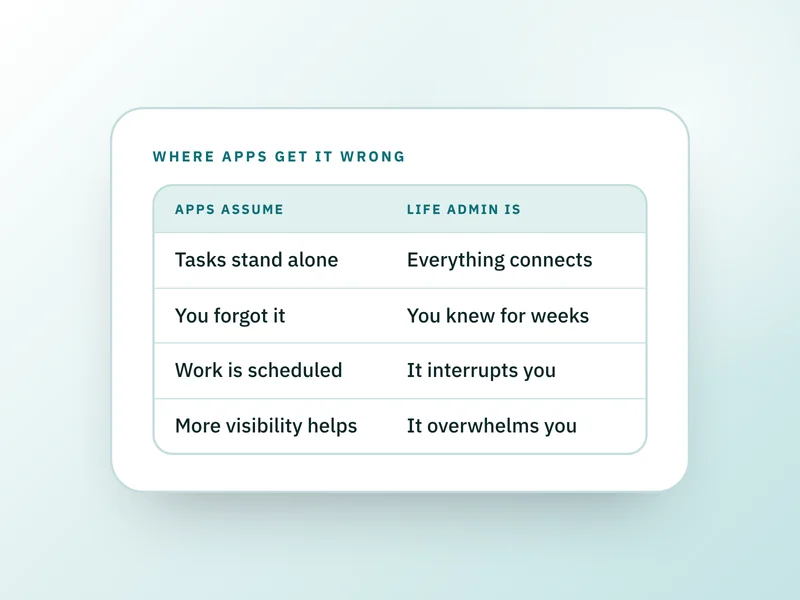 If this is where you areWhy to-do lists and productivity apps fail at life adminNow that you know what life admin is, see why to-do lists and productivity apps handle it badly and what a better tool must do.All guides